



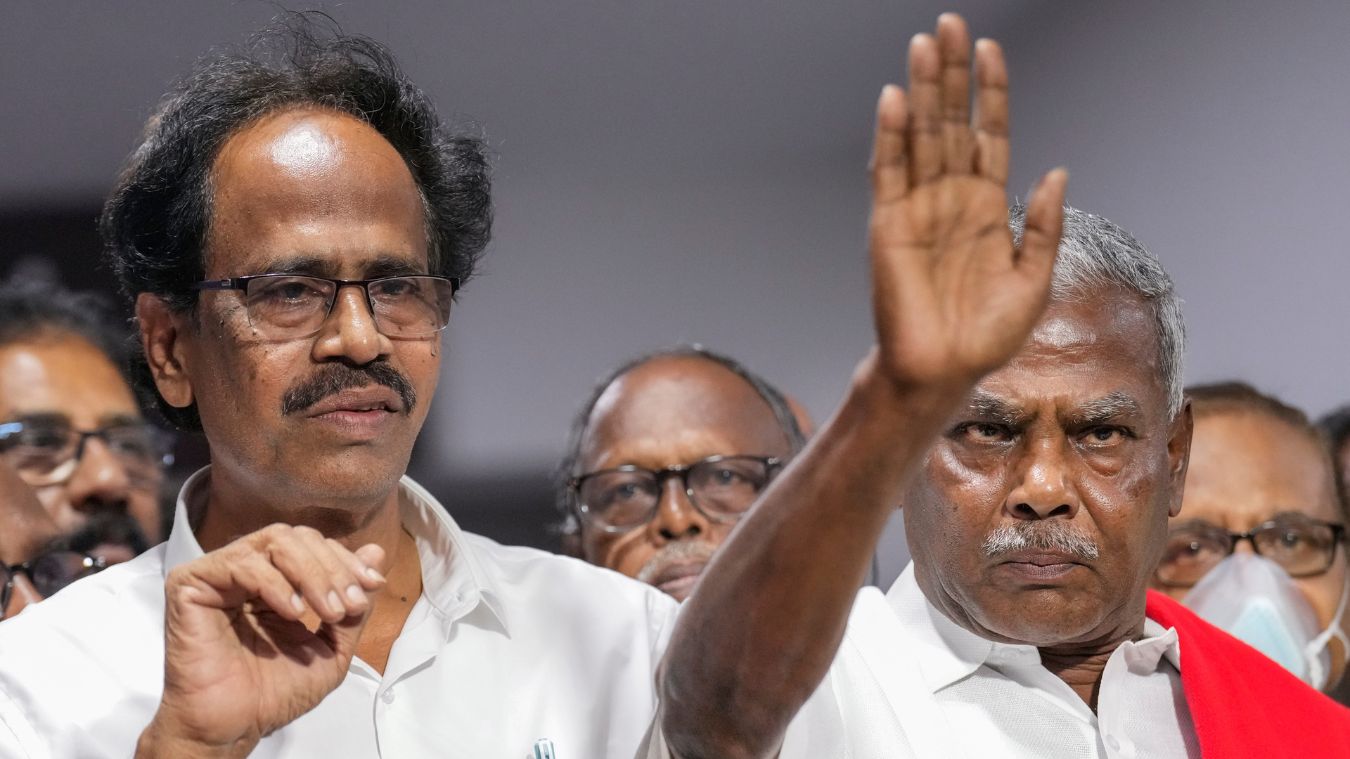
On September 9, when chief minister C. Joseph Vijay-led Tamilaga Vettri Kazhagam (TVK) called for a meeting to name the alliance, both the Left parties chose to skip the meeting. Both the CPI and the CPI(M) leaders said that they are not part of the alliance, but supporting the TVK government only because it is short of majority in the assembly.
And a week later now, both the Left parties have made an unusual choice. When everyone believed that the two will silently watch the developments in the October 6 bypolls to Madurantakam and Dharapuram, they have announced their decision to go it alone. The CPI will field a candidate in Dharapuram, while CPI(M) will contest from Madurantakam. Both parties are expected to announce the names of their candidates on September 15.
The two reserve constituencies fell vacant after sitting AIADMK MLAs resigned and joined TVK. The former MLAs—K. Maragatham Kumaravel in Madurantakam and P. Sathyabama in Dharapuram—have been fielded again by TVK. While the TVK is contesting to seek majority, the AIADMK is contesting to win its lost legacy in the two constituencies, while the DMK which finished third in both the constituencies in the April 23 election has chosen to contest only to put up a strong fight. However, the choice of the Left parties gains significance for various reasons.
It is simply not another electoral contest for both the Left parties. It is an opportunity for them to ask a larger question as to what happens when an elected representative changes parties midway through a term and returns to the electorate under a different banner. And then, the two are likely to put another important question - why should the Left support the TVK government without becoming part of the TVK's electoral alliance?
The answer to both these questions are very simple for those who observe the developments closely. Vijay's TVK-led coalition has brought together parties including the Congress, MDMK, VCK and IUML. The Left is not anyway willing to support a government that is involved in what they call “horse trading”. The second reason is that they have resisted joining the alliance. Their decision to contest Madurantakam and Dharapuram reinforces that independence. They want to keep themselves independent and critical of the wrongdoings of the government.
Apparently, their calculation is straight forward. “Joining the TVK alliance could give us some immediate political space, but at the same time it will reduce us to a junior partner in a much larger coalition, like the other parties. In such a situation we will not be able to be critical of the government when they go against people's welfare. And the main reason being we are not in anyway willing to support a government that encourages MLA resignation and absorbs them into their party,” says a senior Marxist leader in Chennai.
The message to Vijay, however, is very clear - support in government doesn’t mean surrender in electoral politics. And during the election, the two parties are likely to sharpen their attack on the ruling party particularly on horse trading and the opportunistic defections. In fact, the differences between the ruling TVK and the Left parties have sharpened in these 120 days, with CPI(M) state secretary P. Shanmugam criticising the TVK’s performance.
Apart from this, there is also an ideological calculation behind the decision. Both Madurantakam and Dharapuram are reserved constituencies, which hovers around the Left’s traditional political vocabulary—social justice, land rights, labour, rural employment, welfare and the rights of marginalised communities. The two parties feel that they can revive their ground by representing workers, agricultural labourers, Dalits and economically disadvantaged sections. But whether the vocabulary can still translate into votes is a larger question.
But in a closely fought bypoll, even a small vote share can have an impact. When the TVK is flexing its muscles against the opposition DMK, even a few thousand votes secured by the Left parties can influence the outcome even without coming close to winning, which gives the Communists a potential bargaining chip.
Apart from this, the bypolls are Vijay’s first serious electoral test as Chief Minister. So the decision by the Left parties here changes from their idea of contesting to are they trying to influence the outcome in favour any major political party. In case, the TVK wins both seats, Vijay can argue that voters have endorsed his government's politics and accepted the party's expansion into constituencies that previously belonged to AIADMK.
If TVK loses one or both, the opposition will interpret it as an early warning about the government's popularity.
For the Left, either outcome can be useful. A TVK victory does not necessarily hurt the Communists. A respectable Left vote could demonstrate that there remains an independent ideological constituency outside the ruling alliance. A TVK defeat could give the Left greater leverage with the government it currently supports.
But the most important here is the DMK factor. For decades, the CPI and CPI(M) have been important allies of the DMK-led alliance. But the 2026 realignment has changed the political landscape. The votes won by the communists are likely to play a spoilsport for the DMK.
The rise of TVK has created a new centre of gravity on the opposition side, while the Left is trying to determine where it fits. Contest too closely alongside TVK and it risks losing its independent identity.
Remain too closely tied to the DMK and it risks appearing trapped in an older political arrangement. The two bypolls give the Left an opportunity to demonstrate that it can make decisions independently of both major Dravidian formations.
