



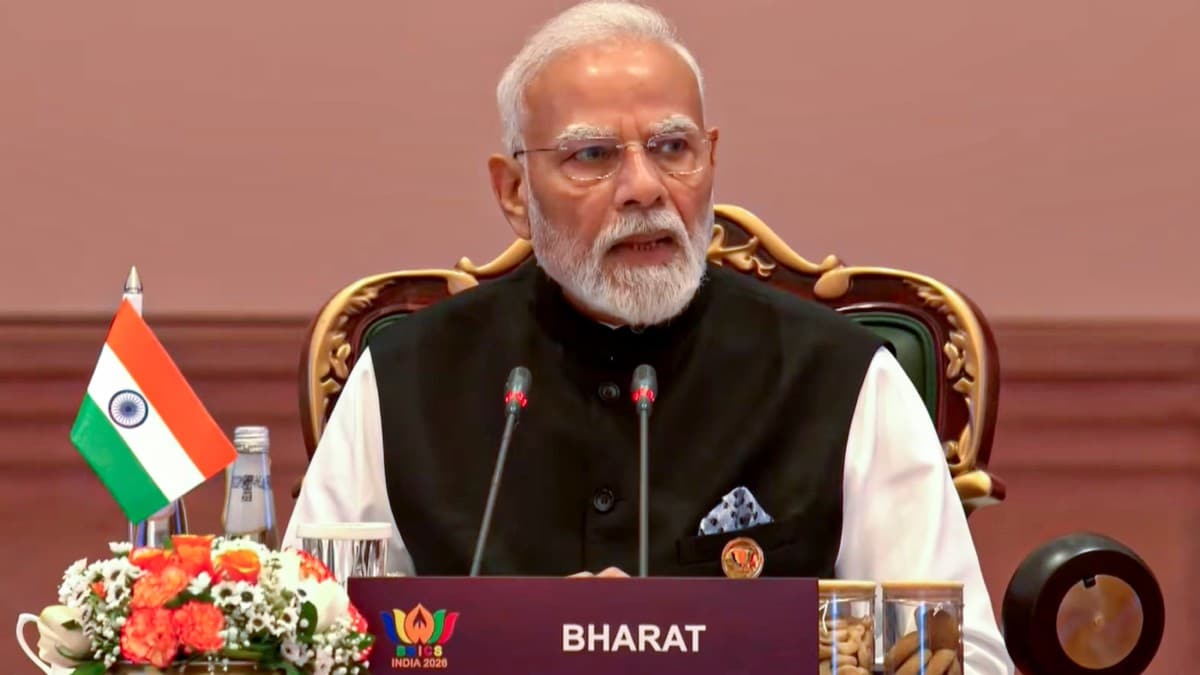
Prime Minister Narendra Modi, on Saturday, called on BRICS nations to help transform the Global South from a “rule-taker” into a “rule-shaper”, outlining "Representation, Responsiveness and Rule-making" as three key principles for reforming global governance over the coming years.
Speaking after declaring that the BRICS Summit 2026 was open, the prime minister said countries of the Global South were often among those most affected by global crises but remained under-represented when crucial decisions were made. “Today, the Global South stands in the front row of global crises but in the back row of decision-making,” Modi said.
He called on BRICS to help transform what he described as a “pyramid of privilege” into a “platform of partnership”, where every country has a voice and a stake in decision-making.
Modi said any roadmap for global governance reform should focus on three aspects — Representation, Responsiveness and Rule-making.
On representation, the prime minister said reform of the UN Security Council can no longer be postponed and called for negotiations to be linked to a definite timeframe and clear outcomes.
He also sought changes in international financial institutions, saying voting power, leadership positions and policy priorities should reflect current economic realities. “Countries that drive global economic growth should also play an appropriate role in shaping global economic governance,” Modi said.
Another area highlighted by the PM was rule-making, particularly as emerging technologies begin shaping the global order.
Modi said equal participation in defining future global rules was crucial, pointing to artificial intelligence, cyberspace, outer space, biotechnology and critical technologies as areas that are not only creating new opportunities but also determining the rules of the future.
“We must strive to transform the Global South from a ‘rule-taker’ into a ‘rule-shaper’,” he said.
Modi suggested that BRICS could play a role by equipping young diplomats and policymakers from Global South countries with negotiation skills, practical training and legal expertise.
Further, Modi called on BRICS members to jointly formulate 10 proposals for global governance reform, with the aim of turning them into a BRICS reform roadmap by the next summit.
He pointed out that the existing global governance structure resembles a pyramid in which power and decision-making remain concentrated at the top, while countries in the lower tiers are affected by decisions without being able to shape them.
“While strengthening BRICS, we must also chart a course for global reform,” Modi said.
He also called for an ambitious agenda for BRICS for the next 20 years, while stressing the need to improve the grouping's own institutional mechanisms.
As the BRICS presidency changes every year, Modi said this should not disrupt institutional momentum. He proposed establishing a BRICS continuity and implementation mechanism that would allow initiatives and outcomes to be followed up through the “Troika” arrangement.
He also suggested creating a secure digital repository to record the nodal point, timeframe and implementation status associated with every BRICS decision.
Modi also proposed establishing a 'Seafarers' Emergency Support Network', pointing to the major contribution seafarers make to global trade and the difficulties they can face during emergencies.
The proposed network would connect maritime authorities and diplomatic missions of participating countries and facilitate assistance in areas including distress alerts, medical aid, family notifications and evacuations.
Calling BRICS a grouping that had reached a moment of “coming of age” after two decades, Modi said it had established a distinct identity on the global stage through consensus and respect for differing perspectives.
He said the time had now come for BRICS to translate that unity and consensus into tangible global outcomes.
