



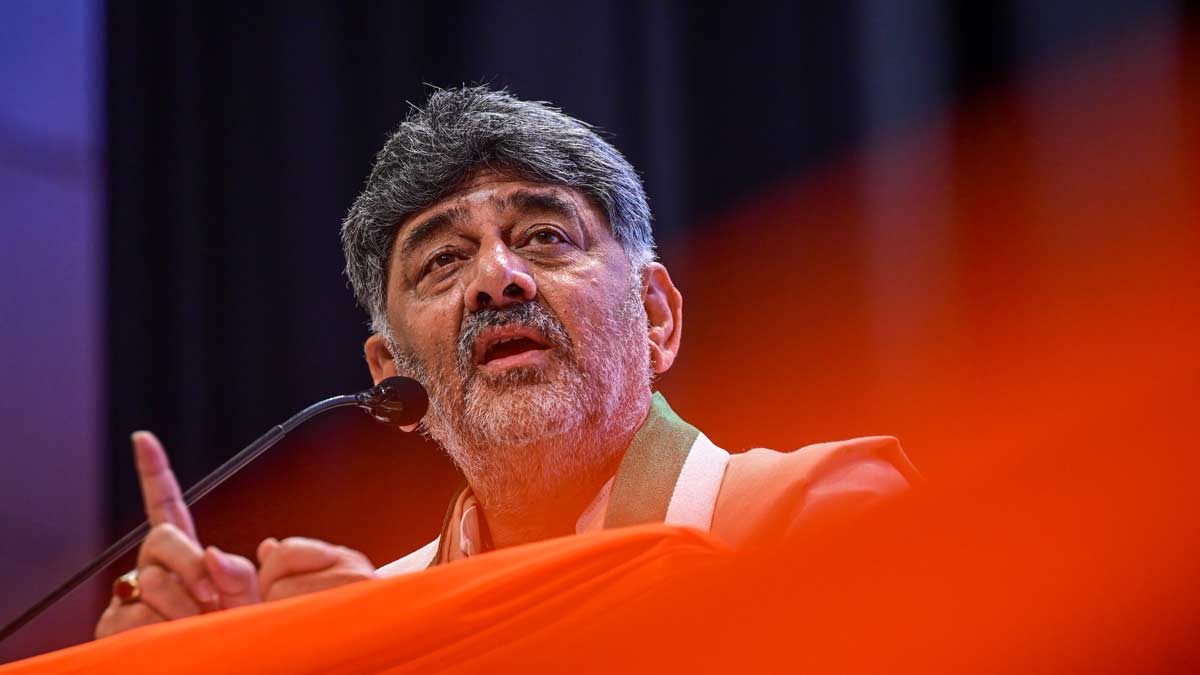
It has been 100 days since D.K. Shivakumar took charge as the chief minister of Karnataka on June 3, 2026, at Loka Bhavan in a low-key swearing-in ceremony. His elevation to the top post marked the culmination of a long political journey for the Congress leader who had waited years for an opportunity to lead the state.
From being a Youth Congress leader to a minister, state Congress president and finally chief minister, Shivakumar’s journey to the top job has taken decades, with the leadership of the Congress eventually handing him the responsibility of running the government.
Shivakumar, who was once known for his combative style and was seen as one of the Congress’s principal troubleshooters, has gradually adopted a more measured approach to politics, particularly after his arrest by the Enforcement Directorate. As the chief minister, he has had to deal with the demands of good governance, managing the unhappy party men and responding to opposition attacks. These responsibilities have made him a mature politician who takes on challenges with equanimity.
His first 100 days have seen a mix of administrative decisions, welfare measures, new initiatives and political controversies, with the government holding a special programme to mark the occasion titled ‘Drudha Karnataka Sankalpa – Shatakada Patha, Pragatiya Ratha’, or ‘Determination for a Strong Karnataka – Path to a Century, Chariot of Progress’, at Vidhana Soudha on September 10.
The event was inaugurated by his predecessor Siddaramaiah, with whom Shivakumar had to negotiate for his turn. Here is the recap of events and decisions that happened in the last 100 days.
Green light (Schemes and guidelines appreciated by all)
Praja Seva: One of the initiatives being highlighted is Praja Seva, which is aimed at taking government services closer to citizens and making the delivery of public services simpler and more accessible. The initiative focuses on reducing the need for people to repeatedly visit government offices and streamlining the process through which citizens access government services at the local level.
Free bus pass for students: The government has also announced free bus passes for students across Karnataka, allowing students to travel by public transport to educational institutions without having to bear the cost of the bus fare. The measure is intended to provide students across the state easier access to public transportation for their regular academic commute.
Bharath Jodo Sanghas: Another initiative is the proposed establishment of Bharath Jodo Sanghas in every panchayat and ward, with each Sangha to receive Rs 10 lakh. The organisations are intended to provide a platform for young people at the local level and create youth groups across rural and urban areas through panchayats and wards.
Reverification of beneficiaries: The government has also begun reverification of beneficiaries under the five guarantee schemes — Anna Bhagya, Gruha Lakshmi, Shakti, Yuva Nidhi and Gruha Jyothi. The exercise involves checking and updating beneficiary records and verifying eligibility, with the government seeking to streamline the administration of the schemes and ensure that benefits reach those eligible.
Streamlining of B Khata to A Khata Process: The government is also working on streamlining the process of converting B Khata properties into A Khata, a move aimed at simplifying the procedure for eligible property owners and bringing greater clarity to property-related records and the process followed by civic authorities.
AI push: Another area that the government has sought to push is artificial intelligence, with initiatives including the proposed AI University and the NIPUNA programme. The government has said the initiatives are intended to strengthen AI education and skills and create opportunities for students and young professionals in the emerging technology sector.
Strict office hours for govt staff: The government has also sought to bring greater discipline to the functioning of its offices by insisting on strict adherence to working hours. The measure is intended to ensure that officials and employees remain available during prescribed office hours and that citizens approaching government departments for services do not face difficulties because of the absence of staff.
Orange light (initiatives or events done in good intention, but lagging or drew mixed reaction)
Roadside parking: In Bengaluru, the government has taken measures to regulate roadside parking and parking charges, with the aim of preventing vehicles from being parked indiscriminately on roads. While the initiative has received some support, the proposal to charge fees for parking outside homes has been put on hold. Implementation has also remained challenging in several areas where designated parking spaces are limited and vehicles continue to be parked along busy roads.
Cleared footpath: The government’s drive to clear footpaths has faced similar challenges, with pedestrian spaces continuing to be occupied by vendors, commercial establishments, parked vehicles and other obstructions in several parts of the city. While civic authorities have undertaken clearance drives, the problem has continued to surface in different areas, making enforcement and maintenance of cleared footpaths a continuing issue. This initiative also drew mixed opinions as some criticised the government for taking away the livelihood of the street vendors.
Food safety raids: The administration has also stepped up food safety raids and inspections, targeting establishments suspected of violating food safety and hygiene norms. The Food Safety Department has conducted inspections and raids at restaurants, eateries and other establishments involved in handling food, with action being taken where violations are detected. Hotel owners welcomed the raids, but the operation lost its pace.
Mekedatu project: On the development front, the Mekedatu project continues to remain unresolved. Karnataka has maintained that the proposed project is aimed at meeting the drinking-water requirements of Bengaluru and surrounding areas and generating hydropower, while Tamil Nadu has opposed the project over concerns relating to the Cauvery river and downstream water availability. The project continues to face regulatory and inter-state hurdles. Now, with Congress supporting the TVK government in Tamil Nadu, the state has to walk a tightrope on this issue.
Anti-poaching operations: The Forest Department has continued action against poaching and illegal hunting in forest areas, with anti-poaching operations aimed at preventing the killing of wildlife and detecting those involved in illegal hunting. The recent killing of three men inside the forest in Chamarajanagar by forest department staff has received mixed reactions. The opposition supported the deceased, saying they were just farmers who went to bring back the cattle, but the forest minister insisted they were poachers and constituted a committee to investigate the incident.
Red Light (Policies that became a headache for the government)
Park’s Amendment Bill: The government’s U-turn on the Parks Amendment Bill became a contentious issue after it reversed its position on the legislation following protests by the Opposition and civic groups, drawing criticism over the decision to backtrack.
Nagendra’s resignation: The resignation of B Nagendra following the controversy surrounding the alleged irregularities in the Karnataka Maharshi Valmiki Scheduled Tribes Development Corporation was another major issue faced by the government. Nagendra’s resignation followed an aggressive campaign by the BJP, which organised the Ballari Chalo padayatra and a public meeting in Ballari to target the Congress government over corruption allegations. The BJP’s Ballari programme also coincided with the Congress government’s 100-day celebrations, allowing the opposition to organise its own political programme at the same time that the ruling party was presenting its achievements.
GBIT township project: The Bidadi GBIT township project has also remained a contentious issue, with farmers and residents raising objections over the proposed project and land-related action. The protests and confrontation over the issue forced the government to engage with the concerns of affected farmers, eventually leading to attempts at a compromise over the project. Shivakumar said he won’t force anyone to give the land and also constituted a committee to hear the farmers' concerns.
PSC controversy: The Karnataka Public Service Commission controversy has added another challenge, with allegations involving question-paper leaks, manipulation of OMR sheets, irregularities in evaluation, nepotism and the alleged use of middlemen in recruitment. The alleged irregularities happened before Shivakumar took over the office, but the Opposition has been attacking the Congress government for "selling jobs for money". The Enforcement Directorate has conducted searches in connection with the allegations, including those linked to the recruitment of veterinary officers, while the controversy has raised questions over the involvement of an IAS officer.
Water sharing dispute: The Cauvery water dispute has also become particularly sensitive because Karnataka is facing a year of rainfall deficiency. The government has to deal with reduced water availability for agriculture and drinking purposes while also managing the issue of releasing Cauvery water to Tamil Nadu in accordance with decisions taken by the competent authorities. With reservoirs coming under pressure during a deficient rainfall year, the dispute has remained a politically sensitive issue for Karnataka.
Demands for ministerial berths: Within the Congress, there has been dissatisfaction among some MLAs over ministerial berths, with legislators seeking representation in the Cabinet and expressing disappointment over the limited opportunities available. The issue of ministerial positions has periodically surfaced within the party as legislators continue to seek accommodation in the government.
No woman minister: The government has also faced criticism over the absence of a woman minister in the Cabinet, particularly because the Congress has made women-centric welfare schemes such as Gruha Lakshmi and Shakti an important part of its governance agenda. The lack of a woman in the Council of Ministers has led to questions about representation of women in the state government.
Besides all these, the most serious challenge outside the political sphere has been the rainfall deficit and drought situation in Karnataka. The state has recorded deficient rainfall across several regions, with around 190 taluks facing rainfall deficiency and several areas experiencing severe conditions. The situation has implications for agriculture, drinking water, livestock and rural livelihoods, while reduced inflows also affect the availability of water in reservoirs for irrigation and other requirements.
The government is also entering a politically important phase, with preparations for the 2028 Assembly elections eventually beginning to influence political activity in the state. Shivakumar will have to manage the government as well as the Congress organisation, while keeping his legislators together and responding to the BJP and other opposition parties.
