



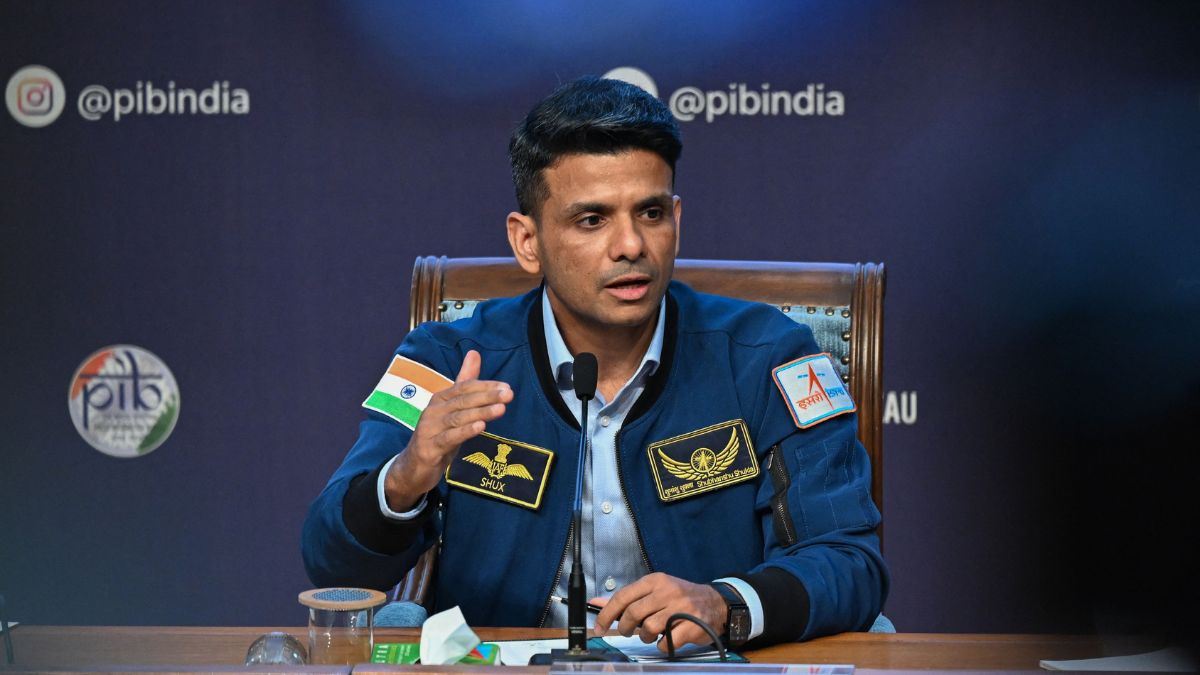
India’s first human spaceflight mission should not be viewed merely as a one-time achievement, but as a launchpad for the country’s next phase of innovation and nation-building, astronaut Group Captain Shubhanshu Shukla said on Saturday, urging young Indians to develop problem-solving abilities, self-belief, and the resilience to keep going despite setbacks.
Speaking at the 6th Dr Rajaram Jaipuria Memorial Lecture organised by the Jaipuria Group of Educational Institutions, Shukla said India has reached a stage where it is “more mature” and “technologically smarter”, but the country now needs the right mindset to convert its capabilities into sustained progress.
Jaipuria Group chairman Shishir Jaipuria, while speaking about Shukla’s space journey and its significance for the country, said the astronaut had carried the aspirations of a new India with him into space.
“He carried with him New India’s vision and dream when he went to space. We have huge potential for India as we are a very young population. We have to work together and grow,” Jaipuria said.
The lecture, themed 'The Indian Century, the Youth, Innovation and Nation Building', focused on India’s demographic advantage, innovation, and the role of young people in shaping the country’s future.
“What does this mission mean? But what about after that?” Shukla said while reflecting on his spaceflight, underlining the need to look beyond individual milestones and build on the capabilities created through India’s human space programme.
For Shukla, the mission was not a personal achievement but a national one. Recalling his approximately 20-day-and-three-hour stay in space, he said he travelled around 1.4 crore km and orbited the Earth roughly 320 times.
“It was a mission for India,” he said, adding that he felt every Indian was with him during the journey.
'Ability to not give up helped me'
Shukla said the ability to persist through difficulties has been central to his journey and should become an equally important quality among young Indians.
“The power of self-belief is very important,” he said, recalling that he had suffered from stage fright as a child.
He said young people should be taught to approach problems rather than simply seek ready-made answers, making problem-solving skills a priority in education.
For those aspiring to become astronauts, Shukla highlighted three broad requirements: excelling in one’s chosen field, maintaining physical fitness, and developing psychological fitness.
He also credited his training at the National Defence Academy with helping him develop discipline, resilience and the ability to deal with challenges.
“The ability of not giving up has helped me a lot,” he said.
Curriculum needs to change
Shukla also made a case for changes in India’s education curriculum to prepare students for a technology-driven future.
“We have to change in curriculum now,” he said, pointing to the Atal Innovation Mission and the growing emphasis on innovation among students.
According to Shukla, India has already built significant technological capabilities and is now at a point where the focus should shift towards using those capabilities for larger national goals.
“We are now more matured, we are technologically smarter,” he said.
He also spoke about the physical challenges of living in space, including the temporary increase in height experienced by astronauts because of microgravity.
Shukla said he grew by about 5cm in space, but returned to his earlier height after coming back to Earth.
Beyond the physical experience, he said space missions test an astronaut’s psychological resilience, decision-making and ability to deal with unforeseen challenges.
Teamwork and collaboration are key
Shukla stressed that ambitious missions cannot be delivered by individuals alone and that teamwork and collaboration would be critical to India’s future scientific and technological progress.
His message to students was ultimately centred on mindset: having the confidence to pursue difficult goals, learning to solve problems, and refusing to give up when faced with failure.
“If you want to achieve something, it is in the mind and you will find a way to do the same,” Shukla said, urging young people to make their minds work in their favour.
“Sky is never the limit,” he said, calling on the younger generation to think beyond existing boundaries as India looks to build what speakers at the lecture described as the 'Indian century'.
