



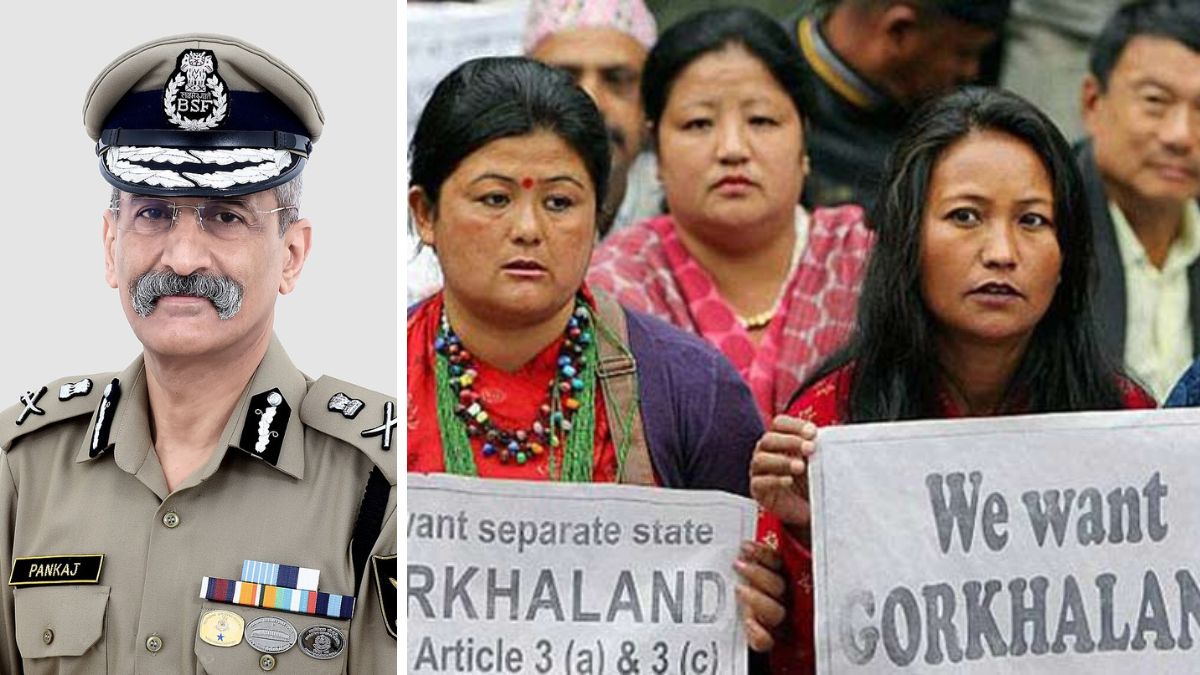
The long-standing demand of the Gorkha community has not gone unnoticed by BJP with the Union Home Ministry forming a committee under former Border Security Force Director General and former Deputy National Security Advisor Pankaj Kumar Singh, who was reappointed as mediator. During Union Home Minister Amit Shah’s three day visit to Siliguri, a three-tier meeting was held on Saturday to chalk out a permanent political solution to meet Gorkhaland demands and factor in points of the BJP manifesto.
The three-tier meeting involved the Centre, West Bengal government and leaders from regional hill parties including the Gorkha Janmukti Morcha (GJM) setting up a meeting. Shah represented the Centre while CM Suvendu Adhikari appeared for the state. Several points were discussed and probable solutions indicated during the meeting.
"This is a long-standing demand of the Gorkhas. Leaders of various political parties presented their views before the Union Home Minister. The chief minister also presented his statement. After listening to all opinions, the Home Minister spoke about the path to a solution that exists,” revealed BJP Darjeeling MP Raju Bista. “The Gorkhas will receive something even bigger than the hope they have lived with for so long,” added Bista.
“Work has now begun on finding the solution we want regarding the Gorkhaland issue," said BJP Rajya Sabha MP Harshvardhan Shringla.
Singh was first appointed in October 2025 as the official government interlocutor to find a solution to the Gorkhaland issue. The committee formed under Singh will look into details of the hill issues and concerns of various stakeholders by leading political dialogue while touring the hills, Terai and Dooars regions. A report will then be submitted to the Union Home Ministry with findings and recommendations of the committee.
The BJP has a strong presence in the hills and with the current Suvendu Adhikari government in the state and regional parties see renewed hope for their Gorkhaland demand.
Regional leaders who attended the meeting termed it as the first meeting aimed at resolving the movement built around the long-standing Gorkhaland demand. The leaders who expressed satisfaction after the meeting included GJM president Bimal Gurung and Gorkha National Liberation Front (GNLF) president Mann Ghisingh.
"Whatever solution is reached will be a constitutional solution. A committee will be formed under the supervision of the mediator, which will submit a report to the central government on the demands of the common people," said GJM general secretary Roshan Giri.
The meeting was held at Hotel Sukna in the foothills of Darjeeling. Bista said the meeting was held on a historic day as it coincided with the date of signing of the Gorkha accord in 1988. The accord was signed between the Centre, the West Bengal government and GNLF had led to the creation of the semi-autonomous body Darjeeling Gorkha Hill Council (DGHC) during the erstwhile Left Front regime. This was after a violent agitation spread across the hills for a separate state of Gorkhaland.
The GJM then emerged as the main party holding violent strikes and protests in the hills and plains for the Gorkhaland demand with the DGHC being defunct and replaced by the Gorkha Territorial Administration (GTA) after the GTA Bill was passed in the West Bengal Legislative Assembly in September 2011 during the erstwhile Trinamool Congress (TMC) government’s regime. The GTA had greater administrative and financial powers which later faced backlash from regional groups demanding renewing demands for separate statehood.
