



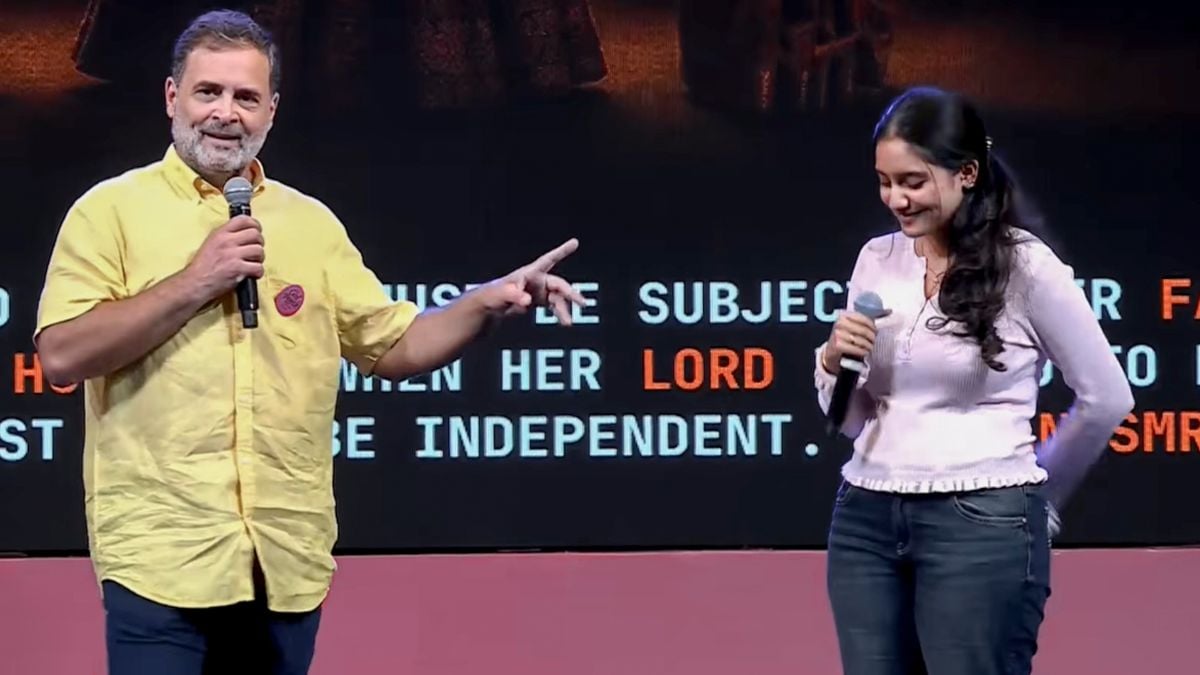
Unlike earlier editions of Rahul Gandhi’s Chhatron Ki Goonj, where men and boys formed an overwhelming share of the audience, Pune offered a markedly different picture. An event exclusively for young women at the AISSMS College Ground was filled to the brim, with women dominating the audience.
Rahul Gandhi, who appeared in a yellow shirt—after wearing pink in Prayagraj—brought a splash of colour to the campaign, given he is often associated with his trademark white T-shirts.
“Many people ask me what India’s biggest strength is. Some say it is our economy, our military or our medical system. Some may say it is our people. But I am very clear: India’s biggest asset is its 70 crore women—their unique journeys, imagination and dreams,” Gandhi said, while kicking off the fourth edition of his student outreach campaign.
“My logic is simple: women are by nature more sensitive, gentle, compassionate and forward-looking than men. That is why I believe India’s young and older women are its biggest asset,” he said.
In Uttarakhand, students had turned up in large numbers despite heavy rainfall that left the venue muddy. In Prayagraj too, crowds gathered despite rain, where more than 80 per cent of the crowd were men. Pune, however, was different. The organisers had deliberately restricted the event to women.
Snehal Kirjat, a software developer who attended the event to hear Gandhi live speech, said she saw him as “the first Opposition leader to take a firm stand".
“I like Rahul Gandhi. He is a leader of the youth, and from his speeches and the way he presents himself, it looks like he genuinely cares about people, especially women,” she said.
Kirjat also criticised what she described as a deteriorating education system.
“My mother is a government teacher. The government has no concern for taking care of even the basic needs of students when we look around at the condition of educational institututes in the outskirts. Nobody cares about them. Those in power are happy to enjoy power, rather than working for people,” she said.
Gandhi also sought to challenge what he described as the narrow ways in which women are viewed in Indian society.
“Whenever I speak to a man, I find that women are often placed in three boxes—wife, daughter or mother. But that cannot be their only identity. We have brilliant women doing fascinating things, pursuing professions and playing multiple roles, yet they are often reduced to just these three identities. And all three are defined through their relationship with a man,” he said.
For All India Mahila Congress president Alka Lamba, the question is not only about representation, but also freedom and safety.
“Women’s safety is important and the current BJP government has not been able to keep the women of the country safe. Moreover, the BJP should not decide where women can go and where they cannot. But today, the BJP is neither able to ensure women’s security nor their freedom,” Lamba told THE WEEK.
Sonali Vaishnav, a UPSC aspirant who attended the event, said women continue to face limited employment opportunities.
“The government’s record on employment generation is poor. Women want to work today, but the government has not been able to provide them with enough opportunities. Another barrier is confidence, as society continues to decide the limits of what women can and cannot do,” she said.
The Congress has increasingly sought to foreground issues concerning women’s safety and dignity following the student protests at Jantar Mantar in Delhi. The party has criticised the use of force against women protesters and targeted the Centre over its handling of student protests.
At the Pune event, some women also framed the gathering in explicitly political terms, arguing that younger voters—and young women in particular—have become more resistant to divisive politics.
“We think women are less likely to hate. So there is a Gen Z factor and a women factor as well that will play out against the BJP, It shows that the women’s segment may be emerging as a stronger sentiment against the BJP, except in places where votes are bought, like Bihar,” pointed out Meenakshi, a college student.
