



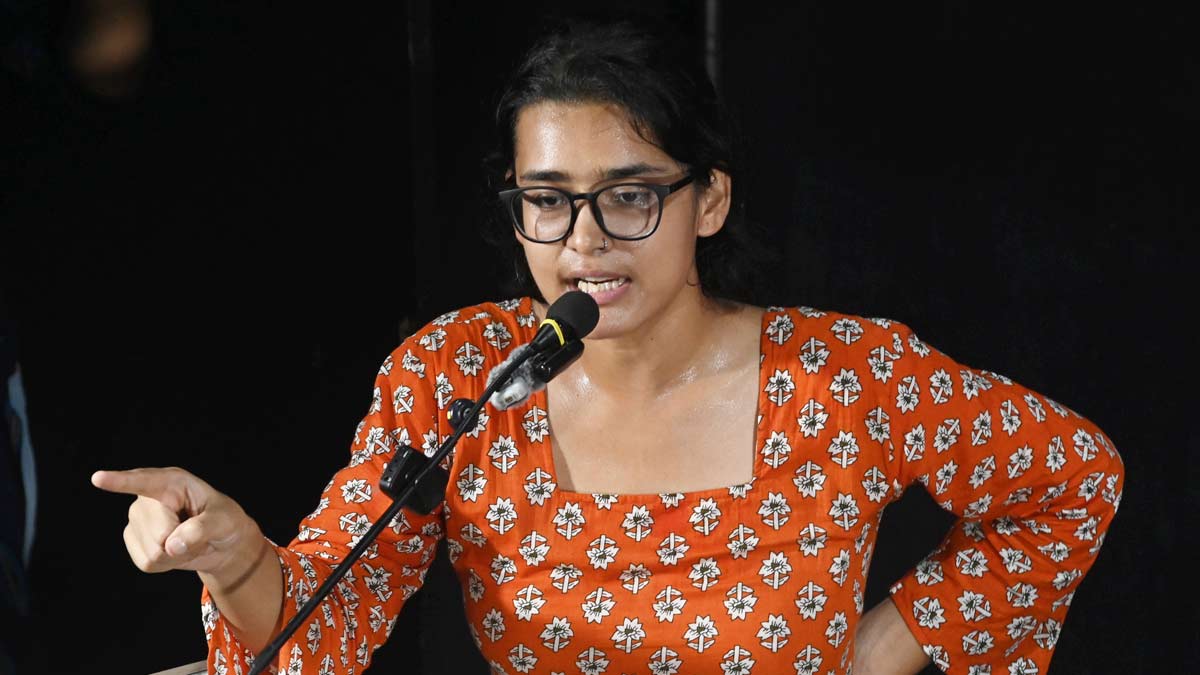
Lamakaan, a public space in Hyderabad known for its intellectual and cultural events, which usually draw modest crowds, was packed with youngsters on August 16. More than 300 people — mostly youngsters, with a sprinkling of middle-aged attendees — gathered to hear Neha Bora, president of the All India Students’ Association (AISA).
She offered what sounded like reassurance to anxious citizens wondering whether it is still safe in a democracy to question a government’s inefficiency. “It’s okay if the (central) government calls you ‘Pakistani’, ‘anti-national’ or ‘digiami Naxal’. Questioning the government’s inefficiency is not sedition,” she said.
The AISA leader delivered the 15th Hasan Memorial Lecture at Lamakaan in Banjara Hills on the evening of August 16. Titled “Young India Speaks: Jantar Mantar and the Way Forward,” the lecture drew an enthusiastic crowd with almost no publicity. Bora argued that genuine love for the country means knowing how broken it is. Former JNU students' union president Sai Balaji also addressed the gathering. She maintained that the government’s crackdown on its critics should be seen as the BJP’s policy, not nationalism.
Fresh off a 23-day hunger strike at Delhi’s Jantar Mantar, which preceded Union Education Minister Dharmendra Pradhan’s resignation over alleged paper leaks and NEET irregularities, Bora told students from NALSAR, IIIT Hyderabad, the University of Hyderabad, EFLU and Osmania University that the protest was never an appeal to the government’s conscience, but to the conscience of ordinary citizens. She said the sight of young people going hungry in the national capital while the government remained silent, instead of asking an underperforming minister to step down, exposed how little the government cared about the country’s youth.
She used the lecture to push back on the routine advice that students should stay out of politics, arguing that politics already intrudes on campus life constantly — through fee hikes, leaked papers, exam irregularities and crackdowns on dissent. Recalling the Jantar Mantar sit-in, where protesters faced tear gas and baton charges, Bora said support poured in from across the country to sustain the movement. She said she is often asked how she wants the protest to be remembered. Her answer, she said, is that it marked the beginning of the end of hate-driven politics and the restoration of democracy to the people.
During the Q&A that followed, students pressed Bora on both the strategy and the personal costs of activism. When a student asked why the Cakroach movement had ended its dharna at Jantar Mantar so soon after Pradhan’s resignation, she said the activists had come from different states and were already fatigued. She acknowledged that they should have deliberated on the decision a little more before calling off the protest.
A female student asked how to deal with friends and family members who support the BJP without questioning its actions. Bora said they should not be labelled “Sanghis” and stressed the importance of reading more about India’s history and current affairs. Rather than arguing without adequate information, she urged students to engage with them and help them understand issues that interest them.
Concluding the lecture, Bora thanked Hyderabad specifically for standing with Delhi protesters when they came under police action and praised students in Chennai and elsewhere for carrying the movement forward under an initiative she called "Jazba Rising." Bora described Pradhan’s resignation as only the first victory and urged students to continue pushing for examination reforms, job creation and accessible higher education. She vowed that the fight would continue “until camps are set up at the destination.”
