



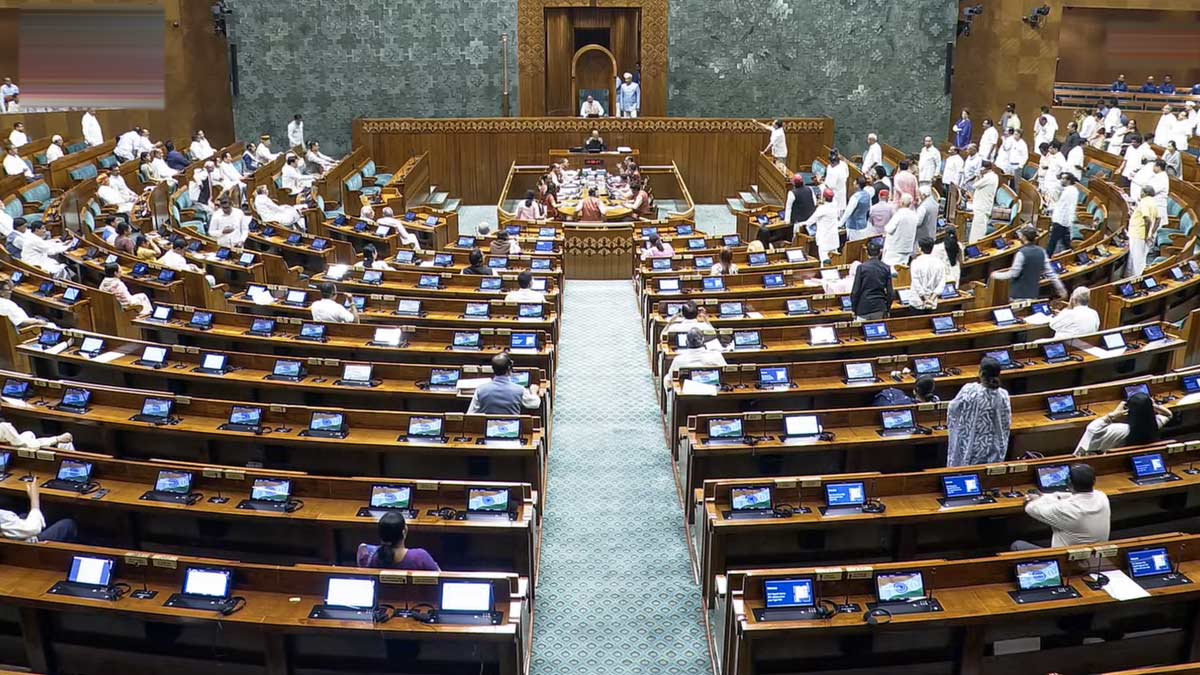
The monsoon session of the Parliament was close to a washout. On paper, the government passed 12 bills in three-and-a-half weeks, but most went through without debate as protests and disruptions dominated the proceedings. Much of what shaped the session happened outside the House, leaving both the Opposition and the government to assess what the protests had achieved.
The Opposition entered the session under pressure after the BJP’s strong showing in the recent Assembly elections in West Bengal and Assam. By the end of the session, however, it appeared to have found an issue around which it could mobilise: student anger and the government’s response to it.
The government was expected to showcase its renewed strength in the session after a series of defections and election victories had expanded its numbers. Instead, it got little opportunity to demonstrate that advantage.
The session opened on July 20 with speculations that the government would bring two contentious pieces of legislation.
The Delimitation Bill, 2026, proposes increasing the strength of the Lok Sabha from 543 to 850 seats. The Foreign Contribution (Regulation) Amendment Bill, 2026, seeks tighter oversight of foreign funding to NGOs and other organisations. Neither was passed. The FCRA Bill was referred to a Joint Parliamentary Committee (JPC), while the delimitation legislation was held back in the face of Opposition resistance.
The main confrontation was over the NEET-UG paper leak, the students' protests, and the theft at the Ram Temple. The students' protests at Jantar Mantar and the government’s response to them had escalated the matter, which eventually led to the resignation of former Education Minister Dharmendra Pradhan.
The Opposition spent much of the first week demanding Pradhan’s resignation. The government initially resisted, but as protests continued both inside Parliament and at Jantar Mantar, Pradhan resigned on July 25. In his resignation letter, he pointed to the government’s actions, including a CBI probe, cancellation of the examination and a re-test.
The government also sought to address concerns over examination integrity through the Public Examinations (Prevention of Unfair Means) Amendment Bill, 2026. The bill, which was passed by both Houses and received presidential assent, provides for faster investigation and trials in cases involving unfair means in public examinations. It allows states and Union Territories to designate special fast-track courts and prosecutors, requires investigations to be completed within two months and trials within three months, and provides for higher penalties and a time-bound appeal mechanism.
The resignation was the clearest indication that pressure from the streets and the Opposition benches had influenced the government’s response.
Congress MP Gaurav Gogoi said he had rarely seen a government appear as unsettled as it did during the session. Prime Minister Narendra Modi and Home Minister Amit Shah were largely absent from the floor of the House.
Parliamentary Affairs Minister Kiren Rijiju, while briefing reporters at the end of the session, said 12 bills had been passed, but expressed disappointment over the lack of debate. He said 11 bills passed the Lok Sabha without discussion, while only one received a proper debate. In the Rajya Sabha, one bill was fully discussed, though the principal Opposition party walked out.
The legislation passed covered a range of areas. The Registration of Births and Deaths (Amendment) Bill makes delayed registration more stringent. The MSME amendment seeks a national digital platform for voluntary registration and measures to improve access to finance and speed up the resolution of delayed payments.
The Bankers’ Books Evidence Bill updates the law to cover electronic, digital and cloud-based banking records. The Tribunals Reforms Bill provides for a National Tribunals Commission and seeks greater uniformity in appointments and service conditions.
The session also passed the Kerala (Alteration of Name) Bill, changing the constitutional name of the state to Keralam, and amendments relating to the National Co-operative Development Corporation and the mining sector. Two ordinances issued before the session, relating to the number of Supreme Court judges and income tax, were also replaced through legislation.
Rijiju blamed the Opposition, saying the government repeatedly sought debate while Opposition MPs avoided it. He accused Congress MPs of reducing parliamentary proceedings to sloganeering and banner-waving rather than substantive discussion.
Congress MP Jairam Ramesh termed the session a washout. He noted that the Monsoon Session of 2015 had also been disrupted, then over the Vyapam scam, which he described as a precursor to the current NEET-NTA controversy.
The data from PRS Legislative Research underline the extent of the disruption. The Lok Sabha functioned for only 15 per cent of its scheduled time, while the Rajya Sabha functioned for 33 per cent. Of the 12 bills passed by the Lok Sabha, nine were passed without any MP—other than the minister piloting them—speaking on them.
Question Hour was also severely affected. It functioned for only nine minutes, or 1 per cent of its scheduled time, in the Lok Sabha and about two hours—or 12 per cent—in the Rajya Sabha. Only two of 380 listed questions received oral answers in the Lok Sabha. The Rajya Sabha answered 16 of 285.
Short-duration discussions and half-an-hour debates were also limited, while private members’ business went undiscussed for a second consecutive session.
The significance of the session lies not only in the disruption, but also in what followed. A minister resigned, the delimitation bill was held back, and the FCRA bill was sent to a JPC. The government also had to respond legislatively to the concerns raised by students over examination irregularities.
Whether this amounts to an Opposition advantage, as some Opposition leaders are already claiming, or a tactical retreat by the government to protect its broader legislative agenda for the Winter Session or a special session, is yet to be seen.
Politics will now move from Parliament to the streets, with Assembly elections in Uttar Pradesh, Punjab, and Uttarakhand next in focus.
