



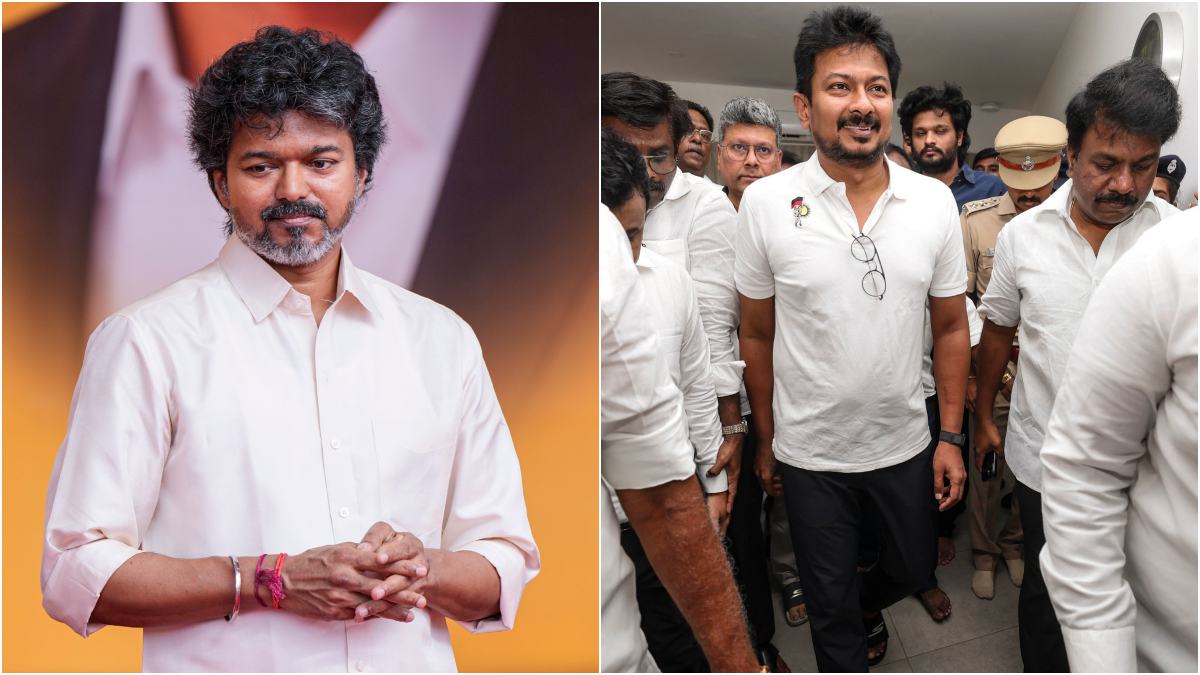
For years, Udhayanidhi Stalin was seen as a dynast, a leader who inherited power from his grandfather, M. Karunanidhi, and his father, M.K. Stalin, to lead the opposition Dravida Munnetra Kazhagam (DMK). The arrest of Udhayanidhi on Tuesday marks a watershed moment in the political evolution of the DMK's principal heir. As he stepped into the police van in front of his Neelankarai residence, just a few metres away from Chief Minister C. Joseph Vijay's residence on Blue Beach Road, he seemed to have shed all the institutional cushioning and familial safety net he had enjoyed over the years.
Clad in his usual white T-shirt bearing the DMK youth wing symbol and black trousers, he was all smiles. When television cameras focused on him and asked questions, he replied: "I am not afraid of this arrest. I did not make any derogatory remark. This is like a comedy show. They are a bunch of idiots."
As the police van carrying Udhayanidhi moved away, DMK cadres ran behind it. As he was taken from Neelankarai near the East Coast Road to Thanjavur, traffic snarls brought much of Chennai to a standstill as DMK cadres came out to block the roads.
Minutes before the arrest, Udhayanidhi's wife, Kiruthiga, and former minister Ma. Subramanian made the police officers wait at his residence, saying he was busy with his morning routine. Shortly after the arrest, the DMK approached the Madras High Court against the Vijay government's move to arrest Udhayanidhi. Soon, protests erupted across the state, with DMK cadres and office bearers gathering in front of his residence. The crowd continued to swell, forcing even Chennai City Police Commissioner Amalraj to come to the spot.
DMK General Secretary Duraimurugan, who is in his late 80s, walked into Udhayanidhi's house, surprising everyone present. "Uncle, why did you come?" Udhayanidhi asked him. His brother-in-law, V. Sabareesan, was seen assisting the office bearers and the advocates, while also arguing with the police. In fact, the DNA of the DMK is that whenever the party faces legal trouble, the entire ecosystem comes together.
For anyone who witnessed the scenes at Neelankarai, as Udhayanidhi exited his residence in police custody, it seemed that he had already undergone the mandatory political baptism that would move him beyond the shadow of his lineage. The arrest transformed Udhayanidhi from a leader whose authority was a by-product of familial inheritance into a standalone politician ready to forge an identity through the friction of being in the Opposition.
In 2021, when the DMK won the elections under M.K. Stalin, it was relatively easy for Udhayanidhi to enter the treasury benches and later be elevated first as a minister and then as deputy chief minister. As a first-time legislator, he occupied the treasury benches, often taking a dig at the BJP and the AIADMK.
But things changed dramatically for the DMK and Udhayanidhi as C. Joseph Vijay's Tamilaga Vettri Kazhagam (TVK) won the election with a thin majority. Udhayanidhi was pushed to the Opposition benches, directly opposite his friend and college senior. Vijay and Udhayanidhi apparently once shared a very close friendship. In fact, both Udhayanidhi and Vijay shared the same circle of friends. Some of them, including leading cinema producers who were once with Udhayanidhi, have moved to Vijay's side in the past two months since the latter assumed power.
The two now sit opposite each other in the state assembly, effectively ending the interpersonal relationship they once shared. Vijay has transitioned from a mass hero to the state's top political leader, while Udhayanidhi, who produced a few of Vijay's films under his Red Giant banner, is regarded more as an urban protagonist than as a mass hero or mass icon like Vijay.
In the long history of the Dravidian movement, urban protagonists have often occupied the central space—like M. Karunanidhi, who was a scriptwriter, as opposed to the mass hero M.G. Ramachandran. But the Dravidian movement in Tamil Nadu has always grown through long speeches and powerful political rhetoric. That rhetoric has shaped the state's political trajectory.
In fact, former Chief Ministers such as C.N. Annadurai were stalwarts who could play with words. Karunanidhi's speeches and his trademark wordplay were always enjoyed by his party workers and sometimes even by his critics. Udhayanidhi, according to his party colleagues, has the same instinct as his grandfather.
But that may not help him climb the political ladder the way it did for his grandfather. Incidentally, Udhayanidhi's comments during the protest rally at Thanjavur on Monday shifted attention away from what the state government wanted to project as the strategic failure of Vijay's Cauvery outreach.
The Vijay government, after its Karnataka counterpart asked him to cancel his proposed visit to Bengaluru, appeared to lose its stance in the Cauvery row. The Delta districts and the farmers were preparing for a bigger show against Vijay and his government over what they saw as its failed outreach.
If Udhayanidhi's comments can be termed slander, the state government's attempts to incarcerate him have actually facilitated his political maturation. In fact, the corruption narrative against the DMK that the Vijay government had been pursuing all this while was shattered by this one arrest.
While it was widely believed that the TASMAC scam or the MLA horse-trading case might eventually lead to the DMK's top brass, the arrest of Udhayanidhi for a speech-related offence has inadvertently helped him bypass that corruption narrative.
With this arrest, Vijay appears to have given his bête noire, Udhayanidhi, a distinct political identity, allowing him to acquire the political scars often considered necessary for leadership and to evolve as a leader in his own right.
