



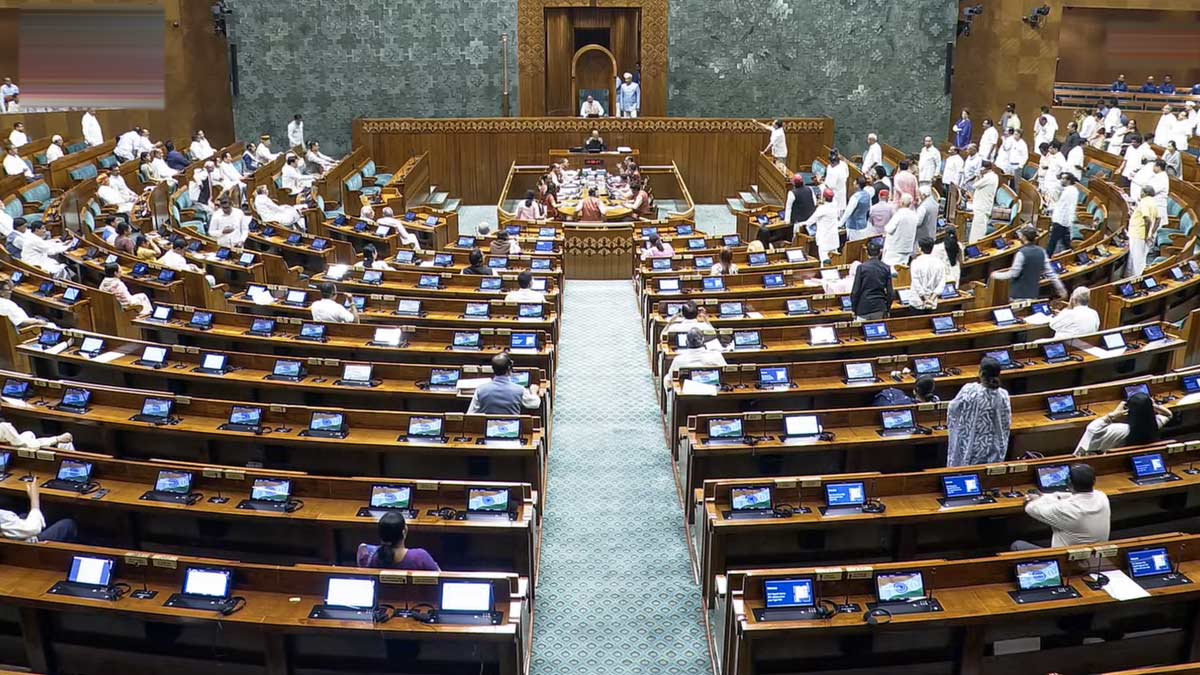
After a week-long washout and a stormy session on Monday, the Lok Sabha is expected to function smoothly on Tuesday as it takes up for discussion the Public Examination (Prevention of Unfair Means) Amendment Bill, 2026, which seeks to strengthen the country's anti-paper leak law.
The Bill, introduced by Union Minister of State for the Prime Minister's Office Jitendra Singh, proposes stricter punishment for those involved in examination malpractices, including imprisonment of up to 10 years and a fine of up to ₹50 lakh.
The Narendra Modi government introduced the legislation after large-scale student protests led by the Cockroach Janta Party (CJP), which ultimately forced Education Minister Dharmendra Pradhan to resign.
The Lok Sabha could not take up the Bill on Monday as the Opposition continued to target the government, demanding accountability from Home Minister Amit Shah over the alleged police brutality against protesting students.
The Rajya Sabha also witnessed repeated adjournments amid persistent Opposition protests over the police crackdown on student demonstrators.
A parliamentary source told PTI that following Lok Sabha Speaker Om Birla's intervention, all political parties have agreed to discuss the Bill on Tuesday.
The Speaker has allocated six hours for the debate, with the possibility of extending the discussion if required, depending on the sense of the House.
Key Highlights of the Bill
Investigations into paper leak cases must be completed within two months.
Individuals found guilty of leaking examination papers or using unfair means will face a minimum of five years and a maximum of 10 years in prison, along with a fine of up to ₹50 lakh.
For organised paper leak rackets, the Bill proposes a minimum jail term of seven years and a fine of up to ₹10 crore.
States and Union Territories will be empowered to establish fast-track courts to ensure trials are completed within three months of the filing of the chargesheet.
In exceptional cases, the Central government will have the authority to constitute a special task force to investigate paper leak incidents.
The legislation identifies 15 offences, including leaking question papers, tampering with OMR sheets, creating fake examination websites, and issuing fraudulent admit cards.
The government announced a series of measures to curb examination malpractices after thousands of students staged nationwide protests demanding accountability over recurring paper leaks and irregularities.
On Sunday, Prime Minister Narendra Modi announced the formation of a high-powered task force headed by Infosys co-founder Nandan Nilekani to recommend comprehensive reforms aimed at making India's public examination system secure and leak-proof.
