



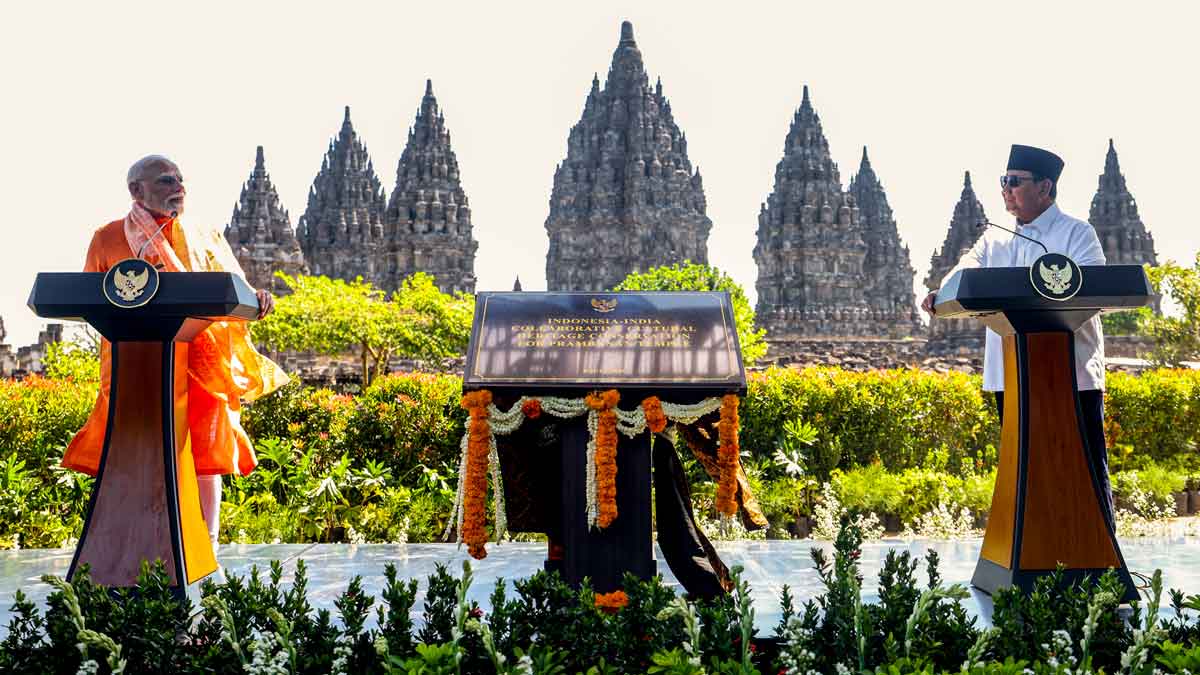
Ties between India and Indonesia have been deep and historical. The visit of Prime Minister Narendra Modi to Indonesia from 6-8 July comes after Indonesian President Prabowo Subianto's visit to India as Chief Guest on the Republic Day last year. Both nations share warm and friendly civilizational ties spanning over 1,600 years. India and Indonesia are connected through centuries-old civilisational interactions that have shaped enduring cultural and economic linkages between the two and in Asia and beyond. As a comprehensive strategic partner, Indonesia is an important pillar in India’s Act East Policy and central to its vision of the Indo-Pacific.
On the economic and trade front, despite huge potential, it has not seen much momentum. Bilateral trade between the two jumped from US$ 4.3 billion in 2005-06 to US$ 24.8 billion in 2025-26 but has come down from the historic high of $38.8 bn in 2022-23. Indonesia is India’s 9th largest trading partner and the second largest in the ASEAN region after Singapore. India is the second largest buyer of coal and crude palm oil from Indonesia, and also imports minerals, rubber and hydrocarbons reserves. India exports refined petroleum products, commercial vehicles, telecommunication equipment, and agricultural commodities to Indonesia. About 100 Indian companies have made significant investments in infrastructure, power, textiles, steel, automotive, mining, banking and consumer goods sectors. Several medium and small Indian companies are operating coal mines in Indonesia.
Being maritime neighbours and strategic partners, defence and security cooperation between the two has also increased over the past few years. India is developing its maiden deep-seaport in Sabang in Indonesia’s Aceh province, situated 700 km from India's Andaman and Nicobar Islands and 500 km from the Malacca Strait. This strategic 40-metre-deep port allows India to monitor a vital global trade chokepoint. The port will be key to India's Indo-Pacific strategy as it gives India better access to the Southeast Asian markets and provides a strategic hedge to China’s increasing presence across the Strait of Malacca and the larger Indian Ocean region.
Both sides have held regular interministerial interactions. The third India-Indonesia Defence Ministers’ Dialogue in November 2025 and the recently held foreign ministers' meeting as part of the 8th India-Indonesia Joint Commission Meeting aim at strengthening bilateral ties, expanding trade, and enhancing cooperation in defence, maritime security, and the Indo-Pacific region.
During Modi's visit, Indonesia signed an agreement with India to purchase BrahMos and Astra missile systems worth around $ 630 million, giving a boost to India’s defence exports. For Indonesia, the acquisition of the missiles will strengthen its defence posturing in the region with an eye on China.
This visit by PM Modi is a testament to the burgeoning relations between the two countries and their commitment to strengthening their collaborations, be it in areas such as trade, investment, defence, security, energy, counterterrorism, cybersecurity, etc. Both sides also signed multiple MoUs, including agreements on critical minerals and steel supply chain technology, medical product regulation, disaster management, telecommunications, and agriculture.
Besides geostrategic and economic ties, the people-to-people and cultural ties are central in further strengthening the relations between the two countries. The influx of Indian culture, religious ideas, and scripts remains etched in Indonesia's inscriptions, temple architecture, manuscripts, and historical records. Scholars from both countries have recognised the role of Sanskrit, the Pallava script, and Indian epics such as the Ramayana and Mahabharata in shaping traditional Indonesian art forms, languages, and statecraft. There is also a recent boost in tourism, with direct air connectivity booming between the two.
Hinduism and Buddhism, which originated in India, continue to hold a prominent place in Indonesian society, culture, and symbolism, despite the country having a Muslim-majority population. It is exemplified by the majestic Buddhist Borobudur and Hindu Prambanan temple complexes. To strengthen the cultural diplomacy further, an India-backed conservation and restoration project is underway at the Prambanan Temple complex in Yogyakarta, a UNESCO World Heritage Site.
Jakarta is critical to New Delhi’s Act East Policy and Indo-Pacific strategies and its outreach with ASEAN countries and beyond, as it is the largest country in the region by economy, population and land size. Indonesia aims to forge its defence and trade ties with India to counterbalance China’s growing assertiveness in the region. India and Indonesia should rekindle their rich historical ties as strategic partners in the region marred with conflicts, tensions and heightened geopolitical contestations. Both sides can be stabilising anchors in Asia and must deepen their bilateral cooperation in economic and trade, defence and security as well as people-to-people ties to take the relations to the next level.
Mohit Anand is Professor of International Business and Strategy at EMLYON Business School, France. Rajesh Mehta is an International Affairs expert working on innovation & public policy.
