



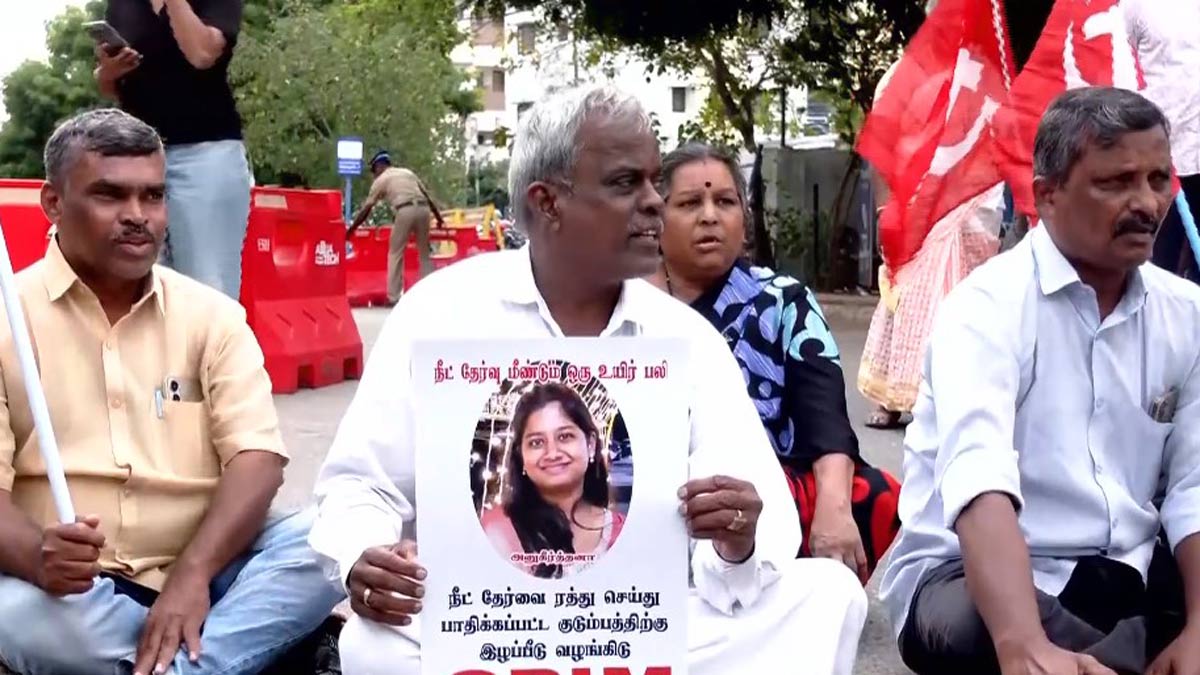
Just four days before the NEET-UG re-examination, a 19-year-old female aspirant from Coimbatore, Tamil Nadu, died by suicide on Wednesday, triggering protests in the region.
Police said Anu Keerthana, daughter of Senthil Prabhu, President of the Coimbatore District TASMAC Employees’ Union, was distressed over having to reappear for the examination following the recent NEET question paper leak. She had already attempted the exam twice earlier.
No suicide note has been recovered, and police have launched a detailed investigation into the incident.
Keerthana’s body was first taken to a private hospital and later shifted to Coimbatore ESI Hospital, where a post-mortem examination was conducted.
The incident has sparked fresh protests against NEET in Tamil Nadu, where there has been a long-standing demand to scrap the national medical entrance examination.
According to an ANI report, more than 100 CPI(M) cadres staged a protest within the hospital premises, demanding adequate compensation and relief for the bereaved family. Protesters said they would continue their agitation and refused to take possession of the body until their demands were met.
They alleged that in previous cases of student deaths linked to NEET, the government had promptly announced compensation, but no such announcement had been made in this case. They also claimed that no ministers had visited the family to offer condolences.
The protesters further raised concerns over alleged irregularities in NEET and demanded the resignation of Union Education Minister Dharmendra Pradhan, holding him responsible for the distress among students.
Tamil Nadu has consistently opposed NEET since its introduction, arguing that it adversely affects students from rural and socio-economically disadvantaged backgrounds, while benefitting students from affluent backgrounds who can afford private coaching.
Chief Minister M.K. Stalin recently said the government had sought permission to fill state quota seats in MBBS, BDS, and AYUSH courses based solely on Class XII marks, replacing NEET scores, as part of its push for more equitable access to medical education.
