



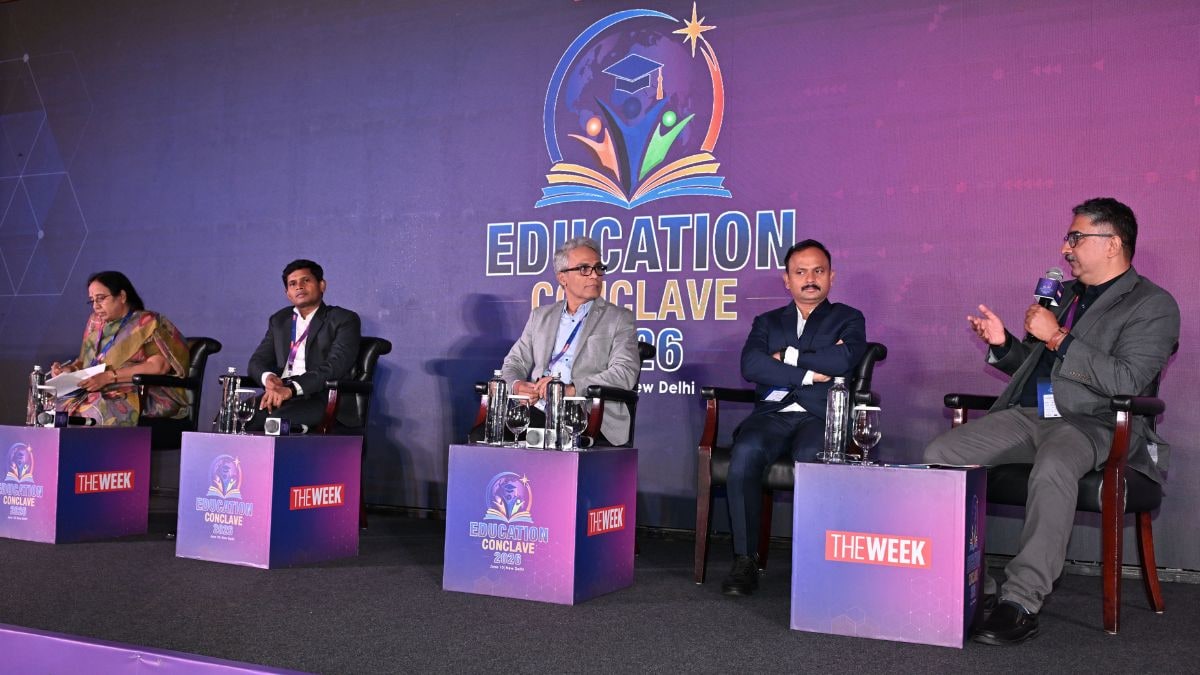
Andhra Pradesh is building an education system centred on measurable learning outcomes, technology-enabled teaching and large-scale skill development, senior government officials said at THE WEEK Education Conclave 2026.
Speaking during a session on the ‘Andhra Model of Education’, B. Srinivasa Rao, state project director, Samagra Shiksha, said the state's reforms are driven by a simple principle: improving learning outcomes rather than merely expanding infrastructure or inputs.
“Earlier, education systems focused on whether textbooks were supplied, teachers trained or technology installed. We are asking whether a child can read, solve problems and apply knowledge in real life,” he said.
The state has made foundational literacy and numeracy (FLN) a top priority, aiming to ensure proficiency among students from Classes 1 to 5. Andhra Pradesh has also introduced AI-based personalised and adaptive learning (PAL) in a significant number of secondary schools, along with technology-driven assessments and a comprehensive digital platform called LEAP that integrates student assessments, attendance, homework and parent engagement.
G. Ganesh Kumar, commissioner, skill employment and training, highlighted the state's focus on linking education with employability. He said Andhra Pradesh has created a unified skilling portal that connects students, training providers and employers while offering career guidance and resume-building support.
One of the state's most ambitious initiatives is a statewide skill census, which maps the skills available across Andhra Pradesh's workforce. The data is expected to support investment decisions, workforce planning, upskilling and reskilling programmes.
Education leaders on the panel welcomed the reforms. Prof C.V. Tommy, Dean at SRM University-AP, said the model addresses a long-standing skill gap between education and industry requirements. He noted that introducing skill development at the school level would help students better understand their strengths and career options.
Prof Uma Vennam, vice chancellor of Sri Padmavati Mahila Visvavidyalayam, praised the government's emphasis on convergence between school and higher education. She said universities are increasingly aligning curricula with industry needs while focusing on developing academically strong, digitally competent, emotionally resilient and professionally skilled graduates.
The panellists agreed that Andhra Pradesh's education reforms could emerge as a model for other states seeking to combine quality learning with future-ready skills.
