



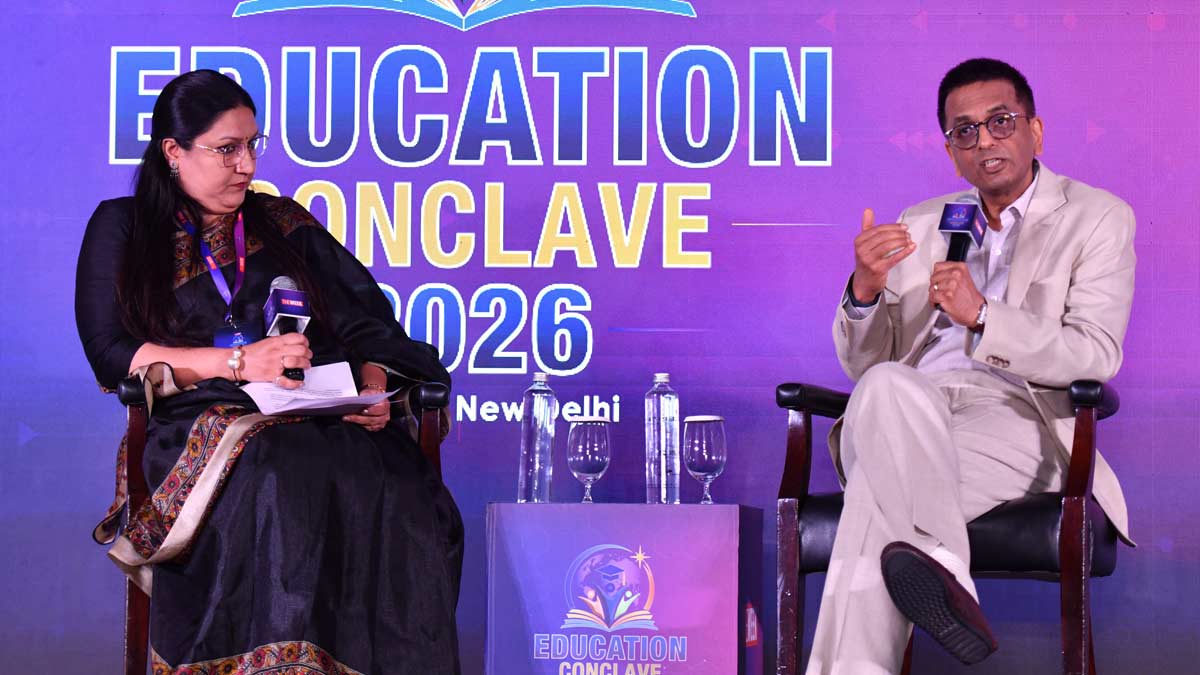
Former chief justice of India Justice D.Y. Chandrachud on Wednesday said that dissent remains the "safety valve of democracy" but cautioned that it should not turn destructive or undermine democratic institutions. Speaking at THE WEEK Education Conclave 2026 in New Delhi, Chandrachud described Gen Z as more fearless and willing to question authority than previous generations, and stressed that democratic societies thrive through dialogue rather than confrontation.
"Dissent is crucial in a democracy. Dissent allows for reasonable dialogue. It is the absence of dialogue that often leads to violence," Chandrachud said in a conversation with Senior Special Correspondent Kanu Sarda. He added that while citizens must question institutions and lawmakers, they should not seek to destroy them.
Reflecting on contemporary challenges ranging from geopolitical uncertainty and artificial intelligence to social media-driven polarisation, the former CJI urged young people not to fear failure and uncertainty. He argued that true confidence comes not from certainty but from character, empathy and the ability to understand others.
Chandrachud also warned against algorithm-driven echo chambers that reinforce existing beliefs and reduce exposure to opposing viewpoints. In a country as diverse as India, he said, citizens must balance their rights with their duties and remain open to different voices and perspectives.
Highlighting the judiciary's modernisation efforts, Justice Chandrachud pointed to the digitisation of courts and the translation of judgments into 22 Indian languages, saying that "third generation reforms" are needed to make institutions more accessible.
Calling himself an optimist, he said India's democratic strength lies in the collective power of individuals whose voices, when brought together, can drive social and political change. "We are a stable country because we have used our voice," he said.
Further, addressing students and young professionals, Justice Chandrachud challenged the conventional belief that academic success alone determines one's future. Reflecting on more than four decades in the legal profession, he said many of the people who eventually excelled in life were not necessarily the top performers in school.
Justice Chandrachud observed that Indian society places immense pressure on children to pursue stability and conventional markers of success. However, he argued that leadership is ultimately shaped by character, social commitment and the ability to connect with others.
"Those who have assumed leadership roles and succeeded have the ability to reach out to people," he said, adding that genuine success requires empathy and a willingness to support others during difficult times.
The former CJI also offered a broader definition of confidence. True confidence, he said, does not stem from being serious about yourself but from taking one's work seriously, possessing strong character and developing an understanding of others. He cautioned against making sweeping judgments about people, arguing that individuals should first seek to understand the circumstances and experiences that shape human behaviour.
Emphasising compassion and social responsibility, Justice Chandrachud urged young people to focus not only on personal achievement but also on making a positive difference in society and treating others with kindness and dignity.
