



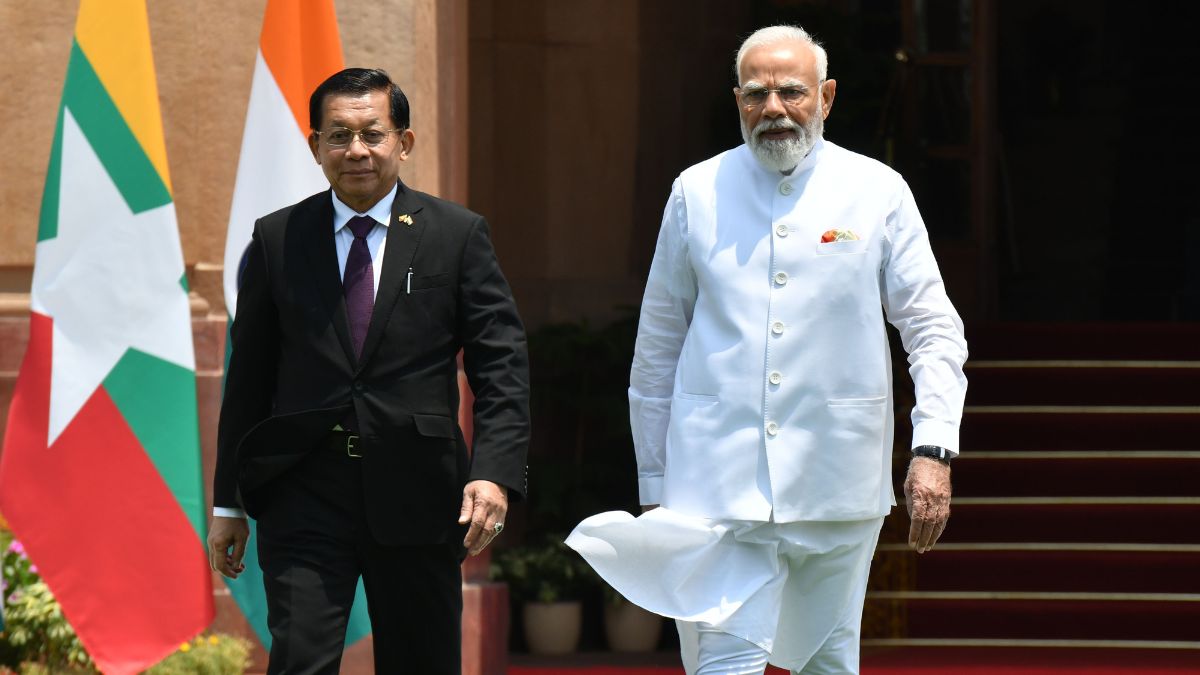
Visiting Myanmar President Min Aung Hlaing made full use of his official five-day-long India tour to visit the holiest of Buddhist shrines when he visited Bodh Gaya in Bihar. On Saturday morning, his aircraft landed straight at the Gaya International Airport from Hanoi.
In about one-and-a-half hours, the President was paying his obeisance at the spot where the Buddha attained enlightenment in around 528 BC.
On May 7, during his first-ever official visit to India, Vietnamese President To Lam also offered his prayers at the Mahabodhi Temple.
And New Delhi isn’t complaining.
Wracked by a civil war, Myanmar is central to India’s Act East policy (AEP). As opposed to the past policy of looking westwards especially Europe and US, India is doing all it can to further its AEP, which seeks to build closer economic, political, military and strategic ties with countries in Southeast Asia that are grouped under the Association of Southeast Asian Nations (ASEAN).
Six of the ASEAN’s 10 countries – Vietnam, Cambodia, Laos, Thailand, Myanmar and Singapore – are overwhelmingly Buddhist while Brunei, Malaysia, and Indonesia follow Islam while Christians are a majority in the Philippines.
In March 2018, after Vietnamese President Tran Dai Quang’s visit to the Buddhist holy spot, a big delegation led by Vietnam’s deputy defence minister Senior Lieutenant General Phan Van Giang visited Bodh Gaya. In December, a 19-member delegation led by General Ngo Minh also visited the place where Buddha attained nirvana.
In June 2018, about 160 Sri Lankan military personnel and their families from the army, air force and the navy were flown down in an Indian Air Force (IAF) C-17 transport aircraft to visit the Buddhist pilgrimage centre at Bodh Gaya. They were later flown back to Colombo in the same aircraft. Sri Lanka is also a Buddhist majority country.
But it is through Myanmar that two key projects—the Kaladan multi modal project and the India-Myanmar-Thailand (IMT) Trilateral Highway—are envisaged to be built.
Additionally, Myanmar is home to some of the richest reserves of rare earths—especially the ‘heavy’ ones like dysprosium and terbium that are crucial for making high-performance permanent magnets for electric vehicle (EV) motors, wind turbines, and defence technology. These are minerals that India needs in abundance for its fledging programme to build its own fighter jets.
Strategically, close collaboration with Myanmar helps maintain strategic space in a country where China is making deep inroads. Currently, most of these rare earth deposits are exported to China for processing.
