



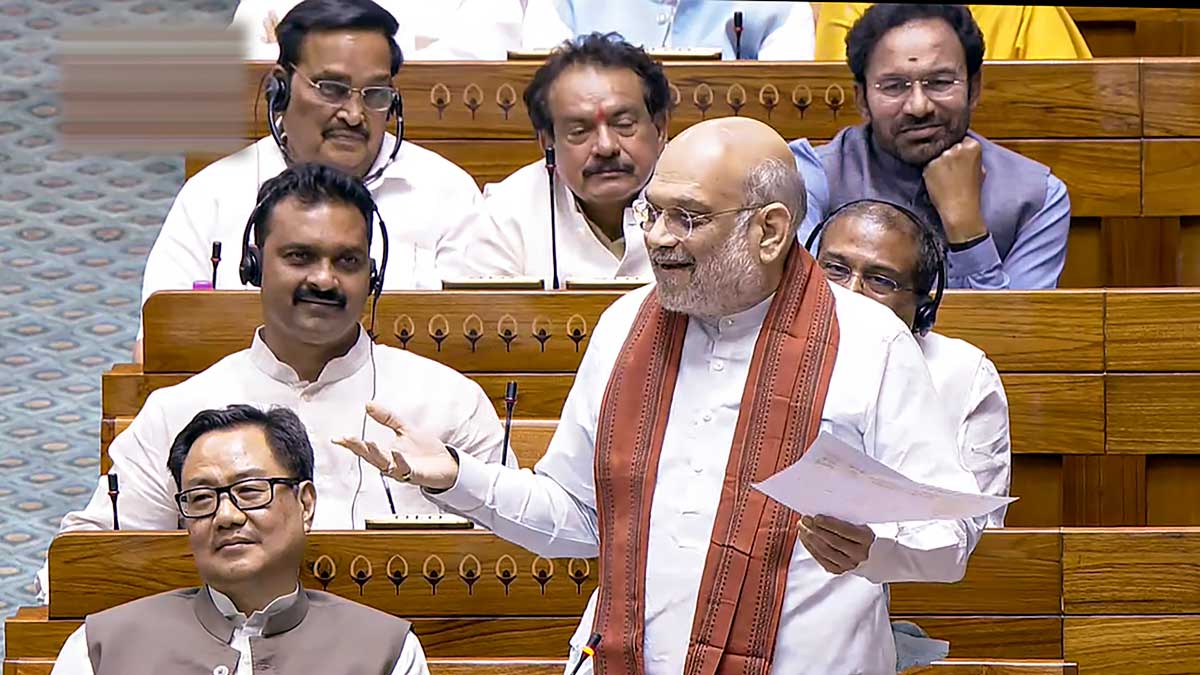
As the Lok Sabha debated the proposed delimitation and women’s reservation framework, the House witnessed agreement on empowering women in legislatures but sharp disagreement on execution, with the government and Opposition clashing over whether the two processes should be linked. The Opposition questioned government’s intent and timing in bringing the delimitation bill which they argued was against the states.
The strongest pitch in favour of the bills came from Prime Minister Narendra Modi. He framed women’s reservation as a historic and necessary correction in India’s democratic structure. He told the House that the country could no longer delay giving women a substantive role in policymaking, stressing that “nearly half the population remains underrepresented in legislative bodies”.
At the same time, Modi acknowledged that the proposal had remained pending for nearly three decades, calling the delay a “collective failure” of successive governments. He argued that while there had been broad agreement across parties, the issue had repeatedly been stalled by procedural conditions and political hesitation.
Seeking to address concerns around delimitation, the PM assured the House that the process would not alter the federal balance. He said any increase in seats would follow the existing proportional framework and insisted that “this decision-making process will not do injustice to any region”. He also warned that opposing women’s reservation could carry electoral consequences, noting that parties resisting it in the past had faced backlash from women voters.
The government’s proposal involves implementing 33 per cent reservation for women in the Lok Sabha and state assemblies from 2029, alongside a significant expansion of the Lok Sabha from 543 to around 850 seats after delimitation based on 2011 Census data. Ministers argued that increasing the number of seats would ensure that no state loses its relative share in Parliament.
However, this linkage between reservation and delimitation emerged as the central fault line in the debate.
Congress MP Priyanka Gandhi Vadra directly challenged the government’s approach, questioning why reservation could not be implemented immediately within the existing strength of the Lok Sabha. She criticised the PM for presenting what she described as a partial account of the legislation, saying he “spoke as though the BJP had consistently backed the bill” while not acknowledging earlier opposition.
She argued that if, as the prime minister claimed, there was no fear among MPs of losing their seats, then there should be no hesitation in implementing the quota without waiting for delimitation. “If there is no fear of losing political space, why delay it,” she asked, adding that the linkage raised doubts about the government’s intent despite its stated support.
Priyanka Gandhi also invoked the Congress party’s role in expanding women’s representation, noting that 33 per cent reservation in panchayats was first introduced under former prime minister Rajiv Gandhi and later implemented under P. V. Narasimha Rao. She pointed to its impact, stating that “out of nearly 40 lakh elected representatives in panchayats, about 15 lakh are women”.
Her party colleague, Gaurav Gogoi, reinforced the demand for immediate implementation, saying, “Congress supports the women’s reservation. But please make it straightforward,” and warning that the current proposal appeared to introduce delimitation “through the backdoor”.
K. C. Venugopal of the Congress was more blunt, arguing that if the government were sincere, it could have implemented the law earlier. “This House unanimously passed the Women’s Reservation Bill in 2023. If the government were sincere, it could have implemented it in 2024,” he said, adding that the issue was being used for “political theatrics”. He also questioned why no all-party meeting had been convened on a constitutional amendment of such significance.
From the Samajwadi Party, Akhilesh Yadav supported the principle of reservation but criticised the government’s intent, remarking that “the BJP is trying to turn ‘nari’ into a ‘nara’”. He also questioned the timing of the move, linking it to delays in conducting a caste census and calling the exercise a “massive conspiracy”.
The treasury benches pushed back strongly against these allegations. BJP MP Tejasvi Surya dismissed the criticism as unfounded, saying, “The opposition is raising vacuous and baseless objections to the delimitation exercise,” and insisting that “delimitation is not a backdoor exercise; we are following what the Constitution mandates”.
Home Minister Amit Shah sought to address concerns from southern states, where fears of reduced political influence have been most pronounced. He said the number of seats in southern states would increase from 129 to 195 after delimitation, with their share rising marginally from 23.75 per cent to 23.97 per cent. “Their share in the overall Lok Sabha is increasing,” he said, adding that the process would not disadvantage any region. He also indicated that a caste census would be conducted in line with the government’s decision.
On the first day of the three-day special session, the debate revealed a broad political consensus on the need for women’s reservation, but deep mistrust over the mechanism proposed to implement it. The Opposition’s position rests on immediate implementation within the current framework, while the government argues that linking it to delimitation ensures fairness and avoids redistributive loss.
