



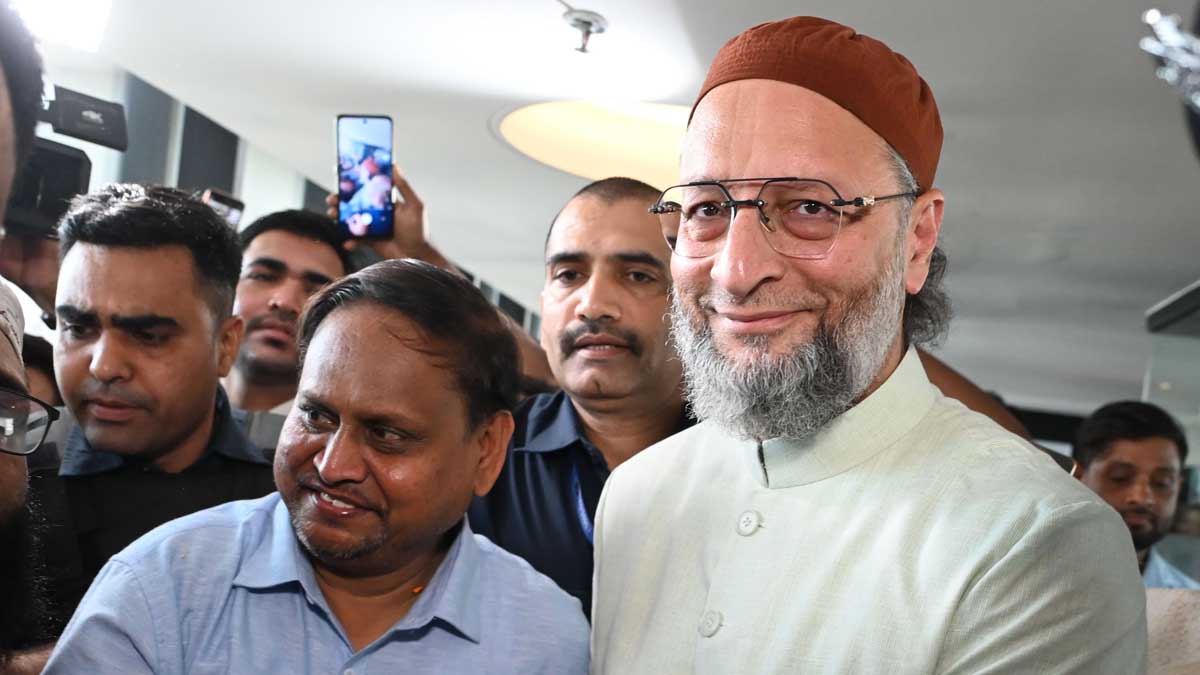
Humayun Kabir’s efforts to form an alliance between his Aam Janata Unnayan Party (AJUP) and Asaduddin Owaisi’s All India Majlis-e-Ittehadul Muslimeen (AIMIM) have finally succeeded. The strength of this consolidation was evident on Wednesday in Murshidabad district, where the two leaders addressed a massive crowd.
“After a lot of debate, criticism, and suffering, I have reached a point where I have Asaduddin Owaisi with me. I am thankful to him,” said Humayun Kabir. “Today, the chief minister calls herself the Maa Maati Maanush, but she has no connection with the people.”
The message was clear: A fragmented minority vote bank that will oppose the Trinamool Congress (TMC), particularly in the Muslim-majority regions of Murshidabad, Malda, and Uttar Dinajpur districts. With over 60 per cent of the population in these areas being from the minority community and 43 seats that the alliance is hoping to cash in on, Kabir is confident that a chunk of voters will resonate with his vision on the Babri Masjid construction and his anti-TMC stance.
Owaisi was brazen in his criticism of the ruling party in the state, claiming that the minority community has been reduced to mere voting machines. “We have been voting for others for 50 years. This time, vote for Humayun Kabir and help your brothers and children succeed,” said Owaisi. “We hope this time, Muslims of West Bengal will emerge stronger. I have come among you so that you can be the leader, so that you can make your own decision about your fate.”
The AIMIM leader also accused the TMC government of neglecting the progress of the minority community. “There is no difference between you and Modi. You both don’t want the poor and helpless to have a free leader. Mamata and Modi are like brother and sister. You cannot depend on them. If you want to depend on anyone, depend on Owaisi and my brother Humayun Kabir. Both Mamata and Modi don’t want a Muslim minority political leadership to emerge in Bengal,” Owaisi asserted.
Political analysts believe that, in larger minority areas, the minority vote tends to be fragmented, which could potentially benefit the new alliance. However, there is skepticism about whether the new alliance will be able to secure enough seats, even if it garners some of these fragmented minority votes. Two key reasons for this are that many voters may still prefer the established TMC, and are also waiting to see if Kabir can prove his leadership capabilities on the ground. Kabir has been with the Congress, BJP and TMC in the past.
“Floating voters will be behind TMC. Humayun Kabir’s party is very new and does not have the strength to pull a majority chunk of votes while contesting 11 seats. They also don’t have organisational strength. They will need to work on the ground for 10-15 years,” said Professor Maidul Islam, a political science professor at the Centre for Studies in Social Sciences.
The only exception to a new minority party winning a seat was the Indian Secular Front (ISF)’s Naushad Siddiqui in the Bhangar seat during the 2021 Assembly elections. Their unexpected victory marked a shift in the political landscape of Bengal. ISF chose not to ally with AJUP this time. The AJUP-AIMIM alliance now hopes to cut into TMC’s vote base and consolidating its presence in the Murshidabad, Malda, and Uttar Dinajpur belt. They aim to become a significant force in West Bengal politics, where the minority vote is a decisive factor, making up nearly 30 per cent of the electorate.
