



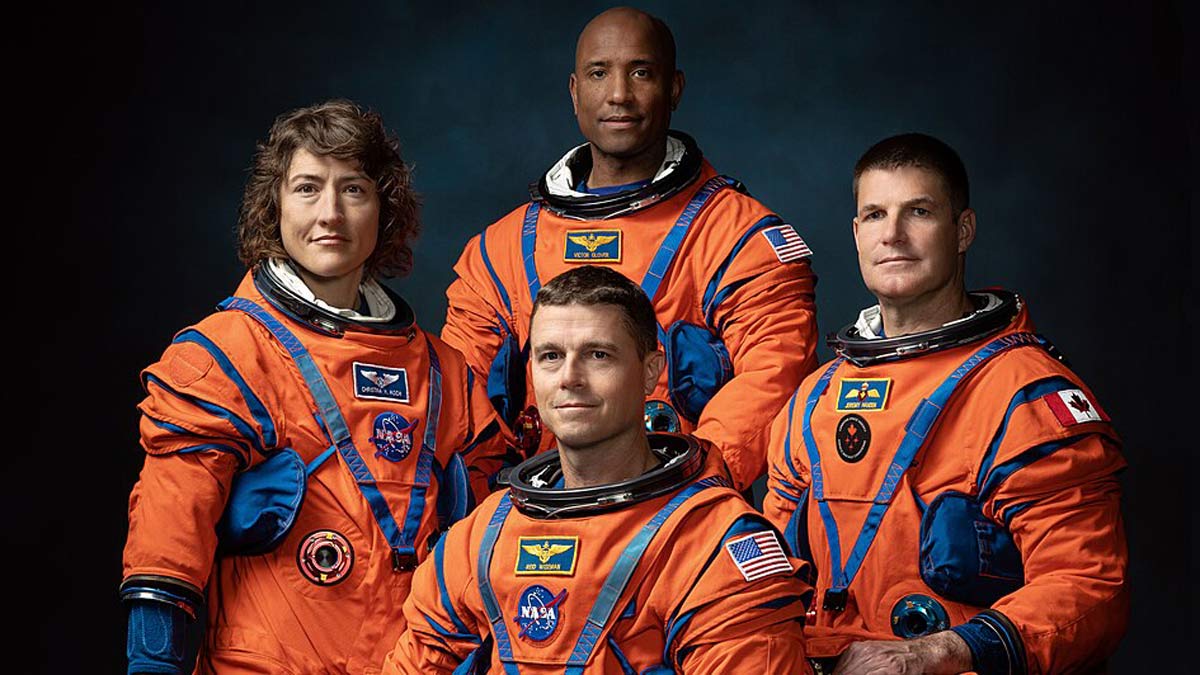
Imagine standing at the edge of something so vast and breathtaking that your heart races just thinking about it. What if you are one of the only four people chosen out of eight billion humans to actually do it? That is what’s about to happen. NASA is sending four astronauts around the Moon — for the first time since 1972. The mission is called Artemis II. And the world is watching.
Why is this such a big deal?
The last time humans travelled this far from Earth was during Apollo 17 in December 1972 — more than 50 years ago. Since then, astronauts have gone no farther than the International Space Station, just a few hundred kilometres above Earth. That’s like stepping to the next street. The Moon is 384,000 kilometres away.
Artemis II marks humanity’s return to deep space—a journey of technology, emotion, and courage. NASA has spent over 20 years and more than $40 billion building the spacecraft and rocket for this goal. Now, after decades of planning, it is finally time.
The launch — what and when?
NASA is targeting April 1, 2026 , at 6.24 pm.EDT for launch, pending final readiness reviews. The spacecraft will lift off from the Kennedy Space Centre in Florida — the same historic pad from which the Apollo missions once began.
The rocket, the Space Launch System (SLS), is the tallest and most powerful NASA has ever built —98 metres tall, about a 30‑storey building. When filled with liquid hydrogen and oxygen, it weighs over 2.6 million kilograms, heavier than 1,700 cars combined.
In March 2025, the SLS was rolled out 6.4 kilometres to its launch pad atop the giant Crawler‑Transporter 2, taking nearly 12 hours, a reminder of just how massive this machine is.
What happens during the mission
Once SLS lifts off, it will push the Orion spacecraft carrying the crew into space. When the upper stage separates, one final engine burn sends Orion past Earth’s orbit toward the Moon. This trans-lunar injection is the great push from Earth to deep space.
The ten‑day journey unfolds like this:
- Days 1–2: orbit Earth while checking every system.
- Days 3–4: ignite engines and head for the Moon, travelling nearly half a million kilometres through silent, dark space.
- Day 5: reach lunar distance, swing behind the Moon, and loop around its far side — the hidden hemisphere no one on Earth ever sees directly.
"The Artemis II crew will once again witness that far side firsthand, the first humans to do so in more than 50 years. Orion will then turn back, spending another four days returning home. In all, the capsule will travel roughly 9,65,000 kilometres before splashdown," explained space analyst Girish Linganna.
Re‑entry will be the most dramatic phase. "The capsule will hit Earth’s atmosphere at nearly 40,000 km/h (11 km/s) — faster than a bullet, heating its outer shell to about 2,760 °C, hotter than molten lava. A specially built Avcoat heat shield will endure this fiery descent before parachutes unfold and splashdown occurs in the Pacific Ocean off San Diego," added Linganna.
Meet the four astronauts
- Reid Wiseman, Mission Commander, ex‑US Navy pilot, visited the ISS in 2014. A widower raising two daughters, he says their curiosity fuels his courage for this journey.
- Victor Glover, Pilot, also a Navy aviator and veteran astronaut, will become the first African‑American to travel beyond low Earth orbit.
- Christina Koch, Mission Specialist 1, electrical engineer and Antarctic researcher, will be the first woman to fly beyond low Earth orbit.
- Jeremy Hansen, Mission Specialist 2 from the Canadian Space Agency, will be the first non‑American ever to travel this far from Earth. It will also be his first flight into space.
Each carries not only professional skill but symbolic weight — representing courage, diversity, and international cooperation.
Living in deep space
Inside Orion, the living area is barely the size of two minivans (≈ 9 m³). Four people will live, eat, and sleep there for about ten days.
Daily routine: roughly 30 minutes of exercise using compact space equipment, eight hours of sleep in hammocks that float gently, and three precisely timed meals. Dishes include beef brisket and veggie quiche, warmed in a small onboard heater. Each astronaut receives two flavoured drinks a day, like coffee or fruit mix, and the crew shares one communal meal daily — a small ritual that keeps spirits human.
"The capsule’s compact Universal Waste Management System uses airflow rather than gravity to collect waste. At times, especially when Orion passes behind the Moon, radio contact with Earth will be completely lost, leaving the crew entirely on their own — relying only on training and trust," said Linganna.
Testing, troubles, and fixes
NASA’s path to launch has not been smooth, nor should it be. Full‑scale “wet” tests revealed a hydrogen leak in January 2025 and a helium flow issue in February. Engineers rolled the rocket back to the Vehicle Assembly Building (VAB) for inspections, fixed the problems, and rolled it out again in March. Every setback was used to make the mission safer.
What comes after
If Artemis II succeeds, NASA will move to Artemis III, which will involve practising docking Orion with the human‑landing craft being developed by SpaceX and Blue Origin. The goal: to land humans on the Moon’s surface around 2028, though most experts say that timeline may slip closer to 2030. The long‑term dream is a permanent lunar base serving as a launch node for missions to Mars.
Why it matters
This mission isn’t just about science; it’s about the human will to keep going.
It’s about a father who looks into his daughters’ eyes and still dares to leave Earth. About a woman venturing farther than any before her.About a Canadian stepping into history’s uncharted edge.
Four people in a capsule smaller than a living room, travelling through darkness at 40,000 km/h, carrying all our hopes with them.
