



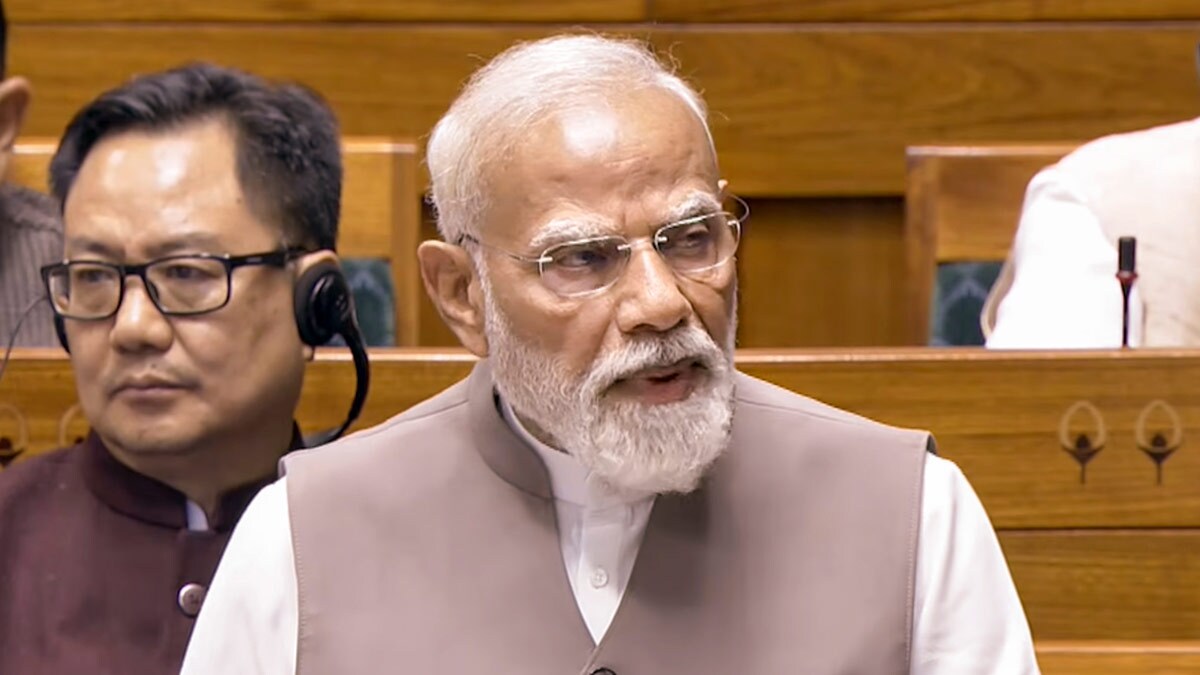
Pointing out that the difficult global conditions caused by the Iran war and the obstruction of the Strait of Hormuz are likely to persist for a long time, Prime Minister Narendra Modi, on Monday, urged people to remain prepared and united, just as they had stood together during the COVID-19 pandemic.
In a statement in the Lok Sabha, PM Modi addressed concerns related to the impact of the West Asia conflict on fuel, fertilisers, national security and other areas in India as well as on its nationals residing in the West Asia region and listed the steps initiated by the government to ensure that "ordinary families face as little trouble as possible."
Modi drew the attention of the House to the internal security dimension of the crisis, warning that certain elements attempt to exploit such situations. He said all security agencies have been placed on alert and that security across all domains, coastal, border, cyber, and strategic installations, is being further strengthened. "Whether it is coastal security, border security, cyber security, or strategic installations, the security of all is being reinforced."
Urging patience, restraint, and vigilance, and cautioning against those who may seek to exploit the situation by spreading falsehoods, engaging in black-marketing, or hoarding, the prime minister appealed to all state governments to ensure strict monitoring and swift action against such elements.
Modi said the crisis has been going on now for more than three weeks, and it is having a very adverse impact on the global economy and on people's lives.
The West Asia region holds critical importance for India for another key reason: nearly one crore Indians live and work in Gulf countries, while a large number of Indian crew members are employed on commercial ships operating in these waters, he said.
“India’s concerns are naturally heightened, and it is therefore vital that a united and unanimous voice emerges from Parliament on this crisis,” he added.
Modi highlighted how the energy diversification strategy pursued over the past decade has proved effective in the current situation. He informed the House that India has expanded its energy import base from 27 to 41 countries over the past 11 years, reducing dependence on any single region.
Emphasising the foresight of this approach, Modi said in the present circumstances, the steps taken over the past decade to strengthen energy security have become even more significant.
He noted that India currently holds over 5.3 million metric tonnes of strategic petroleum reserves and is working to create additional storage capacity exceeding 6.5 million metric tonnes.
In addition, domestic oil companies maintain their own reserves, he said.
“Over the last 11 years, our refining capacity has increased substantially, and the government remains in constant touch with suppliers across multiple countries to ensure uninterrupted oil and gas supplies,” Modi said.
Highlighting evacuation efforts, the prime minister said more than 3.75 lakh Indians have been brought back safely since the conflict began, including around 1,000 from Iran, over 700 of whom are medical students.
Addressing the broader economic impact, Modi noted that energy remains the backbone of the modern economy, and with West Asia being a major global energy hub, the ongoing crisis poses challenges for economies worldwide.
He said the government is responding through a comprehensive short-, medium-, and long-term strategy, backed by strong economic fundamentals, consultations with key stakeholders, and a dedicated Inter-Ministerial Group that meets daily to monitor and resolve issues in India’s import-export chain.
“I am confident that through coordinated efforts between the government and industry, we will navigate these challenges effectively,” he said.
The PM also acknowledged the loss of lives and injuries during the conflict, stating that affected families are receiving necessary support and the injured are being treated.
On concerns related to agriculture, Modi said India remains well-prepared on food security, with sufficient food grain reserves built by farmers.
“We are ensuring that Kharif sowing proceeds smoothly. Adequate fertiliser supplies have been arranged to tackle any emergency. Even in past global crises, our government has ensured that farmers remain unaffected,” he said.
He added that with rising electricity demand during the summer, all power plants currently have sufficient coal stocks.
“India has produced over one billion tonnes of coal for the second consecutive year, while also making significant strides in renewable energy over the past decade,” Modi said.
—With PTI inputs
