



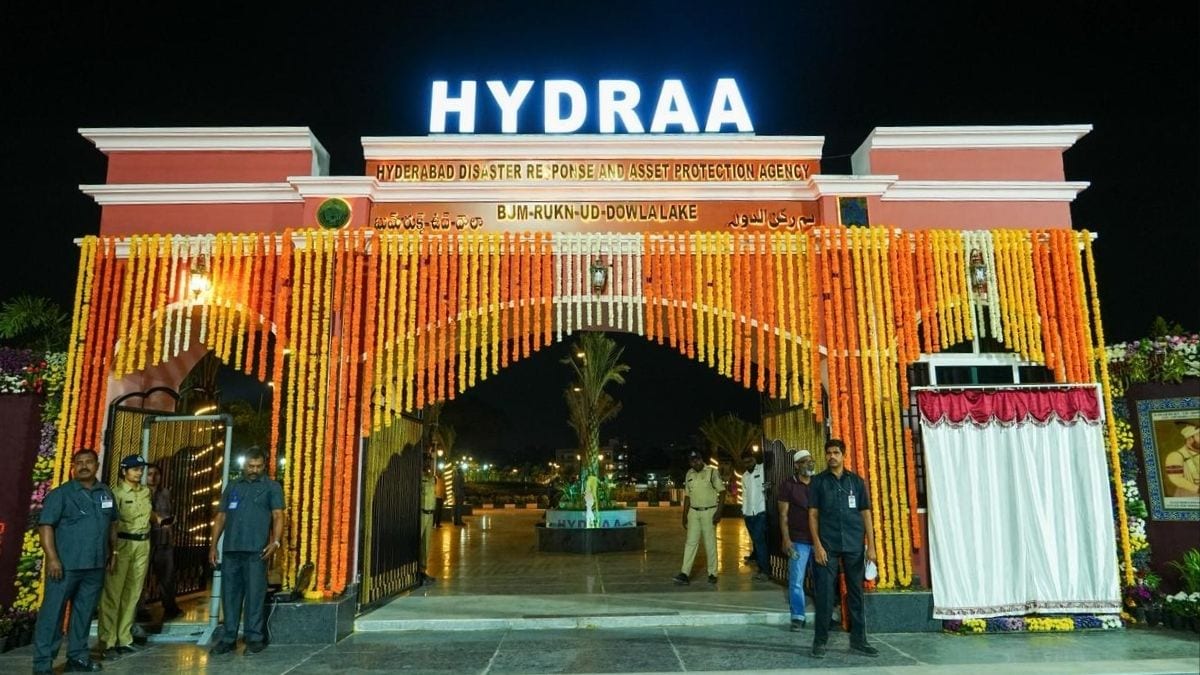
Telangana took another step toward reclaiming Hyderabad’s water bodies with Chief Minister A. Revanth Reddy inaugurating the restored Bum-Rukn-ud-Dowla Lake at Shivarampally, a project executed by the Hyderabad Disaster Response and Asset Protection Agency (HYDRAA). The Chief Minister opened the lake complex to the public along with AIMIM chief Asaduddin Owaisi on Saturday evening.
HYDRAA was created by the Revanth Reddy government, and the agency’s commissioner, A.V. Ranganath, reports directly to the Chief Minister. In a short span, the agency has made rapid progress in reviving Hyderabad’s fading lake ecosystem and reclaiming public land from encroachments.
Officials say HYDRAA has already restored around 12 lakes and reclaimed approximately 200 acres of land from illegal occupation, in addition to addressing thousands of public complaints related to encroachments.
The revival of Bum-Rukn-ud-Dowla Lake also reflects a broader shift in the city’s urban policy—treating lakes not merely as water storage systems but as ecological and public spaces that contribute to environmental protection, flood control and recreation. While inaugurating the lake campus, which has been designed like a children’s park with a Persian-style welcoming arch, the Chief Minister said restored lakes should evolve into vibrant public spaces and eventually grow into “lake economies” that could generate income opportunities for women's self-help groups.
He proposed allocating shops at “Night Economy Hubs” near such lakes exclusively to SHG members. According to the proposal, the women could run the shops until 1 am, turning the restored lakes into safe recreational zones and local economic centres.
Bum-Rukn-ud-Dowla Lake itself has a long history. The word “Bum” means lake or reservoir in Persian, and the water body is named after its developer, a high-ranking official in the Asaf Jahi court of Hyderabad. The lake was originally constructed around 1770 to serve the irrigation and drinking water needs of surrounding villages. Over time, however, rapid urban expansion and encroachments reduced the lake’s water surface area and polluted its bed, transforming what was once a thriving water body into a neglected urban dump.
According to an official familiar with the project, HYDRAA and the Congress government faced strong opposition from AIMIM leaders during the eviction drives, as many encroachments were allegedly linked to local political leaders. Despite the resistance, the agency proceeded with restoration works and expanded the lake significantly. What was earlier a 4.12-acre cell pool has now been transformed into a 17-acre lake with landscaped surroundings.
The restoration involved clearing illegal structures from the lake’s Full Tank Level (FTL) and buffer zones, strengthening the bund and rejuvenating the lakebed. HYDRAA also introduced several public amenities, including walking tracks, recreational spaces and green areas so that residents could reclaim the water body as a community asset rather than an abandoned wetland.
The project is part of a wider programme launched by the Telangana government to revive lakes across the Greater Hyderabad region. Hyderabad once had a vast interconnected network of tanks and lakes that functioned as natural flood-control systems. However, studies indicate that the city has lost nearly 61 per cent of its original lake area over the past four decades due to rapid urbanisation and encroachments.
In the first phase of the lake revival programme, restoration works were taken up at several lakes, including Bathukamma Kunta, Nalla Cheruvu and Bum-Rukn-ud-Dowla Lake. Officials say the next phase will focus on restoring at least 14 more lakes across the city, with the long-term goal of reviving hundreds of water bodies within the Outer Ring Road limits.
HYDRAA’s approach combines strict enforcement with ecological restoration. Encroachments within lake boundaries are demolished, sewage inflows are diverted, and lake beds are desilted to restore water storage capacity. Surrounding areas are then developed with biodiversity zones, landscaping and public facilities to ensure that the lakes remain active public spaces.
Urban planners say this strategy offers several long-term benefits. Revived lakes help recharge groundwater, reduce urban flooding during heavy rains and moderate temperatures in densely built neighbourhoods. They also create green public spaces in a city where open land is rapidly shrinking.
The restoration of Bum-Rukn-ud-Dowla Lake is therefore seen not merely as a beautification effort but as a model for urban ecological governance. By combining enforcement against encroachments with community-oriented lake development, Hyderabad is attempting to rebuild the historic water network that once defined the city.
