



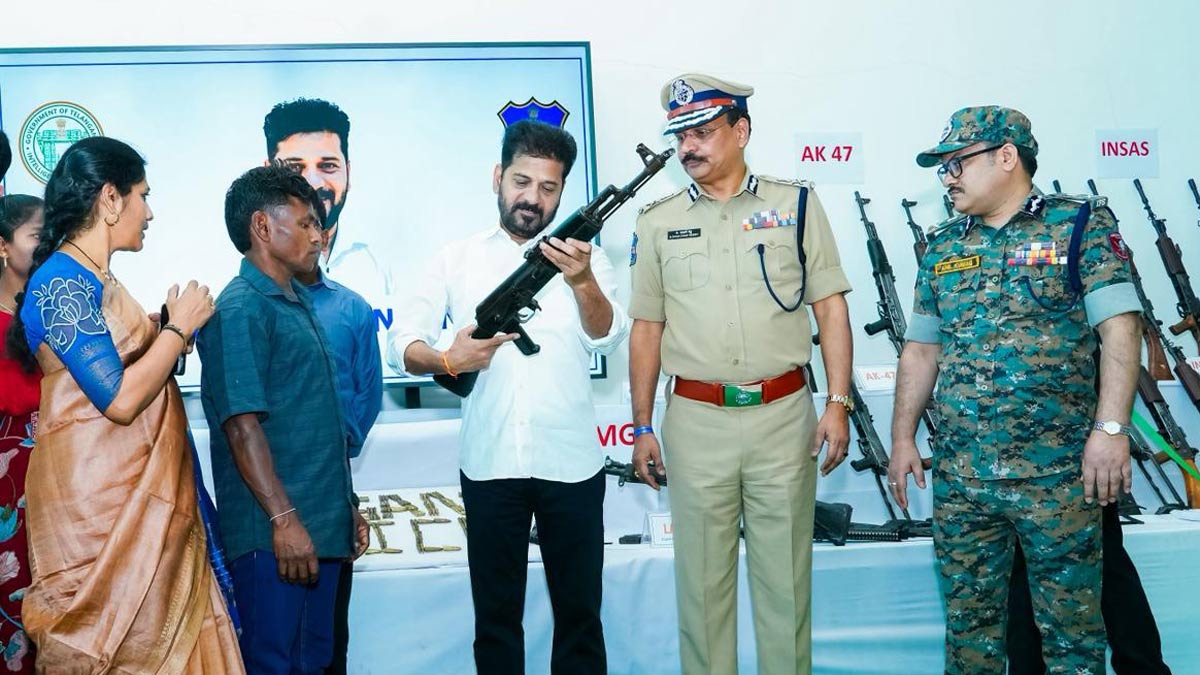
"We don’t want anybody to kill anyone in the name of any ideology, because every life is valuable, and every person is important to their family members. Above all, Gandhi ji has shown we can achieve anything with peace," said Telangana Chief Minister A. Revanth Reddy. He was addressing a press conference at the Telangana Integrated Command and Control Centre in Hyderabad on Saturday during a programme marking the surrender of 130 Maoists.
The leaders and cadres of the left-wing extremist groups surrendered with 124 sophisticated weapons. “We are ready to give them the cash reward, a house and all other benefits and ensure that the mainstreamed Maoists could lead a dignified life,” the chief minister reiterated. The government will soon take a decision on a financial rehabilitation package for all surrendered Maoists, he said.
The CM also proposed to appoint a committee to consider the cases against the Maoists and withdraw the possible cases. “The judiciary won’t allow us to withdraw all the cases. We will sincerely consider the possibilities and try to give legal reprieve,” he explained. He said the government is ready to revoke cases against the extremists within the purview of the law and, if required, constitute a committee to review the cases.
He also invited the CPI (Maoist) former secretary and powerful leader Ganapathy to join the mainstream. Appealing to all top Maoist leaders, including central committee members, to surrender, Reddy said they should join mainstream life and take part in the reconstruction of Telangana.
He said, “Our officials told me that your health is not in great condition. We will take care of you. Please come and join us.” The government, he added, was ready to provide healthcare, financial assistance and housing to those who surrender.
The Revanth Reddy government has reaped the benefits of a pacifist surrender policy, which preferred life and persuasion over killings and encounters. Most significantly, out of the 130 Maoists, 125 are from Chhattisgarh, and most of them are young women.
Scribes pointedly asked the CM, DGP and other officials if the surrendering Maoists were preferring Telangana over Chhattisgarh due to the fear of encounters. Though the CM and the police officials refused to draw any comparison between the states, the intelligence officials indicated that Chhattisgarh has become the least preferred choice due to fear of possible police retribution.
Referring to proposals submitted by surrendered Maoist leaders such as Devji and Damodar, the chief minister said he had brought the matter to the attention of Union Home Minister Amit Shah. He expressed hope that the former Maoists would raise people’s issues through democratic means in the future.
The 130 surrendered members included leaders and cadres from the People’s Liberation Guerrilla Army (PLGA), the Dandakaranya Special Zonal Committee and personal staff of central committee members. Addressing the conference, Telangana Director General of Police B. Sivadhar Reddy said the Maoists have lost the PLGA, the most important of its three “Magic Weapons”. He appreciated the work of the intelligence wing and the Special Intelligence Bureau for playing a key role in the surrender.
Vijaya Kumar, state intelligence chief, described the chief minister’s call to ensure peaceful surrenders in his speech on Police Martyrs’ Day on November 26 as the cornerstone of the police approach. The chief minister also stressed that dialogue was the only lasting solution to the Maoist problem. “The ballot is more powerful than the bullet to solve problems. India strongly believes that challenges must be addressed through peaceful and democratic means,” he said, adding that violence cannot be a solution to every issue.
A scribe who specialised in Maoist party reporting told THE WEEK that, “Devuji and other senior leaders surrendered in Telangana due to the safety of life offered to them by Telangana police. He could have been killed in Chhattisgarh.” THE WEEK could not verify this claim independently.
