



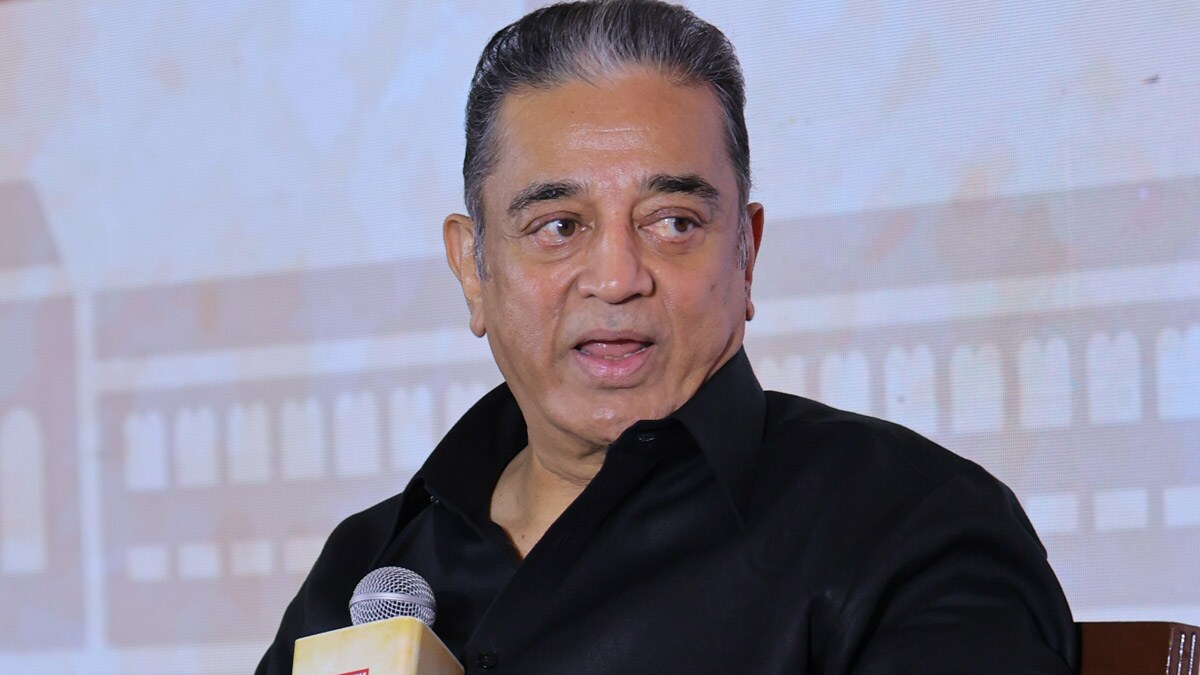
Actor-filmmaker and Rajya Sabha MP Kamal Haasan stressed the need for an education system in which a child’s life goals take priority, and the school system supports those goals. He was speaking at a panel discussion alongside Tamil Nadu School Education Minister Anbil Mahesh Poyyamozhi at THE WEEK Leadership Summit held in Chennai on Monday.
The Rajya Sabha MP noted that people often claim public schooling and science education succeed only through elite institutions or dramatic success stories, but that this is not true.
“I myself am a dropout. If you want an even bigger example of success, look at Kalaignar Karunanidhi—he studied only up to the third standard. I am five years more formally educated than him. Does that really matter? To me, education is meaningful only when it truly reaches a person,” he said.
Haasan added that states such as Tamil Nadu must support an education system that does not merely produce clerks but nurtures thinkers and leaders who can take India forward—not just a workforce for others to use.
“There are structural constraints, including the concurrent nature of education governance, and we have repeatedly raised these concerns. Instead of assuming we know how to educate children, we must first understand children and their needs. Only then can we offer the education they truly require,” he said.
“We want skill, knowledge, and well-rounded individuals,” he added, acknowledging that such change cannot happen overnight.
“I still call myself a student—not out of humility, but necessity. I must keep learning and building skills. Whatever success I have comes from developing skills. I studied in many places; the difference was that those ‘schools’ did not charge fees. They even supported my living while teaching me. That is why I respect my mentors,” said the actor.
He also said he valued the midday meal scheme—and even the idea of a full-day meal—if it enables children to pursue knowledge and earn skills that align with their passion.
Poyyamozhi said Tamil Nadu has taken major steps to adapt education to present-day realities.
“Earlier, education was largely about how well we answered questions. That system still exists to an extent—I see it in myself too. Students search for answers in books, memorise the information and reproduce it in examinations. But as we enter the age of artificial intelligence, the real challenge will be different: how many students can understand a concept, ask the right questions, and express their ideas briefly and clearly. Testing skills and comprehension will matter more in the future. Based on this thinking and our educational progress, we introduced the TN Spark scheme. Today, answers are readily available on our phones and computers. So the focus cannot be on copying information; every student must truly understand each concept. Our education policy is moving toward this understanding-based approach,” he said.
Responding to Haasan’s remarks on caste discrimination still persisting in Tamil Nadu, the minister said the state was also addressing the issue.
“The classroom should first teach equality before anything else. Our School Education Department is trying to address it, though I am not claiming it has been fully resolved,” he said.
He added that the government introduced the ‘Magizh Mutram’ (Circle of Joy) house system in schools to counter caste discrimination.
“It seeks to change social attitudes that students may bring from their homes. In some districts or schools, one or two incidents may still occur, but isolated instances should not be used to judge the entire state, the education department, or all schools,” he said.
Tamil Nadu has also recently issued strict guidelines to curb caste discrimination in schools, based on the Justice K. Chandru committee report on caste practices in educational institutions.
“Whenever such incidents happen, the chief minister speaks out immediately, and action is taken. We are not lethargic or indifferent. We respond quickly and seriously,” the minister said.
