



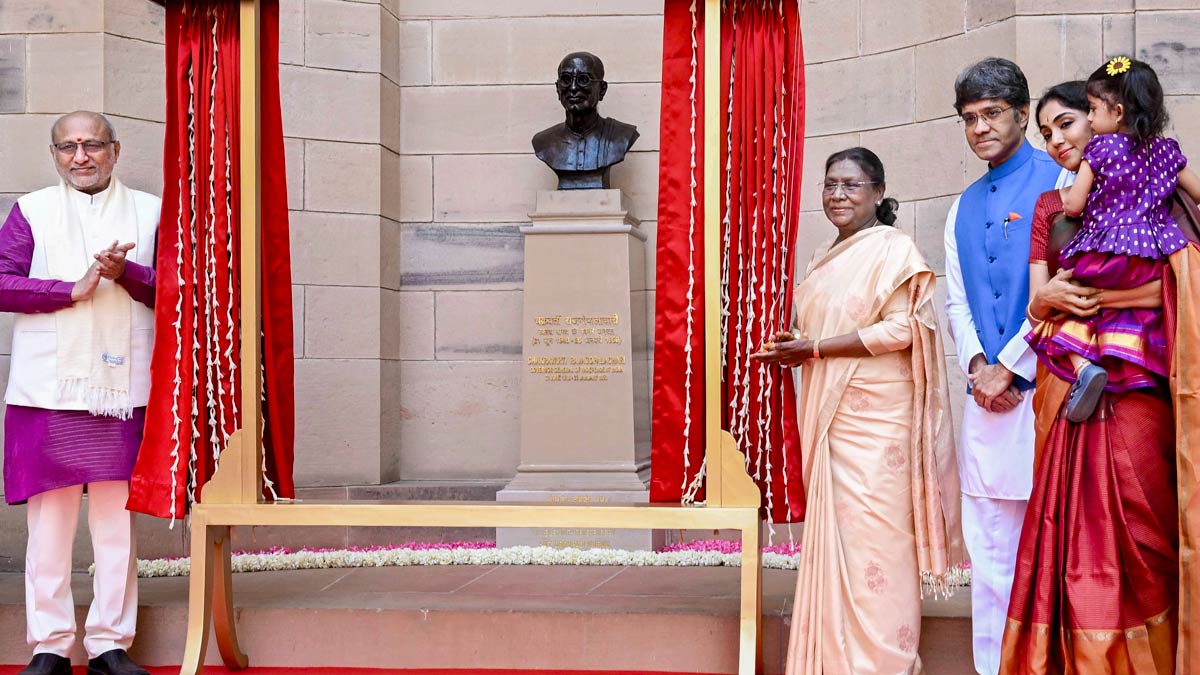
The unveiling of a bust of C. Rajagopalachari at Rashtrapati Bhavan is more than a tribute. The government has replaced a bust of Edwin Lutyens, the British architect who designed the building when it was the Viceroy’s House, with that of Rajagopalachari. The move is being presented as part of an effort to remove colonial symbols from public spaces. It also comes months before assembly elections in Tamil Nadu, where the BJP has struggled to gain ground.
Rajagopalachari, known as Rajaji, was Independent India’s first and only Indian Governor-General. He took office in 1948 after Lord Mountbatten and served until India became a republic in 1950. He once lived in the same building where his bust now stands. Replacing Lutyens with Rajaji carries clear symbolic weight.
Rashtrapati Bhavan was completed in 1929 and served as the residence of the British Viceroy from 1931. It was built as a symbol of imperial power. By removing Lutyens’ bust and installing Rajaji’s, the government is reshaping the narrative around the building. The message is that colonial markers are being replaced with Indian figures.
Tamil pride
This step fits into a larger pattern. When the new Parliament building was inaugurated in 2023, the Sengol, linked to the Chola tradition, was placed in the Lok Sabha chamber. The event was projected as a civilisational marker and was widely seen as outreach to Tamil identity.
The government has also organised the Kashi Tamil Sangamam, linking Varanasi with Tamil scholars and citizens to highlight cultural ties. These efforts are viewed as part of the BJP’s attempt to expand its presence in Tamil Nadu, a state dominated by Dravidian politics.
Other changes over the past decade follow the same line of indigenisation of colonial spaces. These include installing a statue of Netaji Subhas Chandra Bose near India Gate, building the National War Memorial, renaming the Central Secretariat as Kartavya Bhavan, and the PMO as Sewa Teerth.
Vice President C. P. Radhakrishnan described the installation as a step towards freeing India from a colonial mindset. He linked it to Prime Minister Narendra Modi’s call for “Gulami ki Mansikta se Mukti.”
President Droupadi Murmu unveiled the bust.
The broader message is that the government sees decolonisation as an ongoing process.
Why Rajaji matters
Rajaji had a complex political career. He was close to Mahatma Gandhi but later opposed Jawaharlal Nehru’s socialist policies. In 1959, he co-founded the Swatantra Party, arguing for economic freedom and limited state control.
In Tamil Nadu, his record is mixed. As Premier of the Madras Presidency in 1937, he made Hindi compulsory in schools. The move sparked protests and strengthened the Dravidian movement led by Periyar E.V. Ramasamy and later C.N. Annadurai. But later, he opposed Hindi imposition. Politically, Rajaji helped build an opposition alliance that defeated the Congress in the 1967 assembly elections. That election ended the dominance of Congress in the state, and it has not tasted power since then.
Rajaji was both a Tamil leader and a national figure. That makes him politically relevant. His family remains active in public life. His grandsons, Gopalkrishna Gandhi and Rajmohan Gandhi, are well-known public figures. His great-grandson C.R. Kesavan, moved from the Congress to the BJP.
For the BJP, Rajaji represents a Tamil icon who is not tied to Dravidian parties. He allows the party to invoke Tamil history without relying only on religious symbolism.
Electoral context
Tamil Nadu has been a difficult territory for the BJP. Politics in the state is shaped by language, social justice, and resistance to what is seen as northern dominance. The party’s strategy has combined cultural outreach with symbolic gestures.
Replacing Lutyens with Rajaji serves two purposes. Nationally, it reinforces the government’s anti-colonial narrative. In Tamil Nadu, it signals recognition of a Tamil statesman at the highest constitutional address in the country.
The decision to remove Lutyens rather than place Rajaji alongside him makes the gesture sharper. It turns a tribute into a statement.
Whether this will change voting patterns is unclear, but the symbolism draws attention. It would certainly give the BJP talking points for its campaign in the state.
