



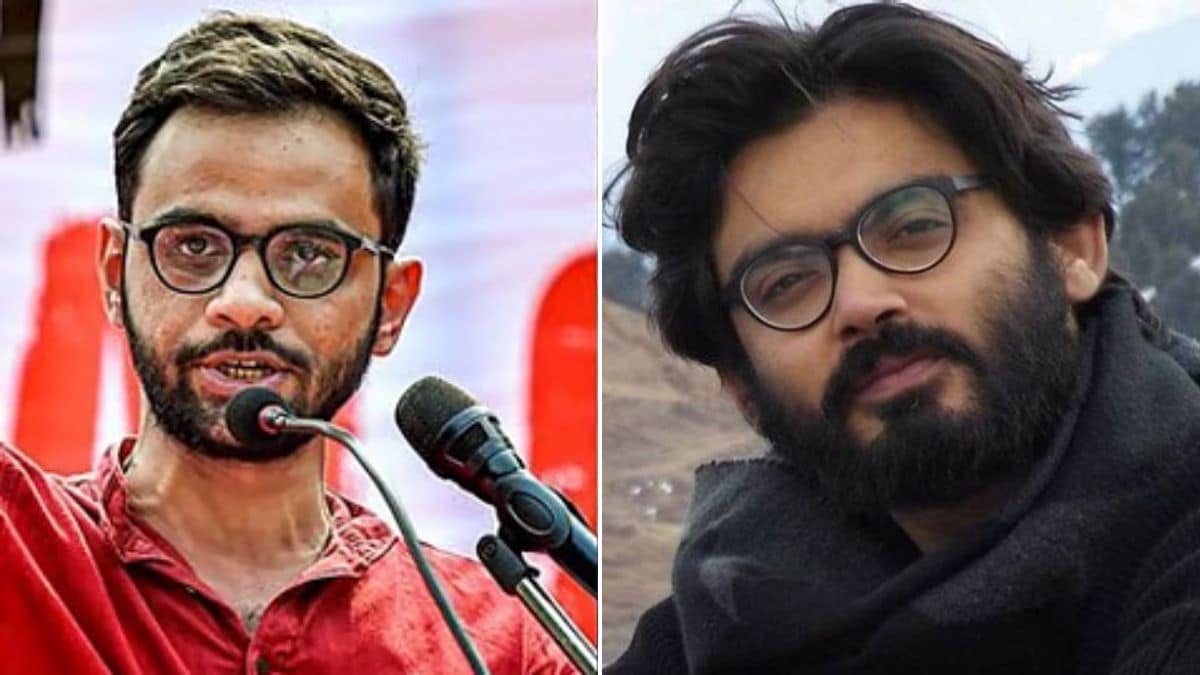
The Supreme Court on Monday ruled on bail pleas arising from the alleged conspiracy behind the 2020 Delhi riots, it was not merely deciding who would walk out of prison. It was attempting to draw a judicial line between different kinds of criminal liability—one that may shape how courts deal with prolonged incarceration in complex, multi-accused cases involving national security and public order.
Rejecting bail for Umar Khalid and Sharjeel Imam, while granting relief to five other accused, the apex court emphasised what it described as a “hierarchy of participation”.
To disregard the distinction between those alleged to have played central roles and those whose involvement was merely facilitatory, the bench observed, would itself amount to arbitrariness.
The formulation is significant because bail jurisprudence in India has traditionally rested on broader considerations, the gravity of the offence, the likelihood of tampering with evidence or influencing witnesses, the possibility of absconding, and increasingly, the length of pre-trial incarceration.
In this case, however, the top court placed relative culpability at the centre of its analysis underscoring that all accused in a conspiracy cannot be treated alike, even at the bail stage.
Drawing see-through lines within a conspiracy
Conspiracy law has always posed a challenge for courts. By design, it allows liability to attach not only to those who commit overt acts of violence, but also to those who allegedly plan, incite, or facilitate them. In cases involving mass protests, political mobilisation and communal violence, this elasticity often results in a wide net being cast, with numerous accused grouped under a single prosecutorial narrative.
The Supreme Court’s observation seeks to impose internal discipline on that narrative.
By recognising gradations of participation, the bench signalled that judicial scrutiny must be calibrated and individualised.
Those alleged to have played central or architectural roles, it suggested, stand on a qualitatively different footing from those whose involvement may have been peripheral, episodic or reactive.
This reasoning explains the split outcome. While five accused were granted bail—subject to stringent conditions—the court held that Khalid and Imam were differently placed, based on the prosecution’s case that they occupied leadership or ideational positions within the alleged conspiracy. The distinction, the court indicated, was not merely factual but went to the heart of culpability itself.
Liberty, delay and the limits of time as a defence
The ruling, however, sits uneasily with another judicial concern that has gained prominence in recent years, prolonged pre-trial incarceration.
Both Khalid and Imam have spent over five years in custody, with the trial still far from completion. In multiple cases, the Supreme Court has held that such delay can itself violate Article 21 of the Constitution, which guarantees the right to life and personal liberty.
In this case, the court acknowledged the length of incarceration but refused to treat delay as a trump card. In prosecutions implicating the sovereignty, integrity or security of the State, the bench held, delay does not automatically displace statutory restraints on bail. Instead, delay merely triggers heightened judicial scrutiny, it does not, by itself, compel release.
This distinction is crucial. It reflects a judicial unwillingness to allow the passage of time alone to neutralise legislative intent in national security cases. At the same time, by directing the trial court to ensure that the examination of protected witnesses proceeds without delay, the court implicitly recognised that endless incarceration without trial remains constitutionally fraught.
Expanding the idea of a terrorist act
Equally consequential was the top court’s broader articulation of what may constitute a terrorist act. Rejecting a narrow, weapons-centric understanding, the bench observed that terrorism is not confined to the use of bombs, explosives or firearms. It may also encompass acts that disrupt supplies or services essential to the life of the community, or those that threaten the economic security of the nation.
This interpretation expands the conceptual scope of anti-terror legislation, aligning it with contemporary forms of disruption that may not involve conventional violence but can nonetheless destabilise society.
A precedent with far-reaching consequences
The idea of a hierarchy of participation is likely to resonate well beyond the Delhi riots cases. It equips trial courts with a conceptual framework to differentiate between accused at the bail stage, even when charges are identical. At the same time, it places a heavier burden on judges to engage closely with the prosecution’s narrative raising concerns that bail hearings may begin to resemble mini-trials.
The unresolved balance
Ultimately, the Supreme Court’s ruling reflects a deeper tension within India’s criminal justice system, how to balance individual liberty against collective harm, and how to do so without either flattening distinctions or prejudging guilt. By articulating a hierarchy of participation and clarifying that delay is not an automatic passport to bail in national security cases, the court has attempted to walk a narrow and contested path.
Whether this approach leads to greater fairness or deeper entrenchment of prosecutorial narratives will depend on how lower courts apply these principles and how vigilantly appellate courts revisit prolonged incarceration as trials inch forward.
