



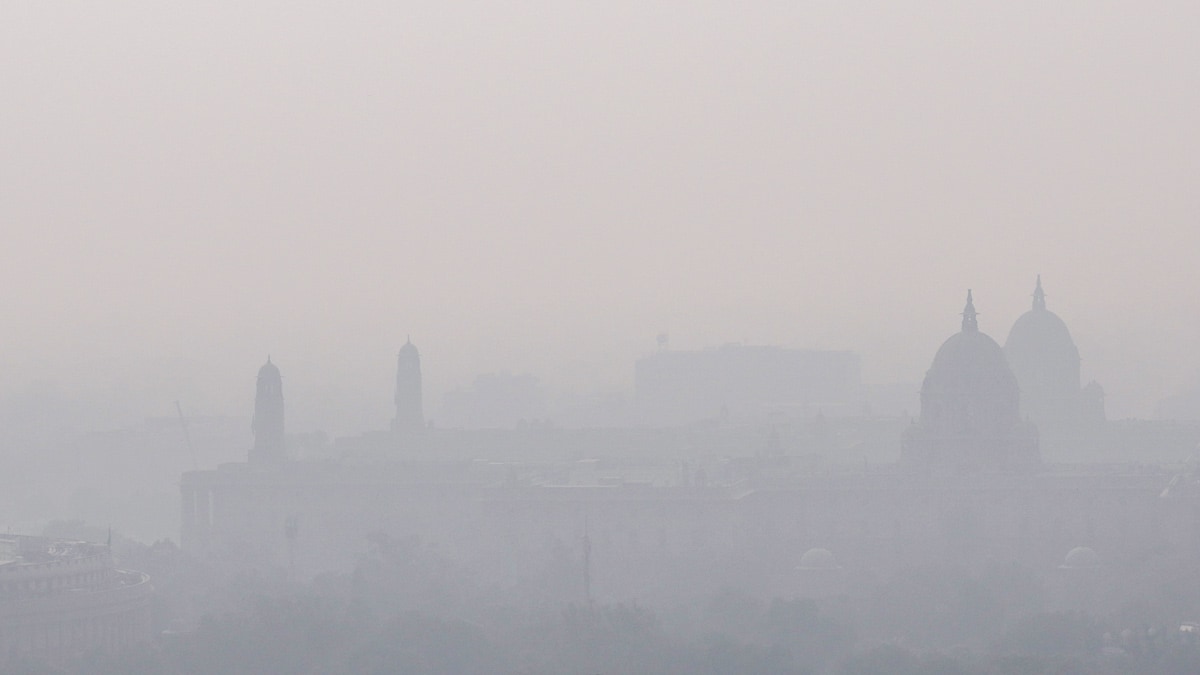
Every November, Delhi slips into the familiar dystopia. The air smells ashy, tastes metallic, and a dense grey settles over the city. But even as pollution becomes impossible to ignore, the numbers meant to quantify this crisis adds to the confusion. India’s air quality index (AQI), whether published by the Central Pollution Control Board (CPCB) or displayed on government-backed trackers like SAFAR, never goes beyond 500! Private trackers, such as the Swiss air monitoring firm IQAir, show the number shooting past 500 and even hitting 700-800.
So which number reflects the reality? And why does India’s AQI hit the threshold before the pollution does?
India caps AQI at 500
India launched its National Ambient Air Quality Index (NAQI) in 2014 when the then environment minister Prakash Javadekar outlined the AQI as “One Number - One Colour - One Description”. It was for the common man to easily understand the air quality in his/her vicinity.
The system takes data from eight pollutants, including PM2.5, PM10, ozone, nitrogen dioxide and carbon monoxide, converts their concentrations into a single value, and assigns a colour-coded category. An AQI of 0–50 is ‘good’, 51–100 ‘satisfactory’, 101–200 ‘moderately polluted’, 201–300 ‘poor’, 301–400 ‘very poor’, and 401–500 is ‘severe’.
And that’s where the scale ends – at 500, no matter how much higher the actual pollutant concentrations go.
“At the time, such extreme pollution levels in India were less common, and the scale was designed accordingly,” says Arindam Datta, senior fellow at The Energy and Research Institute (TERI), explaining the reason behind the decision. At the same time, “Some experts and officials argue that health impacts largely plateau once AQI reaches > 400 level, hence in the last 10 years nobody cares to revise it.”
Explaining the reason why CPCB and international trackers show different AQI readings, Manoj Kumar N., analyst at Centre for Research on Energy and Clean Air (CREA), explains: “It’s because they use different methodologies. While CPCB uses the Beta Attenuation Monitoring (BAM) method, IQAir does the same using sensors, and hence, showing different readings.”
Hidden gaps in India’s AQI system
The issue isn’t just that India caps its AQI at 500, but the standards set, too, are lenient.
For instance, India labels PM2.5 levels up to 60 µg/m³ as ‘satisfactory’, a limit four times higher than the World Health Organisation’s (WHO) recommended 15 µg/m³.
“The location of monitors matters too. In densely populated areas, readings are naturally higher; place a monitor in a sparsely populated or peripheral area and the numbers drop,” says Kumar, pointing to another flaw in India’s air-quality monitoring system.
He further highlights that while Delhi has 39 operational air monitoring stations, some cities and towns only have one, often not enough. “Take Perundurai in Tamil Nadu. It routinely ranks among the cleanest cities despite being highly industrialised,” he says.
Does India’s AQI system need a revamp?
While India outlined its National Ambient Air Quality Index in 2014, the WHO revised its air quality standards in 2021.
“Our standards are outdated. And it would be good practice to measure air quality beyond 500, because pollutants like PM2.5 cause health impacts even at low concentrations,” says Kumar.
Datta adds that India may finally be rethinking its approach. “Now with increasing pressure from international AQI measurements, India is also thinking about revising its AQI with no cap, similar to the US and China.”
The question now is not whether the change is needed, but how soon it will come.
