



Kerala’s Communist Party of India (Marxist)-led Left Democratic Front (LDF) government, under Chief Minister Pinarayi Vijayan, has long opposed the National Education Policy (NEP) 2020, describing it as a “centralising and exclusionary” framework that promotes “saffronisation”, corporatisation of education, and undermines state autonomy.
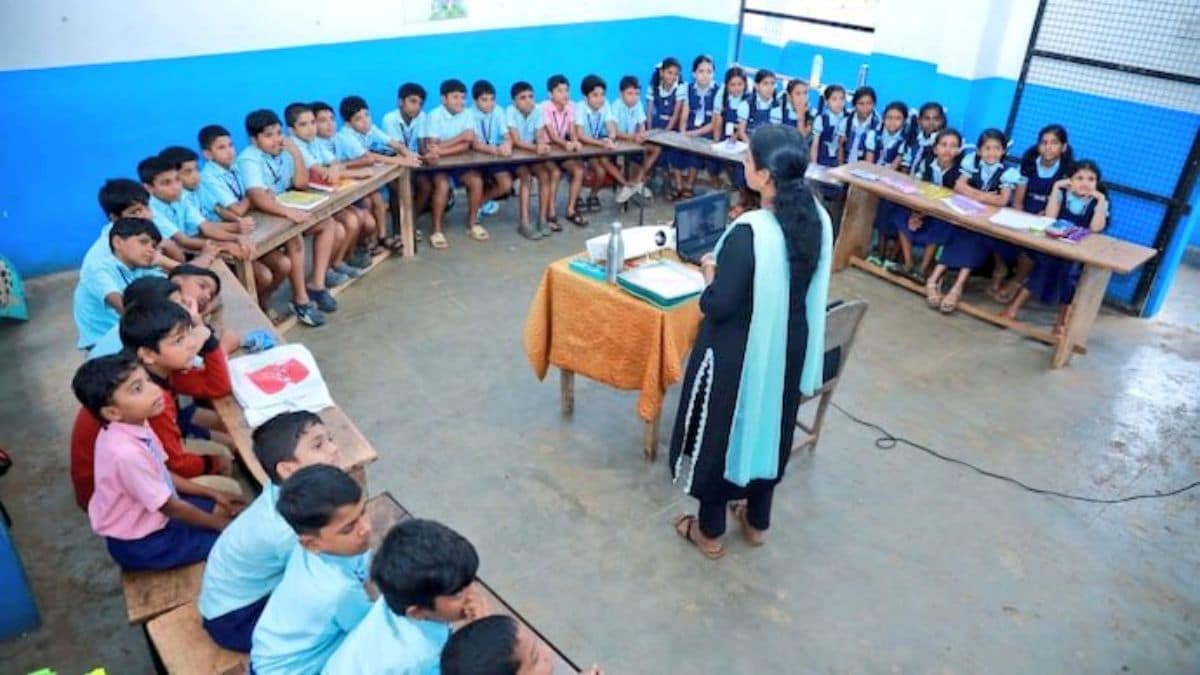
The state government has also resisted the PM SHRI (Pradhan Mantri Schools for Rising India) scheme—launched by the Union government in 2022 to upgrade around 14,500 existing government schools nationwide into model institutions—calling it a “backdoor entry” for NEP.
However, recent developments suggest a shift in stance. A letter issued by the Principal Secretary of the General Education Department has now surfaced, revealing that the department had communicated with the Centre regarding PM SHRI as early as March 2024. Significantly, the Centre has linked the release of funds under the Samagra Shiksha Abhiyan (SSA) to the implementation of PM SHRI. Kerala’s SSA funds have been blocked, and central assistance worth over Rs 1,000 crore remains withheld.
Facing the funding crunch, the ruling CPI(M) appears to have softened its position. Education Minister V. Sivankutty has publicly supported the scheme’s implementation, citing the financial blockade. CPI(M) state secretary M.V. Govindan had even made a dismissive remark—“What CPI?”—when asked about the government’s moves and the CPI’s opposition. Meanwhile, CPI(M) veteran and former finance minister T.M. Thomas Isaac argued in an article that “signing PM SHRI does not mean ceding ideological ground”.
Yet, the CPI—a key ally in the LDF—remains firm in its opposition, asserting that the scheme should not be implemented due to its ideological implications. CPI leadership, reportedly, expressed strong dismay at the way the CPI(M) leadership handled the matter, which, in turn, led CPI(M) leaders to temper their response.
As the issue escalated into a political controversy, THE WEEK spoke to Amruth G. Kumar, Professor at the School of Education, Central University of Kerala, to explore the broader academic implications and potential long-term challenges for the student community if Kerala decides against implementing the NEP and the PM SHRI scheme. Edited excerpts:
Q. The PM SHRI scheme, once it is implemented, Kerala will have to implement the National Education Policy, too. The Communist Party of India—a key ally in the CPI(M)-led government—has raised major objections. From your perspective as an educational expert, should we view the opposition to NEP purely as an ideological issue, or are there substantial, academic reasons behind it that deserve attention?
Personally, I feel that the ideological opposition to NEP itself is quite shallow. Because NEP, as such, even though it mentions traditional ideas like BanaBhatta’s “64 arts”, is fundamentally based on Western modern scientific theories. Many of its arguments and frameworks are drawn from modern research, not from ancient Indian sources.
For example, why does the NEP recommend that pre-primary education start at the age of three? Why is the pre-primary section designed to extend up to the age of five? Why does it propose the three+three+three+four structure for schooling? All of this is based on modern neuro-psychological and cognitive studies that define learning patterns by age groups.
So, if you look closely, there is a contradiction within NEP itself—it talks about ancient arts while being structured entirely on modern cognitive science.
The main ideological objection seems to be the claim that the NEP will impose a centralised curriculum, through which ideology could be injected. But, in reality, there is no real substance in that claim. The NEP nowhere says that state boards will be suspended. In fact, that cannot happen, because education is on the Concurrent List of the Constitution.
If state boards continue to exist, that means each state will continue to create its own syllabus. So, how can the central government’s syllabus enter the state’s education system? That’s the first question.
Now, there are already schools that follow a central syllabus—like CBSE schools, Kendriya Vidyalayas, and Navodaya schools. They must continue with the central syllabus because that’s what their examinations are based on. Meanwhile, state-board schools will continue following the state syllabus.
This is a very basic fact, but many in Kerala ignore it when they claim that the central syllabus is being “imposed.” Where exactly is the imposition happening within the state syllabus?
What we have is a National Curriculum Framework (NCF), which only says that each state must develop its own State Curriculum Framework. The confusion arises because many educational experts here do not seem to understand what “framework” means.
A framework is only a contour—a boundary, not the actual content. It’s like building the structure of a house: you create the pillars and floors, but the decision about how the rooms are arranged is made later by the designers of the syllabus.
So, the NCF is just a framework suggesting how children of a certain age should learn, or what kind of scientific developments they should be exposed to. It is suggestive, not directive.
Based on this, the state can prepare its own State Curriculum Framework. The state may even adapt or reinterpret the contours of the national framework to suit its context. Within that framework, the state develops its own syllabus.
So, in aided and government schools, and in English-medium schools following the state syllabus, it is the state that prepares and inserts the syllabus.
I am referring only to the technical side of the issue, and I am not taking from a political angle on this.
Q. What are the long-term implications for students and society if Kerala decides not to implement NEP? Could Kerala choose to selectively adopt only some elements of the NEP and still move forward in its own way?
There are two types of implications — one futuristic and the other financial. The first, futuristic one, relates to students’ educational aspirations and their future opportunities. For instance, students who complete their studies under the 10+2 system may not face major issues for the next 10 years. However, one has to note that in India, almost every state — except three — has already implemented the new structure. These three are Kerala, Tamil Nadu, and West Bengal.
Even in those states, it is not entirely absent. For example, Tamil Nadu has no Navodaya schools, but it has almost 10 times more CBSE schools than state-board schools. The same is true for West Bengal.
If we look at Kerala, officially, about 30 per cent of students study in English Medium (CBSE) schools. But this number is unreliable, because it includes both recognised and unrecognised schools. In reality, the number of unrecognised private English-medium schools is much higher, and the state government does not even have accurate data.
Many unrecognised schools operate by affiliating themselves with nearby recognised schools, often using their registration for examinations.
So, when we say 30 per cent of students in Kerala are in CBSE or English-medium schools, the real figure is probably much higher. That means nearly half the students in Kerala already follow the modern, revised structure — the 5+3+3+4 model — while the rest, a small minority, follow 10+2.
Across India, the same pattern holds — in the three states combined, the share of students still following 10+2 will be less than 10 per cent of the total enrolled students.
So, this small minority (less than 10 per cent) would be the only group not aligned with the 5+3+3+4 structure.
Now, looking 10 years ahead, there is a clear issue. All higher education institutions will start requiring the 5+3+3+4 qualification for admission. Right now, that requirement is not written anywhere, but it will naturally evolve over time — when the system changes nationwide, it becomes the de facto standard.
So, after 10 years, students who graduate under the old 10+2 system may face difficulties getting admissions unless they go through legal channels to get “equivalency” status.
That is the first, futuristic problem.
The second issue is financial. The central government is already blocking or restricting funds for states that do not align with the NEP framework.
Legally, this can be questioned — they cannot directly deny funds — but it is part of what they call non-coercive strategic measures. By controlling how funds are released, they effectively regulate compliance.
This financial pressure affects schools more than higher education, because Kerala’s colleges and universities are already following many NEP-linked reforms, such as: Four-year undergraduate programmes (FYUP), Four-year integrated teacher education programmes and Academic Bank of Credits (ABC) registration, which almost all Kerala universities have joined.
So, the only area of resistance left is schools.
Q. This means that at the school level, since a large number of students are already moving to CBSE, awareness of such future risks is likely to push even more parents to enrol their children in CBSE schools?
Definitely. That’s exactly what I said. Once people start thinking a little about these repercussions, parents will automatically swing that way, they will shift in that direction. You see, for parents, the government's stance or policy does not matter much. What matters to them is their children's future.
Automatically, a major trend we are noticing is that the number of low-cost English-medium schools across India is rising.
That means English-medium schooling is no longer something only the economically privileged or upper-class families can afford. Even in Kerala, low-cost English-medium CBSE schools are coming up rapidly.
This is going to be serious. The government does not even have proper data on how many recognised and unrecognised schools exist. And, this means more shift towards private CBSE schools will take place.
Q. Some of the critics of PM SHRI say that Kerala already has schools with good infrastructure, so why do we need such a scheme? They ask “Do not we already have smart classrooms? Do not we already have all these facilities?” So, is PM SHRI only about improving facilities, or is it about introducing a new culture of schooling—a new model or approach that a state like Kerala might miss out on if we do not participate? Is this a concept that is inspired by some successful model abroad?
Actually, when we talk about facilities and infrastructure, it is all relative. The point is, how much further can we advance from our current state? That is what determines how much additional funding we receive.
It is not that Kerala has “everything” and no scope for improvement. For example, if Kerala’s schools are at eight out of ten, the question is how to move from eight to nine or ten. If Tamil Nadu is at six out of ten, they will move from six to eight. So, it is about advancement, not a basic necessity.
School infrastructure has improved in a lot of states. I have personally visited schools across states. Gujarat and Bihar really surprised me — especially Bihar.
In Bhagalpur, Bihar, I saw some government schools with excellent facilities — almost like a typical college campus, with 1,500–2,000 students. The buildings were highly professional and well-designed, with modern classrooms and good teaching environments. Gujarat, too, has very impressive schools. The one state where I felt schools lagged a bit was Madhya Pradesh.
Across India, all schools have improved under Samagra Shiksha. Since 1986, crores and crores of rupees have been flowing into school education. Now, a large share of the total GDP allocation under NEP again goes to schooling. So, every state’s government-aided schools have now reached a certain infrastructure level. The question is: how to move forward from that level?
Now, coming to PM SHRI, the goal is not just to improve infrastructure. That’s only part of it. The scheme also has pedagogical purposes, green-school goals, and even links with nutrition (PM Poshan).
They mention six pillars for PM SHRI schools — which include pedagogical innovation, experiential learning, environmental sustainability, and mentorship.
These schools are meant to be innovative learning hubs. They will receive funds not just to upgrade facilities, but also to experiment with new teaching models. They will then become model schools that mentor nearby schools.
So, the goal is not just to get funding. But to create a trickle-down model, where innovations and quality practices spread from PM SHRI schools to others.
Over time, both the Central and State governments can build on this model with more funding schemes.
In short, PM SHRI funding is meant for advancement, not for basic needs. The funds can be used for improving existing infrastructure or for advancing teaching and learning quality.
So yes, it is about upgrading and building a model culture of schooling, not just adding smart classrooms or facilities.
