



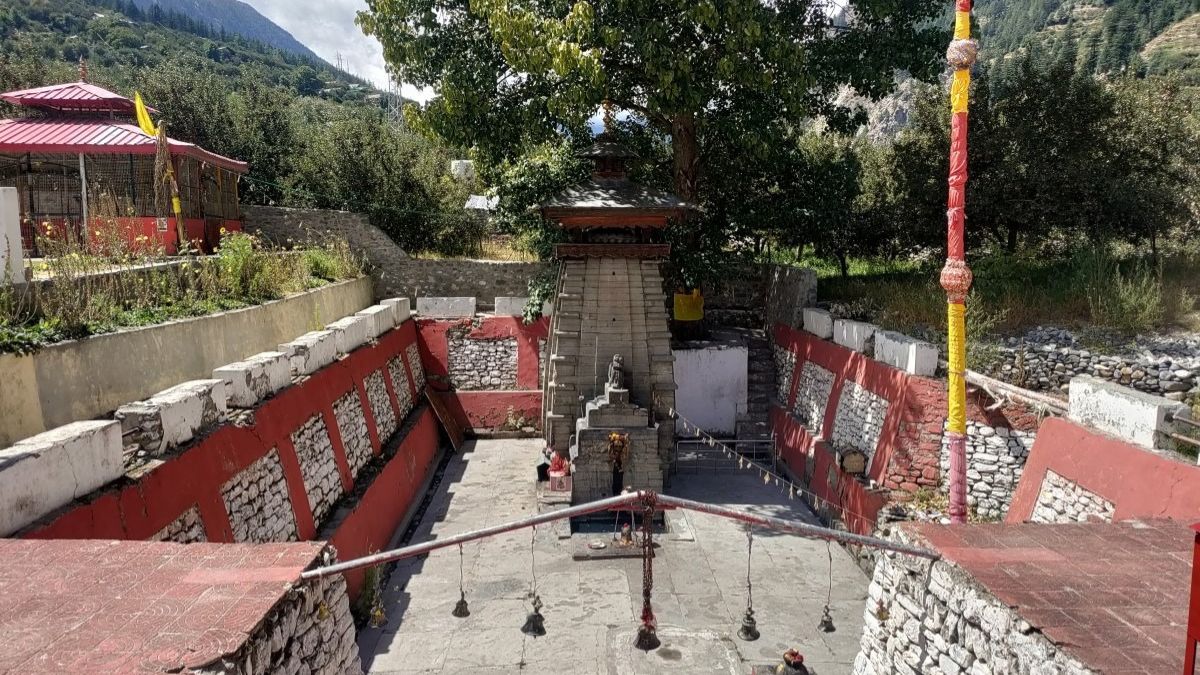
The flash floods in the Khir Ganga river in Uttarakhand’s Uttarkashi district have completely buried Kalp Kedar, an ancient temple in Dharali village on the Gangotri Highway, according to reports.
The temple, which stood the test of time, is now buried under debris at the height of a two-story building.
Legend has it that the Kalp Kedar, an ancient shrine dedicated to Lord Shiva, was built by the Pandavas in exile, but its existence was known only in 1945, after excavation efforts revealed a ‘shikhara’ structure.
The temple stood seven metres below ground level, and devotees had to descend steps to offer prayers. There are stone carvings outside the temple, and the ‘Shivling’ in the sanctum sanctorum is shaped like the back of Nandi, much like in the Kedarnath temple.
It is said that the temple first vanished from sight after a flash flood or landslide, triggered by a glacial burst. The temple remained underground and unknown for many centuries until people spotted its spire. Locals soon began digging the area, and after days of effort, the temple’s entrance was visible 12 feet below ground level. It is believed that more than half of the temple is still underground.
However, as fate would have it, the flash floods have buried the temple again.
It is estimated that the temple sank deeper this time, and the sanctum sanctorum, where the Shivling was located, is completely filled with debris and mud. The upper structure of the temple is believed to have been washed away.
