



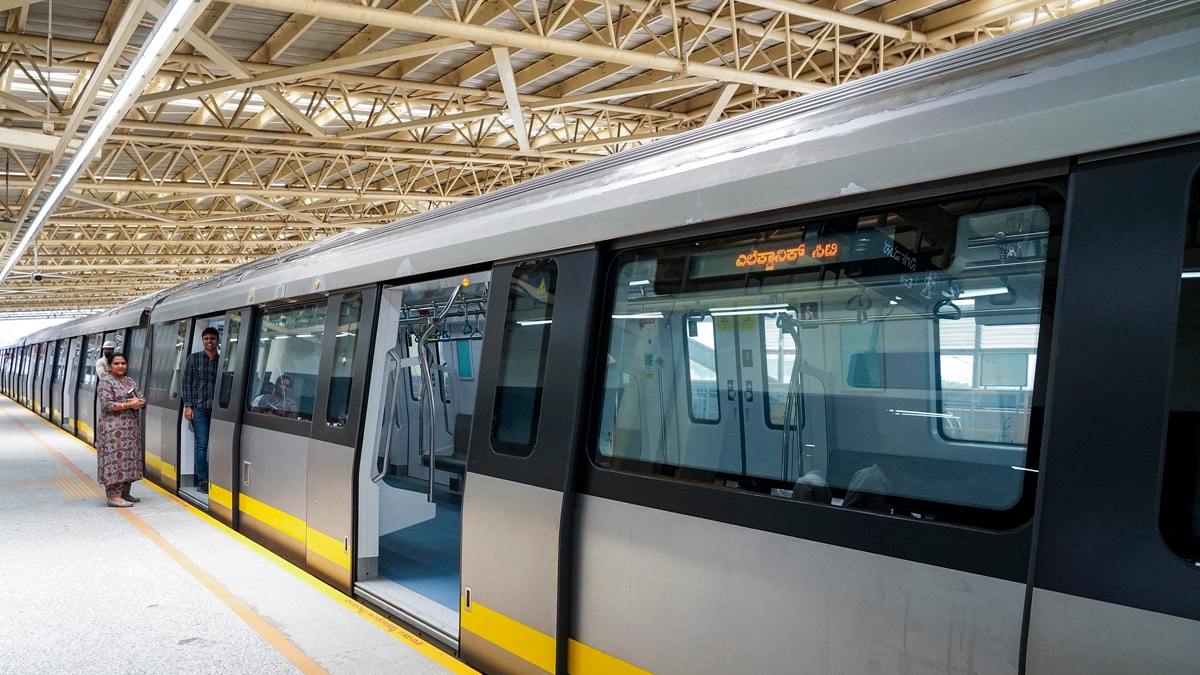
Will Namma Metro's Yellow Line ease notorious Bengaluru traffic? Not yet
On August 10, Prime Minister Narendra Modi will inaugurate the 19-km-long 'Yellow Line' of the Namma Metro train connecting the city to Electronic City – one of India's largest technology and industrial clusters.
The Central Silk Board (CSB) junction in Bengaluru – one of India's worst traffic bottlenecks (average peak-hour speed of 4.48 kmph as per a 2017 study) – might finally get rid of its "notoriety" tag.
After a construction delay of eight years, the Yellow Line, with 16 elevated stations, built at a cost of ₹7,610 crore, will connect RV Road to Delta Electronics Bommasandra station via Ragigudda, Jayadeva Hospital, BTM Layout, Central Silk Board, Bommanahalli, Hongasandra, Kudlu Gate, Singasandra, Hosa Road, Beratena Agrahara, Electronic City, Infosys Foundation Konappana Agrahara, Huskuru Road and Biocon Hebbagodi.
Deputy Chief Minister and Bengaluru Development Minister D.K. Shivakumar, who went on a trial ride on Tuesday, said, "Namma Metro is a joint (50:50) project of the Centre and the state government. Initially, three driverless trains will operate at a 25-minute frequency from August 11. After the arrival of the fourth train set, the frequency would be 20 minutes, though our goal is to run a train every 10 minutes."
Namma Metro – Lifeline of IT city
Currently, the operational network of Bangalore Metro is 76.95km with 69 stations - North-South corridor (Green Line) is 33.46km long with 31 stations, and East-West corridor (Purple Line) is 43.49km long with 38 stations. Namma Metro is the second-largest metro network in the country after the Delhi Metro.
Namma Metro Phase 1, with a total length of 42km - Purple line (18.10km) connecting Byappanahalli to Mysore Road and Green line (24.20km) connecting Nagasandra to Yelachenahalli with an interchange station at Majestic and 40 stations was built at a cost of ₹14,405 crore and was fully operational by mid-2017.
The Namma Metro Phase-2 project of 72.10km (revised 75.06km) was sanctioned at the estimated cost of ₹30,695 crore in 2014. The Phase-2 comprises four Phase-1 extensions and two new lines. The 15.81km-long reach-1 extension from Baiyappanahalli to Whitefield (Kadugodi), the 9.58km-long reach-2 extension from Mysore Road to Challaghatta, the 3.14km-long reach-3 extension from Nagasandra to Madavara, the 6.12km-long reach-4 extension from Yelachanahalli to Silk Institute, the 19.15km-long new line (reach-5) from RV Road to Bommasandra, and the 21.26km-long new line (reach 6) from Kalena Agrahara to Nagawara (elevated 7.5 km and underground 13.76 km).
Namma Metro Yellow Line (Phase 2, Reach-5) connecting R.V. Road to Bommasandra has three interchange stations, and runs along important tech corridors housing Infosys, Wipro, Biocon, Delta, Tech Mahindra, among others. It has two stations funded by corporate giants, Infosys (₹200 crore), Biocon and Delta Electronics (₹65 crore each for naming rights for 30 years).
The RV Road interchange connects the yellow line to the Green line (Nagasandra to Silk Institute), the Jayadeva interchange to the upcoming Pink Line (Kalena Agrahara to Nagawara), and the Central Silk Board interchange station to the upcoming Blue Line - Phase-2A & 2B (Central Silk Board to Kempegowda International Airport).
The Bengaluru city has 1.20 crore registered vehicles, including 82.4 lakh two-wheelers and 25.2 lakh passenger cars.
Namma Metro, with an average daily ridership of 7.7 lakh (with ridership reaching 9.6 lakh during festivities), has become the lifeline of Bengaluru, providing a safe, reliable, and green mode of transport. The Yellow Line is hoped to decongest the IT corridor, which keeps making global headlines for traffic jams despite the many urban mobility initiatives taken to cut down the travel time.
Traffic experiments at CSB junction
CSB junction is where the busy Outer Ring Road, Hosur Road, Electronic City, and tech clusters in the east converge. Besides, the NICE road that connects Electronic City to Mysore Road, Tumkur Road, and Kanakapura Road, and Bannerghatta Road, a double-decker flyover from Ragigudda to CSB was made operational, an AI-powered traffic signal system was integrated in mid-2024, an experimental one-way traffic system monitored via 500 CCTV cameras was put in place, a dedicated bus priority lane from Silk Board to KR Puram and a limited stop AC Express bus route (30.6-km stretch) connecting CSB and Hebbal have significantly reduced the travel time to the Electronic City (IT corridor).
However, the Metro train is hoped to decongest the traffic at CSB junction and subsequently along the IT corridor when it starts its operations with an adequate fleet and frequency to cater to an estimated 8 lakh commuters on this stretch.
Netizens flag last-mile connectivity concerns
The poor frequency – a train every 25 minutes might lead to overcrowding and eventually push the commuters back to private vehicles, fear urban experts.
Netizens who are eagerly waiting for the inauguration of the Yellow Line have demanded more coaches and better frequency, besides integrating the last-mile connectivity.
The BMTC (bus) Metro feeders are presently covering 43 metro stations along 151 routes. However, they cater to fewer than a lakh metro commuters daily. Streamlining autorickshaw services to make it affordable and reliable, the introduction of mini-buses, the creation of walking and cycling lanes, and building EV infrastructure (e-scooters) can boost a green last-mile commute, say netizens.
