



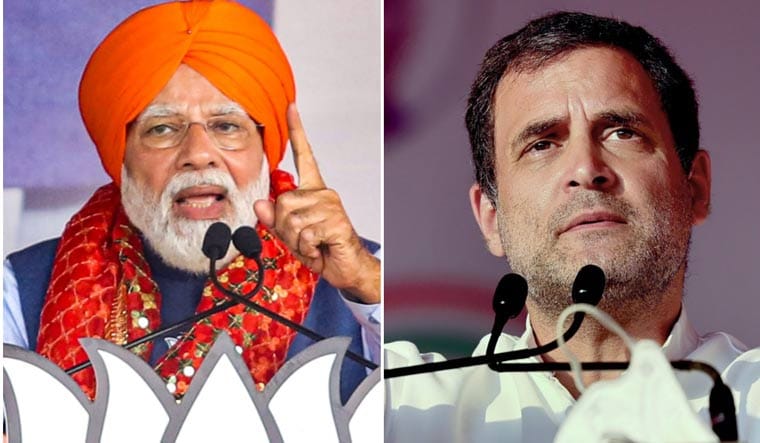
The stage is set for a fierce debate in Lok Sabha on Tuesday as the BJP-led government at the Centre faces a no-confidence motion moved by the opposition parties. Congress leader Rahul Gandhi, who returned to a rousing welcome to Parliament on Monday after the Supreme Court stayed his conviction in a defamation case, will lead the opposition's charge.
The motion, submitted by Congress's deputy leader in the Lok Sabha on July 26, is Prime Minister Narendra Modi's second no-trust motion—the first in his second term as PM.
Since the start of the Monsoon Session on parliament last month, Opposition bloc leaders have been insisting on a discussion and a detailed statement from Modi on the violent clashes in Manipur.
Amid these protests by opposition leaders, business in both Houses of the parliament have been repeatedly disrupted. The no-trust motion is seen as part of the Opposition's strategy to finally get the PM to speak on the issue in the Lok Sabha.
The Business Advisory Committee of the Lok Sabha has allotted 12 hours for the discussion on the no-trust motion. The debate will begin at 12pm on Tuesday and Modi is expected to respond to the debate on Thursday.
Political observers believe that the Opposition have given a platform to Modi, who is known for his oratorical skills, to forcefully make his points during the reply to the debate on the no-trust motion. But opposition leaders have said that this only a matter of morality as it is important that the prime minister, who has largely remained silent on the ongoing violence in the north eastern state, speak on the issue.
What is a no-confidence motion
A no-confidence or no-trust motion is meant to test whether the government enjoys the confidence of the majority of the house—a government can only be in power if it commands the majority in the directly elected house. Parliamentary procedure allows the opposition to move the no-confidence motion to challenge the government.
Once it is supported by 50 members, the Speaker admits the motion and issues dates for debates. After the debate in Lok Sabha, comes the no-trust vote. The present no-trust motion will face the vote on August 10.
This is the 28th no-confidence motion in the history of independent India. According to reports, only once did such a motion lead to the fall of a government—Morarji Desai-led administration in 1979.
What do numbers say
Though this is the Opposition's tactic to corner the BJP on the Manipur issue, the Modi government will sail through this test with the numbers comfortably stacked in its favour. In the Lok Sabha, where the halfway mark is 272, the BJP's strength alone is 301. With its allies, the BJP-led NDA has 331 MPs in the house.
There is no threat to the Modi government, but the voting patterns will be closely analysed in the run-up to the high stakes general elections next year. Y.S. Jagan Reddy’s YSRCP and Naveen Patnaik’s BJD, both of whom tipped the scales in the BJP's favour in the Delhi Services Bill on Monday, are expected to support the government this time too. Together, they have 34 MPs, taking the government's numbers to 366. The Opposition bloc INDIA has only 142 members.
Modi govt's second no-trust motion
In 2018, PM Modi faced a no-confidence motion moved by Chandrababu Naidu's Telugu Desam Party. The motion was defeated, with the government getting 325 votes. Only 126 votes were bagged in favour of the motion.
