



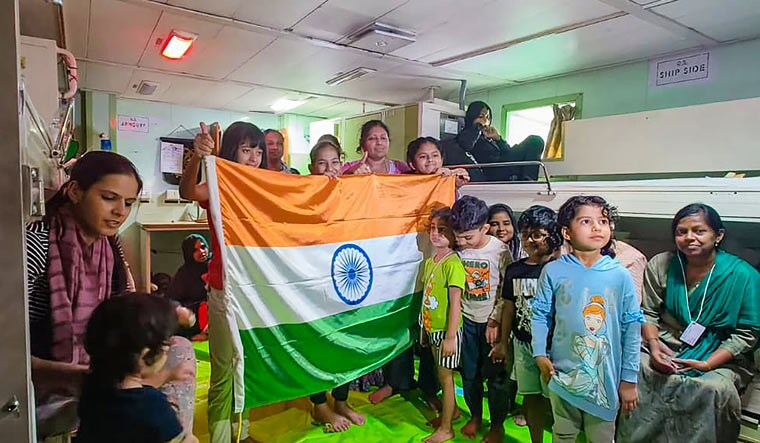
India's 'Operation Kaveri' to bring back around 4,000 of its nationals stranded in war-torn Sudan is under way, with at least 500 of them already headed back home.
“First batch of stranded Indians leaves Sudan under #OperationKaveri,’’ tweeted External Affairs Ministry spokesperson Arindam Bagchi on Tuesday. “INS Sumedha with 278 people onboard departs Port Sudan for Jeddah,” he said.
India had stationed the naval ship at Port Sudan while two IAF C-130J aircraft have been positioned on standby in Jeddah.
It is another moment of pride for India as in the past nine years under Prime Minister Narendra Modi, rescue operations—often large and complicated—have emerged as an important plank of public diplomacy. From ensuring safe evacuation of Indians stranded in various countries due to Covid-19 to bringing back the students stuck in war-hit Ukraine under Operation Ganga, India has been successfully managing the rescue missions. The naming for the operations is also deliberate. If it is Kaveri this time—a river that is worshiped—it was Devi Shakti for the rescue mission in Afghanistan and Ganga for Ukraine. According to a government official quoted by ANI: "Rivers reach their destination irrespective of barriers. It's like a mother who will ensure she will bring her children back to safety.”
In June 2014—a month after Modi was sworn in—46 nurses were held captive in a hospital in Tikrit, Iraq. This mission was the then foreign minister Sushma Swaraj’s baptism by fire. And, she passed with flying colours. After some painstaking negotiations, and with some help from Saudi Arabia and the NGO Red Crescent, she brought them back home. Since then, India has mastered the art of the homecoming.
The situation in Sudan, however, is not easy. Food and water was running out. A report in the BBC, quoting Red Cross spokeswoman Alyona Synenko, described the condition "untenable" . There is an internet blackout. As the fighting broke out suddenly, one of the big challenges for India is to track down all the citizens.
“They are in different parts,’’ said Bagchi at the weekly media briefing on Thursday. “Either they are in hotels, some of them are in housing. Remember, this happened very quickly, and I don’t think people were able to find other options. But yes, we are in touch with them. Everybody is safe and sound. I wanted to emphasize that our embassy has been really pushing in terms of trying to track down every Indian, who is there, who is registered, trying to build a database of information, and trying to counsel them.”
Going beyond just keeping the flock together, the MEA has been working behind the scenes to ensure that the operation is a success. External Affairs Minister S. Jaishankar spoke to his counterparts in Saudi Arabia, the UAE and Egypt on the ground situation in Sudan with a focus on ensuring the safety of the Indians. He had also discussed the situation in Sudan with UN Secretary-General Antonio Guterres.
“We will not rest till our fellow Indians are safe,’’ Jaishankar had tweeted in February 2022 when the students were stranded in Ukraine. It was very much an echo of the mantra that had been perfect by his predecessor Swaraj who in her tenure had also undertaken successfully one of the largest missions, Operation Rahat in Yemen.
“I do not sleep. I do not let Indian envoys sleep,'' Swaraj had quipped at a press conference once. This lighthearted remark has really become the heart of the MEA’s reach out to its diaspora. And a big win for the Modi government.
