


 Add as a preferred source on Google

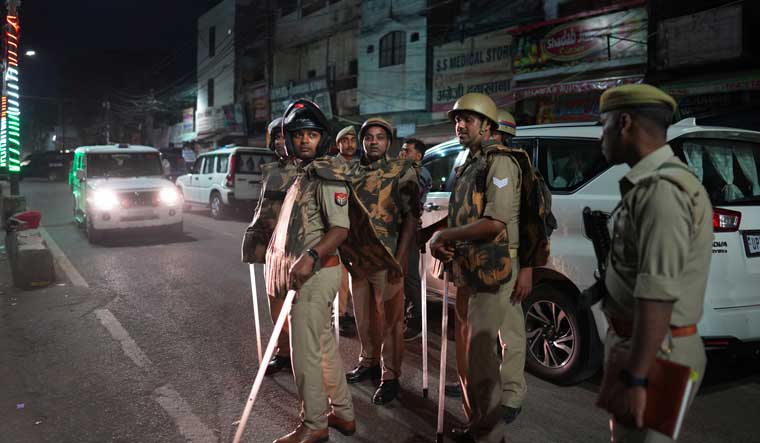
The killing of gangster-politician Atiq Ahmed and his brother Ashraf, when they were being escorted by the police in Prayagraj, has triggered a debate on the human rights of criminals killed in police encounters and custodial deaths. As the National Human Rights Commission issued notice to the Uttar Pradesh police on the recent killings, Prabhat Singh, IPS (retired), a former Director General (Investigation) in NHRC, explains how the state is the custodian of human rights of its citizens and why the media, the public, the political leaders and the judiciary must play their role with honesty and efficiency before dissuading police officers from becoming trigger happy.
Let me begin by explaining the concept of 'human right'. It is understood that human beings who are at the very apex of creation need certain rights to enable them to live their lives with dignity. These begin with the very right to life and have now been enlarged in scope to include the right to food, education, health and certain liberties. These rights are inalienable to human beings and it is the responsibility of the state to safeguard them. The state thus becomes the custodian of human rights. While traditionally that is true, in modern times, it has been further expanded to mean that even in private businesses, the employer must ensure the same to the employees.
We are frequently asked the question as to whose rights come first—that of a criminal or the policeman? From the explanation above it naturally follows that since the state is the custodian of human rights of its citizens, the life of those who are in custody of the state must be accorded the highest priority. Therefore, if any death that occurs in custody or at the hands of state authorities by way of encounters which do not have prior sanction of law by way of court verdicts and procedure established by law must be looked into with utter seriousness. State must explain how a life was lost. It is in view of this that instructions were issued by the NHRC in the early 1990s that all cases of custodial deaths must be reported to it within 24 hours. Subsequently, detailed guidelines on steps that were needed to be taken immediately by District Magistrates and Superintendents of Police of districts across the country in such cases were also framed and circulated. Deaths in police encounters are a different category though human rights are an integral aspect of them, too. These category of cases also have to be reported to the Commission within 48 hours.
I was often asked if the job of the NHRC in handling inquiries against policemen was tough and whether it caused a sense of divided loyalties? Investigations into the conduct of policemen in NHRC is no different than investigating other crimes committed by someone else. A well meaning officer does not distinguish between crimes committed by a policeman and those committed by others. All it requires is to perform one's job with honesty. Pulls and pressures are brought to bear upon the officers in all situations. However, investigations of such cases are accorded a high priority in terms of time within which they have to be completed. But investigation methods and standards remain the same in all cases.
Another question that is often asked to me id if the NHRC needs more teeth to ensure compliance by errant states? Certainly. Unless the NHRC is provided more teeth, the cause of meaningful human rights will only remain aspirational. The NHRC can acquire greater effectiveness by doing the following:
a) Allowing the investigation division to start enquiries including making spot visits suo moto, without prior approval of the Commission, whenever a violation is brought to its notice. The Commission can subsequently decide on its findings and recommendations.
b) Making the Commission's recommendations after conclusion of investigation mandatory on the authorities.
c) Raising the quantum of fines and punishments awarded to the deviant officer or authority including government departments to meaningful levels.
The public has also been curious to know whether the NHRC and state human rights commissions meet international standards? As far as capabilities of our institutions are concerned, we certainly compare well with other countries. But our success should be measured not in terms of international comparisons but in terms of providing satisfaction to those who approach the NHRC or SHRC for relief. In this context, I do believe much more needs to be done.
Finally, one question that agitates everyone's mind is “What changes should be brought about to deter policemen from becoming 'trigger happy'”? The media, the public, the political leaders and the judiciary must play their roles with honesty and efficiency before we can dissuade police officers from becoming 'trigger happy'. The society must stop glorification of extra judicial killing of criminals while the police department must be very parsimonious in awarding out of turn promotion to ‘encounter specialists’. The political leaders must only frown at encounters rather than encourage them. A time has come when a self effacing police officer who performs his job seriously must be recognised rather than a flamboyant 'trigger happy' policeman.
