



In a lab in Minneapolis, US, scientists have constructed the world’s quietest room, an anechoic chamber. You can hear the sound of your own stomach, lungs and heart working. After about 15 minutes, subjects become disoriented and start to exhibit psychotic symptoms.
I feel a bit the same way when I spend too much time listening to the television studios of Delhi. The organs of the political class and commentariat rumble and gurgle-acronym this, number that, seat projection-and give the illusion that this anechoic chamber is a reflection of the opinions and voting intentions of 81 crore people.
Trends often look stronger when mirrored in the media than they appear on the ground. Most people cast their vote for odd, incidental reasons. This was brought home to me during the 12th Lok Sabha elections in 1998. A landless labourer in Medak in Andhra Pradesh told me she had come to a rally for one reason alone: to see what Indira Gandhi’s daughter-in-law looked like. In the same way, a sari wholesaler in Banaras argued last week that his commitment to the BJP was because he believed it was no longer a Hindu nationalist party. “People of our generation don’t want to go back to those things,”he said. And what of the puckish gentleman in Pappu’s, the tea shop in Assi Ghat made infamous by Kashinath Singh’s novel Kashi ka Assi, who had a method for getting rid of nosy reporters? “We tell them that the Aam Aadmi Party and the Congress are doing well here. So they leave.”
During March, I made a spidery loop through India, starting in Karnataka, proceeding through Andhra Pradesh, hopping to Gujarat, flying across to Bihar and travelling by road to Uttar Pradesh, before moving to Delhi (imagine the shape of a freely drawn rupee sign). It was not exactly a representative survey: I avoided some well-populated states like Tamil Nadu, Maharashtra and West Bengal because their voting intentions seemed relatively settled. Instead, I tried to locate an impressionistic range of 2014’s national and regional leaders and voters: the hunters and the hunted.
Bangalore: The professionals
UNDERNEATH THE FLYOVER at Vijayanagar, young Laxmi Arali, wearing a turquoise kurti and Aam Aadmi Party cap, was handing out leaflets. When she was not campaigning, she worked in software support. For her, corruption was the worst problem. If a middle-class parent wanted to get admission to hospital or a place at school for their kid, they had to pay a bribe. This was the last chance to save India, and Arvind Kejriwal was the only hope. As his roadshow approached, activists waved brooms, banged drums and handed out leaflets. It seemed as if the party leader spent just a moment beneath the flyover, being photographed and addressing a small crowd with energy and conviction, before moving on.
It was only when I was with him on the road, travelling in his convoy, that I realised Bangalore was not much interested in the man who had rattled Delhi and sent Sheila Dikshit into exile as governor of Kerala. Despite an amplified filmi voice blaring “Vote for the party of the common man!”as we paraded through the city streets, people seemed to be unsure who Kejriwal was. His strongest recognition came from schoolchildren. Although Bangalore had reacted enthusiastically to the launch of his battle against corruption two years ago, this attempt to reach out to a mass audience in Karnataka was, in the words of a headline writer the following morning, “a flAAP show”.
Commoners, though, were not Kejriwal’s only target. For several days, news that the AAP was holding a Rs.20,000-a-plate fund-raising dinner at a fancy hotel had been causing agitation. The media was barred from it. An advocate even filed a complaint with the Election Commission that the dinner was a “blind imitation”of American political traditions, and unconstitutional since it was “dividing society as rich and poor”. All the hassle was getting to the organiser, Dr C.N. Radhakrishnan, a paediatric surgeon who was not used to being in the political hot seat. “We are not here to bring single malt and dance the night away,”he said to me in exasperation, while trying to placate a dozen or so police officers who had taken over the hotel lobby.

Down in the ballroom, well-dressed professionals waited for the arrival of the main attraction. Their dinner did not look too appetising: a yellow Waldorf salad, a grey dessert that went by the name of Mocha Gateaux. When Kejriwal finally appeared, he looked tired but calm, and spoke late into the night, answering rambling questions and throwing out random condemnations and allegations of impropriety. The guests were told they could not make donations in cash, and were obliged to take a receipt.
Although the AAP will not win more than a handful of seats in the election, its ability to enthuse the detached middle classes, and convince them it is possible to make a difference in India, will be its most important legacy. (It was not reported that the following evening, a rather more exclusive AAP dinner was held at a private residence, at which each guest had to donate a minimum of Rs.10 lakh.)
In a different format, Bangalore was home to another new kind of campaign. Fresh from giving an Aadhaar number to more than half of India’s population, Nandan Nilekani was contesting for the Congress in the south of the city. The seat was held by the BJP, and Nilekani had at best a fifty-fifty chance of winning. After a round of Ambedkar Ground, where he was photographed hitting a tennis ball with a cricket bat, we ate idli for breakfast. I asked whether his experience of government had put him off politics. “It was seeing it from the inside that made me want to join. As a technocrat, there was a limit to how much change I could effect. You can only do a job like finance minister if you’ve been elected.”
Later, after a stint at a Ganapathi temple, the candidate began a rapid, raucous padyatra. The contrast between the regular Congress party workers and the ‘Team Nandan’techies was profound. One youngish man, who had made a fortune in data analytics, told me: “I’m interested in social entrepreneurship. As Nandan tells us, the campaign has to be both hi-tech and high-touch.”
Barrelling along the road, the candidate looked exhausted, although the sun was not yet up in the sky. “It’s physically demanding,”he admitted. If he was not elected, would he stay in politics? “I will. It’s a great weight loss program.”
Andhra Pradesh: A state divided
IN WHAT WILL soon become Seemandhra and Telangana, national politics exists only in the form of a question: does a leader in New Delhi help or hinder the division of the state and the allotment of contracts for the building of a new capital city?
Like in neighbouring Tamil Nadu, where its old allies have evaporated, the Congress finds itself eclipsed. Having been delivered the partition of Andhra Pradesh by the Congress, state leaders were rushing to escape its vortex, and new groupings were springing up, with Jagan Reddy’s YSR Congress Party and N. Chandrababu Naidu’s Telugu Desam Party gaining momentum.
The unusual thing, speaking to the ideologue behind the successful Telangana agitation, Prof. M. Kodandaram, was that he showed none of the expected passion for blood and soil. What was the historical basis for the idea of separation? He was vague: problems with water, misuse of state funds, above all, a lack of chief ministers from the Telangana side. Kodandaram even said he could imagine reuniting with Seemandhra after a few years, “if we came together as equals”-a conundrum.
L. Rajagopal, the ex-Congress MP and industrialist famous for spraying pepper in Parliament (“it was a small and legal pepper spray, like ladies carry in a handbag”), explained why local loyalties came first here. “It’s easy to arouse passions, but we should create states on a scientific basis. That hasn’t happened here. Throughout India, loyalty is: 1. caste, 2. religion, 3. region, 4. language, 5. nation,”he said.
The political process was based on caste, the activist and thinker Kancha Ilaiah agreed-or what he called, “Reddy hegemony and crony capitalism”. The BJP’s support for small states, he said, was a way of shaking the foundations of the Congress. “The Telangana movement is led by feudals-it’s not progressive. In order to get Central funds and CBI cases suspended, nearly all the seats here will go to the NDA after the election,”he said.
Ilaiah said rural India had done well over the last 10 years. Certainly, Telangana’s dusty villages were more prosperous than when I last visited, in 2002, and the People’s War Group was fighting the TDP. “There’s more wage security because of NREGA, less feudal bondage, and rice and oil are subsidised for poor families. You no longer see people starving in my village. An aspirational revolution is taking place, with SCs and OBCs learning English,”said Ilaiah.
The reasons for the change were complex: the infrastructure put in place by Naidu’s administration to enable biometrically-authenticated direct payments, individuals going abroad and sending money home, and the social welfare schemes introduced by the UPA-which in other states had been badly or corruptly handled. The Aadhaar scheme was, in my experience, universally popular among the marginalised. Was the Congress capable of reaping any electoral benefit? It didn’t seem likely.
An interlude in Gujarat
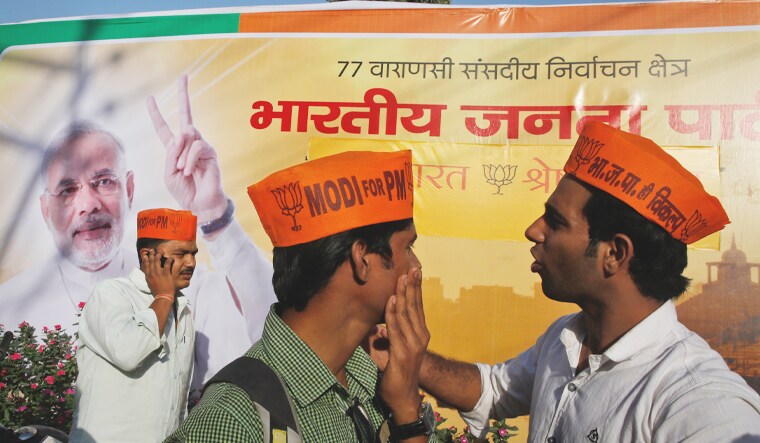
BECAUSE THE BJP is handling its national campaign more slickly and strategically than the Congress, I had expected to find signs of the ‘Modi leher’promised by the party’s strident but generally anonymous social media promoters wherever I went. But where I found enthusiasm for the BJP, it was more often for a promise of better governance and less graft than a dedication to the idea of a future prime minister Modi. (When I asked the BJP’s national spokesperson Nirmala Sitaraman what the party’s top five priorities would be in government her answers were, notably, all economic―constraining the fiscal deficit, introducing selective FDI, and so forth.) The only place where I met unconstrained Modi waving was in Gujarat itself. It came in the traditional Hindu form: as one lady said weepily over illegal evening drinks, “He has made Indians proud again.”But how did the Congress challenge this narrative on Modi’s own turf?
Shankersinh Vaghela, sitting in his palatial house outside Gandhinagar, controlled the BJP in Gujarat until he was ousted by an upcoming Narendra Modi. Now he is with the Congress. His rage against the usurper came quickly to the surface. “It’s all marketing. The people are hypnotised. He’s like Hitler, doing his stuff. He put his photo on a condom packet. What woman would allow her husband to use that for family planning? There is no law and order in the state, there is raping and cow-slaughtering...”I stopped him. How was the Congress going to win seats? “I don’t believe Delhi should choose people for Gujarat’s seats,”he said with a sigh. “I’m the leader here in the state. But, OK; when in Rome, you have to do as the Romans do.”
Vaghela was alluding to how the Congress high command ignored its own people, and parachuted in chosen candidates. Earlier that day I had met Lalji Desai, an impressive man who had started life in a semi-nomadic pastoralist community and now headed an internationally connected NGO in Ahmedabad. Though he was not even a member of the Congress, and had flirted with the AAP, he was contacted of the blue a few months ago by “Team Rahul”, as he termed it. “I suppose they knew I was a community organiser and they had IB reports on me. I felt shy at being inducted. When Rahul Gandhi came to meet the salt pan workers in Kutch, I had to anchor his dialogue with them. Now Team Rahul has made me a general secretary of the Congress party in Gujarat.”It was the opposite of grassroots politics: rather, an unaccountable management team from the capital anointed a member of the public.
Bihar and UP: In the Hindi heartland
EXPECT THE UNEXPECTED in the cow belt. Expect good, swift roads as you drive from Patna to Ghazipur, passing through red and green fields along the side of the wide, grey Ganga. Expect small industry and refrigeration units in the countryside. Expect castes that no longer vote in a bloc, and people who refuse to be beaten down. “Now you cannot slap,”said a Bihari. “Ten years ago in my village, you could slap someone and they wouldn’t say anything.”Expect elections without the ‘tak, tak’of rivals firing guns. Expect the familiar: filth and dereliction in the holy city of Banaras, the roads pitted with potholes. And expect the assertion of dynastic politics in states that for a generation were run by the radical leaders who arose out of the JP movement: Ram Vilas Paswan, Lalu Prasad, Sushil Modi, Nitish Kumar. The netas want to pass on the mantle.
Chirag Paswan, fresh from making his debut in the costly flop Miley Naa Miley Hum, intended to become an MP. At 32, he felt ready. “A politician’s kid is more aware about politics than any other kid,”he said. “But I was very vocal that I wanted to do some movies before politics.”He said he had persuaded his ‘secular’father, Ram Vilas Paswan, to do a 180-degree turn and support the BJP. Why? “With Modi, we will take the country to the next level.”What next level? “In development.”
Paswan junior wore a crisp white shirt and expensive-looking blue jeans. Which designer were they from, if he didn’t mind me asking? “I don’t know if I should say this, but they are True Religion.”
Lalu’s daughter Misa Bharti, with declared assets of Rs.5.5 crore, also hoped to enter Parliament. She was thoughtful, and cautious about saying anything except that she had seen the worst of times as well as the best. Instead, Lalu did the talking, sitting outdoors for his evening durbar on a towel-clad plastic chair, chewing paan, adjusting a burning mosquito coil and gobbing into a spitoon.
A generation ago, 300 people would run in front of Lalu’s rath at night. Now he was at home on bail from jail, with an audience of 50 loyal followers. “Everyone says Modi coming, coming, coming,”he boomed. “What coming? I am here! How will I show my face abroad if he is our prime minister? It will be the same as 1947. There’s an international conspiracy to put in a hardliner, a hidden agenda by very, very cunning hi-fi people.”Lalu was in eclipse, but his brilliance as an impromptu orator was undimmed.
In Patna, an anonymous close associate of Narendra Modi had told me “fifty IITians are at work in Bihar,”running a brilliant shadow campaign, separate from that of the BJP workers. But repeatedly in Bihar and eastern UP, it felt that this technical campaign was not unrolling on the ground, at least at this stage of the election campaign. The talk instead was of the Samajwadi Party, the Bahujan Samaj Party (which was bouncing back with a Dalit-Brahmin-Muslim alliance), the Congress and the Rashtriya Lok Dal, and of smaller parties. If the BJP is to take the 70 or 80 seats it has promised it will win in these two states, something will have to shift-fast.
“If this is a crisis election, the most important one since 1977, I don’t get any feeling of it here,”said a Banaras local leader. “This is not a polarised place. The waves of the Varuna and the Ganga are gentle and sweet, even if the city is still a total mess after having Murli Manohar Joshi as our MP.”
In Jalalipura, a Muslim part of the city, the sentiment was the same. In a narrow lane, watched by a goat wearing anklets, Azizul Haque, a powerloom owner, admitted that the failure of the opposition parties to agree on a joint candidate meant that Narendra Modi would take the seat. Did he feel under threat? “In this city, Hindus and Muslims are interdependent. Hindus sell us silk yarn, we weave it and sell it back to the Hindu traders. We would never vote for the BJP-although some Shias might-but when in government, you have to unite people.”
Were women voting the same way as men, I asked, since the dozens of figures surrounding us were all male. “The guardian of the house decides; there’s no use talking to women about voting,”he said.
Down by the ghat, Sharda Pandey, recently widowed, was carrying a little basket containing a brass pot of rice, and some jaggery and bel leaves. She came from Siwan in Bihar. “I will be here until my death. My entire family have died here,”she said. Were things better now than they were 10 years ago? “A little. When I first came to this place, I used to mix salt and water and have that for a meal.”Who would she be voting for? “I’m not sure. In earlier times, we voted for Indira Gandhi. Now traditionally we vote for the Lotus. Everyone is making noise about Modiji, Modiji.”But would this support in the sacred city spread out across the Hindi heartland?
In the national capital, this feels like the most polarised general election since the late 1990s. The old guard, who have prospered under a decade of UPA rule, are frightened of an outsider bringing change to Lutyens Delhi. Will he, they whisper, seek to destroy the Family? It is undeniable that the BJP has so far had the best campaign, on everything from billboard posters to social media, while the Congress has been inept at trumpeting its achievements. A reluctance to go for the jugular and a lack of clear leadership (who will the Congress put up as prime minister if it wins?) contrast with Modi’s unerring talent for the cruel but effective jibe: calling Kejriwal “AK 49”, or saying of Rahul Gandhi, “The shehzaada is giving sermons and lectures... as if he has come from Mars.”Modi’s own failure to clarify his economic policy, or to answer questions and be interviewed properly, passes under the radar-for he is making the political weather.
How much does all this count? Less than we think. Wooing the newspaper-reading and tweeting classes has limited electoral impact in India. A headline such as “When NCP got 1 lakh likes”tells us nothing, except that journalists enjoy doing Facebook stories (especially since the ‘likes’in question came over three months). “Did you know,”a senior Congress leader asked me, revealing his limited understanding of technology, “that they have put Modi’s face on the first page of Google?”
For many Indians, perhaps for the majority, the imbalance between their own position and the power of the state is so great that all electoral calculations are immediate and transactional. Will the pradhan deliver the new sanitation that has been promised? Will a vote for this party or that party make it more or less likely that I get subsidised rice? In rural and semi-urban areas, there is remarkably little interest in the identity of the potential prime minister. Even in UP, most potential BJP voters only seemed interested in the fact the party was making promises of improved administration and growth.
Similarly, Rahul Gandhi’s long-time championing of weaker sections produced no discernable resonance on the ground. This disjuncture may come from the expansion of remote and nepotistic family politics. Again and again, I was struck by the looming entrenchment of new, aspiring political dynasties. Too many leaders showed an undemocratic sense of entitlement, which was increasingly treated as normal by the media. Let me give a single example: Yashwant Sinha and his son Jayant, who hopes to become an MP, sitting in pomp and being fed questions on a platter by a television interviewer. “What advice do you have for your son as he enters politics?”was one. After his answer had been given, the son praised his father’s wisdom.
Nothing ages worse than images of the future, so projecting the outcome of a general election is a risky business. But here are some possible (or possibly haphazard) predictions:
The Congress will haemorrhage seats, but will hit three figures and not go down to the sort of catastrophic defeat predicted a year ago. The party still has a machine-like ability to turn out the vote on polling day, and its lacklustre campaign belies its structural strength. The NDA will win twice as many seats as the UPA, but the BJP itself will have difficulty getting much above 200. Contrary to rumours, the party will stick with Narendra Modi if it possibly can, while a grand coalition is built. If he becomes prime minister, he will be severely squeezed by potential partners such as the Trinamool Congress and the AIADMK. (Will Jayalalithaa want funds from the Centre, or will she demand control-maybe over power and water? Will Modi give way?) It will be a rag-tag coalition, and keeping it intact will require feats of accommodation and alliance that may not come naturally to the new prime minister. Other regional parties like the BSP, the Biju Janata Dal and the TDP will also be aware of their potential clout if an existing ally falls away.
Then there are the promises. What are the mechanisms that can be used to deliver good governance, or an end to corruption? Where is the capacity of the Indian state, with its drastic shortage of public sector employees, to deliver? When placed under pressure, will Modi remain as restrained over Hindutva as he is as a candidate? And how will he satisfy the corporates who think he is on the verge of unleashing dynamic growth, or the foreign investors who believe he is going to turn India into Singapore? By 2017, the press may be full of disappointed articles about broken election promises.
