



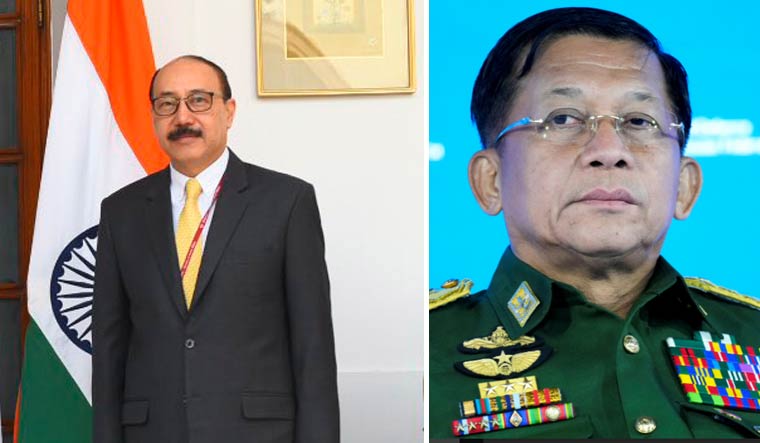
It seems to be business as usual with Myanmar. Foreign secretary Harsh Vardhan Shringla will visit the country from December 22 to 23. This will be India’s first high-level engagement since the coup in February.
“During the visit, Foreign Secretary will hold discussions with the State Administration Council, political parties and members of civil society,’’ the ministry of external affairs said in a release.
“Issues relating to humanitarian support to Myanmar, security and India-Myanmar border concerns, and the political situation in Myanmar will be discussed.”
This will be Shringla’s second visit to the country in two years. He last went army chief General MM Naravane visited Myanmar last year.
The visit comes as America considers further measures to push Myanmar onto the path of democracy. "I think it is going to be very important in the weeks and months ahead to look at what additional steps and measures we can take—individually, collectively—to pressure the regime to put the country back on a democratic trajectory," Secretary of State Anthony Blinken was quoted as saying on December 15. While Blinken did not specify what measures were being taken, he did indicate that “that is something that we are looking at.”
The visit also comes after Aung San Suu Kyi was sentenced to four years of prison on December 6 for inciting dissent and breaking COVID rules. Her sentence has been reduced to two years, but it is the first in the series of 11 charges that Suu Kyi faces. A court hearing a case against her for illegally possessing walkie talkies was to announce the verdict on December 19, but this has reportedly been postponed.
India’s move is unlikely to go down well with democratic groups facing the might of the junta. Earlier in the year, the Indian military attache attended the annual military parade on a day that the junta launched a deadly crackdown. India was one of the eight countries that attended the function. The Civil Disobedience Movement (CDM) of Myanmar asked on Twitter why India—“one of the greatest democracies in the world”—chose to “shake hands with the generals whose hands are soaked with our blood”.
It is unlikely that India will make any headway in trying to soften the military towards democracy. But the inclusion of members in Shringla’s meetings will be an attempt to reduce the blowback from working with a junta that is clearly determined to crush dissent with force.
For India, the visit is possibly an acknowledgement of the help that the military has offered. Last week five insurgents from Manipur were handed over to India—the second time the Myanmar army has delivered. China too has signalled that it is business as usual—in August, Sun Guoxiang, Beijing’s special envoy for Asian affairs, made a surprise visit, according to reports. The visit was to help the country deal with Covid 19. Similar reasoning, possibly, for Shringla’s visit too.
