



After being prevented from retrieving the body of a person who had died due to the suspected Ebola infection, protesters had set the isolation wards at Rwampara General Hospital, near Bunia in Ituri province, on fire. Police had to fire warning shots to disperse the crowd at the hospital.
At the time of the attack, six patients were undergoing treatment. Reportedly, a healthcare worker was injured after being hit by stones. The fire also consumed a body prepared for burial, along with several hospital tents.
According to authorities, a lack of awareness about the disease led to the attack.
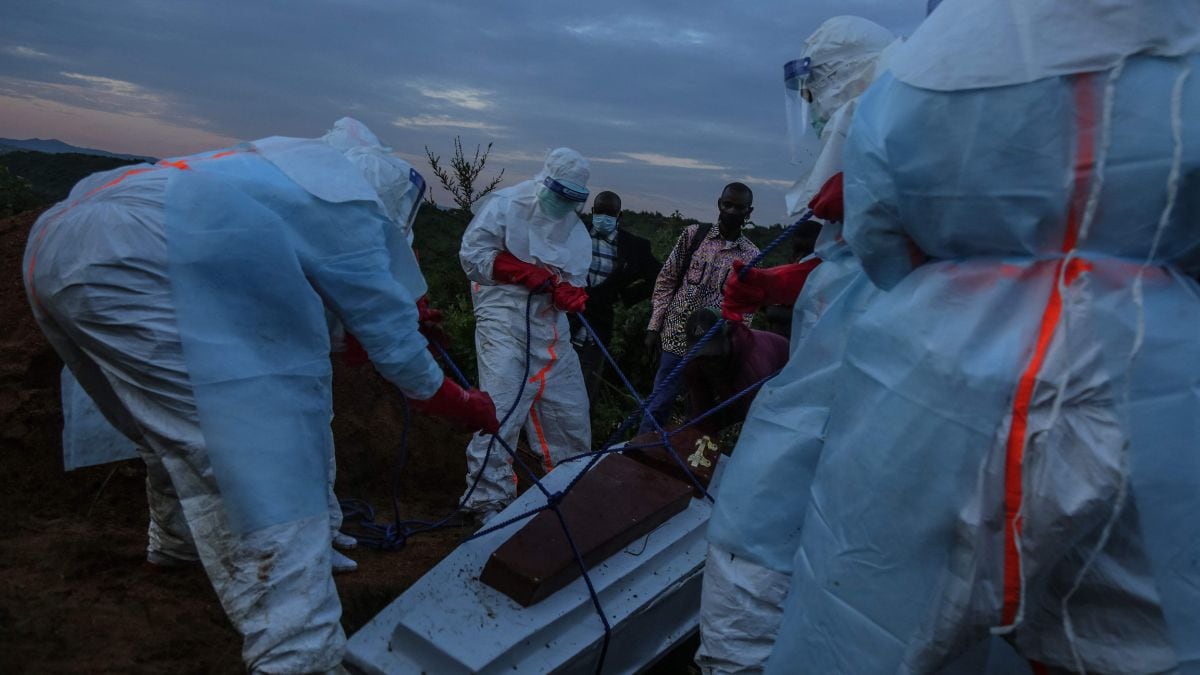
The World Health Organisation (WHO) mandates 'safe and dignified burials' conducted exclusively by trained teams in protective gear.
What is the safe burial protocol for Ebola deaths?
According to the WHO, 20 per cent of the new Ebola infections occur during burials of deceased Ebola patients.
* PPE kit: The team must don full Personal Protective Equipment (PPE), including fluid-resistant gowns, double gloves, face shields, and rubber boots.
*A dedicated team member acts as a communicator to sit with the family, explain exactly what is going to happen, and obtain consent before any action is taken.
*Traditional practices like washing, dressing, or kissing the deceased are completely prohibited, as the skin and bodily fluids are highly infectious.
*Only the trained team handles the body.
*The room and the body are sprayed with a 0.5% chlorine solution (a powerful disinfectant that kills the virus on contact).
*The body is placed inside a secure body bag, zipped closed, wiped down with disinfectant, and then placed into a second body bag or a coffin. Once sealed, the bags are never reopened.
*Before the final sealing, family members are permitted to view the face of their loved one from a safe distance (at least 1 meter) to confirm identity and achieve closure.
*Spiritual leaders (Pastors, Imams, etc.) are allowed to perform prayers and funeral rites at the home or the graveside, provided they maintain physical distancing rules and do not touch the body or the coffin.
*The grave must be dug to a depth of at least 1.5 to 2 meters (about 5 to 6 feet) to prevent scavenging animals from disturbing the remains.
*Once the body or coffin is lowered, the burial team carefully removes their PPE using a precise "doffing" sequence to avoid self-contamination. All single-use gear is burned or buried in a designated pit on site, and reusable items such as boots are thoroughly disinfected with chlorine.
