



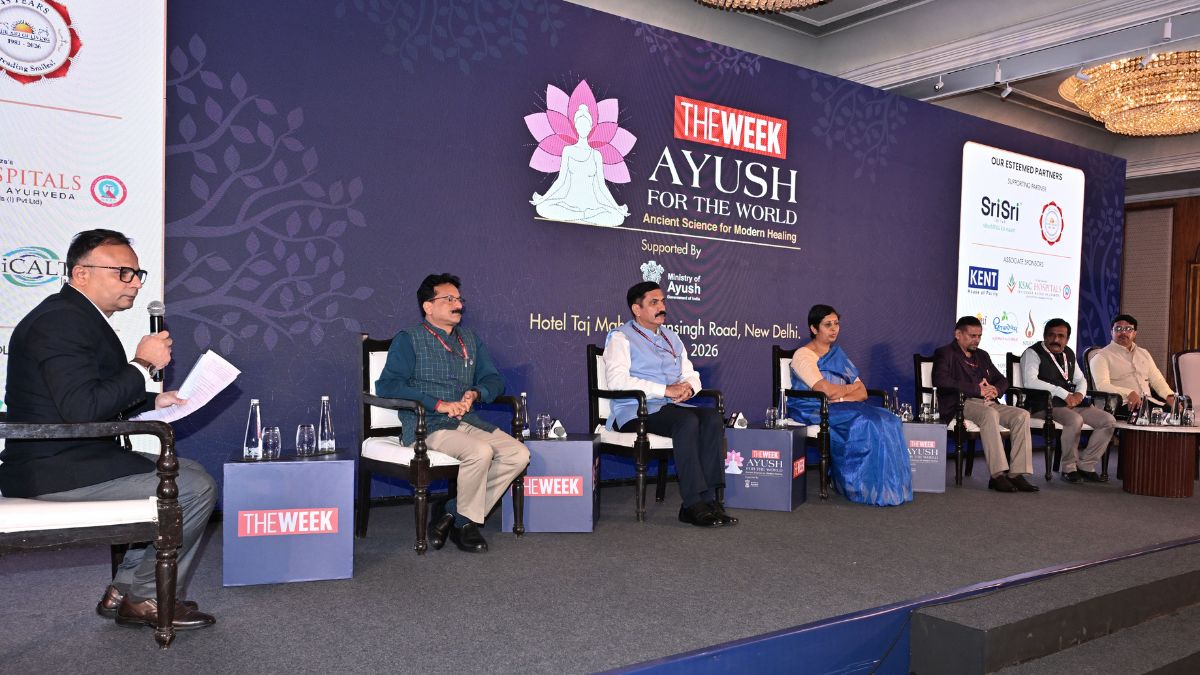
A very insightful discussion on “The Future of Ayush” on Saturday laid out the broad roadmap for Indian traditional medicine and healing systems that have been witnessing growing popularity and acceptability not just at the national level but also across the globe.
The Ayush ministry includes Ayurveda, Yoga, Unani, Siddha, Homeopathy with the Buddhist traditional healing system of Sowa Rigpa being the most recent entrant into the Ayush fold.
The panel discussion at THE WEEK’s conclave, themed “Ayush: For the World”, saw leaders from the various Indian traditional systems coming together to brainstorm on the way ahead.
The panelists included Prof Rabinarayan Acharya, director general, Central Council for Research in Ayurveda Sciences (CCRAS), Dr Subhash Kaushik, DG, Central Council for Research in Homoeopathy (CCRH), Alarmelmangai D., joint secretary in the Ayush ministry, Dr N. Zaheer Ahmed, DG, Central Council for Research in Unani Medici ne (CCRUM), Dr NJ Muthukumar, DG, Central Council for Research in Siddha (CCRS), Dr Kashinath Samagandi, Director, Morarji Desai National Institute of Yoga and Dr Padma Gurmet, Head of the Leh-based National Institute of Sowa Rigpa. The session was moderated by THE WEEK’s Pratul Sharma.
Highlighting the holistic character of the Indian traditional systems, Alarmelmangai D. pointed out that with the focus on being preventive rather than being curative, there is an abiding need to move out of it because the Indian systems cater not just to the physical requirements but also the mental, emotional and spiritual imperatives of an individual. And therefore all the more reason to spread them all. On the growing popularity, she pointed out that many Ayush OPD centres across the country are seeing “more than 2,500 footfalls a day”.
Interestingly, the Ministry of Ayush's Amrit Kaal vision 2047 aims to establish India as a global leader in holistic health, making traditional medicine part of every household with a strategy that focuses on bridging traditional knowledge with modern technology, enhancing research, ensuring quality, and creating an integrated, affordable, and accessible healthcare system.
These are ambitious aims given that the Ministry of Ayush was formed in November 2014, but the tempo at which it is progressing towards achievement of its set goals and gaining acceptability for betterment of holistic health underlines the fact that it is at a “take-off” stage.
All the panellists concurred on the need for more evidence-based research based on an effective and scientific system.
Prof Acharya pointed out the lack of a proper and effective communication mechanism on the efficacy of the Ayurvedic system, while adding that there needs to be a focus on geriatric research, as India will have a substantial elderly population in a few decades, as it is a country with the world’s biggest youngest population now.
Dr Kaushik said while allopathy is still the preferred mode of treatment for emergencies, the traditional Indian systems have shown great effectiveness in dealing with non communicable diseases.
Dr Ahmed spoke of the Grecian origins of Unani, but that was brought to India by the Mughals after being enriched by the flora and fauna-based medicinal systems of many regions and countries. He vouched for “medical pluralism”, which is based on the documented and validated community-based skills and practices.
Admitting that the language barrier had been a huge problem in propagating the knowledge base and practices of the Tamil-based Siddha system, Dr Muthukumar pointed out that with the Ayush Ministry’s help, everyone across the country should avail the benefits of Siddha.
Alluding to the holistic appeal and applicability of Yoga, Dr Samagandi underlined the need to integrate yoga into every individual’s life as every ailment is due to lifestyle and stress.
Pointing out that the first sermon on Sowa Rigpa was given by the Gautama Buddha himself, it has a very strong spiritual dimension that is aligned with the achievement of salvation and hence offers a 360-degree approach to a healthy body and mind.
