



CLAIM:
Eating food on banana leaves provides health benefits because the leaf contains a waxy coating rich in antioxidants (polyphenols). When hot food is served on it, this layer melts and mixes with the food, making it healthier to consume.
FACT:
Banana leaves do contain antioxidants like polyphenols and may have antimicrobial properties, but these benefits are mainly seen in lab studies or extracts. There is no strong evidence that simply serving hot food on banana leaves transfers enough nutrients to provide real health benefits, though they remain a safe, eco-friendly option.
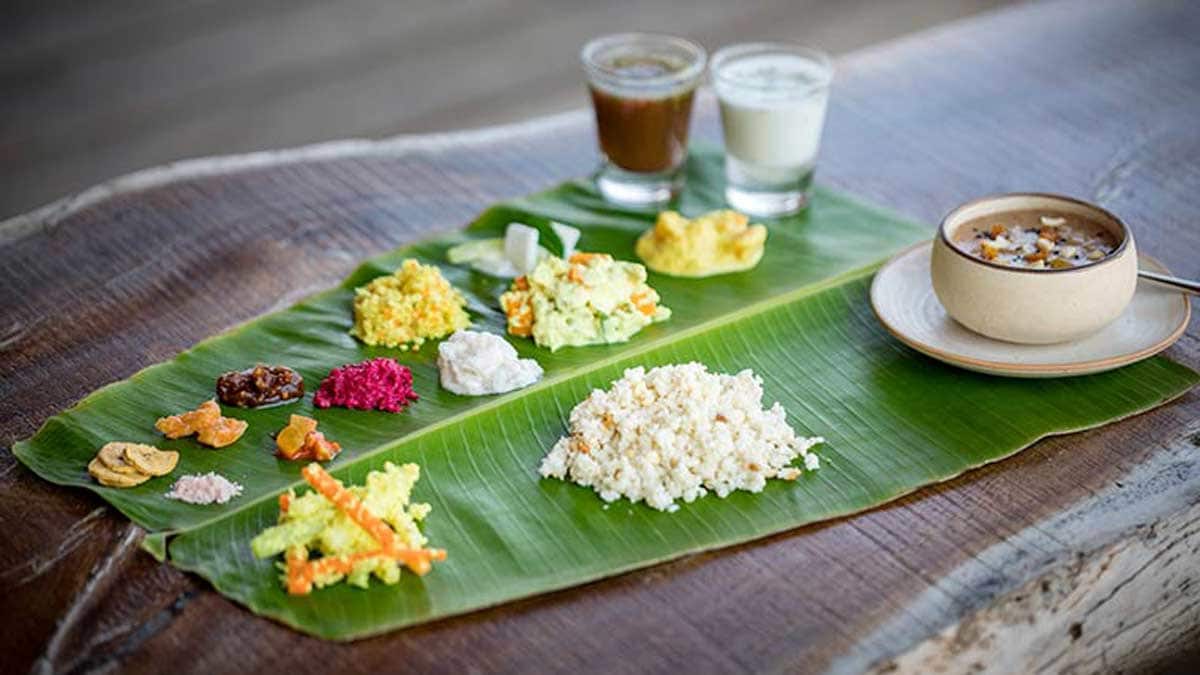
You must have seen people eating food on banana leaves in many parts of India, as well as across Southeast Asia - such as Indonesia, Malaysia, the Philippines, Thailand, and in Sri Lanka. The practice is deeply rooted in tradition and is often associated with festivals, temple meals, and community feasts.
In a recent viral reel posted by AgniV, a young content creator who has over 1 million followers on Instagram, the creator attempts to explain the science behind this age-old practice. According to his YouTube bio, he describes himself as a “multilingual boy who can speak Tulu, Tamil, English, and Learning Kannada,” and is “curious to know things around” him.
In the reel, he explains that eating on banana leaves may have health benefits due to the presence of a waxy coating. He claims, “it has a waxy substance which is a good antioxidant called polyphenol. So when the hot food touches the waxy substance, it melts down and gets mixed with the food.” He adds that consuming this could be beneficial, as “the antioxidants go and it's good for your health.” The video also shows him demonstrating how to cut and use the banana leaf for eating.
The reel has gained massive traction online, amassing over 7.5 million views, 4.96 lakh likes, and 1.38 lakh shares, sparking curiosity about whether this traditional practice actually offers real health benefits.
Does eating on banana leaves have real health benefits?
Available research suggests that while banana leaves do have beneficial compounds, the direct health impact of eating on them is less clear.
A 2018 review highlights the long-standing cultural and practical use of leaves as plates, noting that “leaves are the prime plates used for serving food” and have been used since ancient times for their convenience and hygiene. It adds that banana leaves are “huge, thick, and not easily punctured,” making them suitable for serving food. The review also mentions that “banana leaves contain a lot of polyphenols, a characteristic cancer-preventing agent,” and may enhance the aroma and taste of food. However, much of this discussion is rooted in traditional knowledge and cultural beliefs rather than measured health outcomes.
Building on this, a 2023 study on the banana plant emphasises its rich nutritional and medicinal profile. It notes that bananas and their plant parts are “loaded with ample nutrients” and contain “phenolics, flavonoids… and other bioactive compounds required for wellbeing of human health.” The study also highlights that different parts of the plant, including leaves, have been used in traditional medicine for their antioxidant, antimicrobial, and anti-inflammatory properties. However, these benefits are largely linked to extracts or direct consumption of plant parts, not specifically to using leaves as plates.
Further evidence comes from a 2025 review, which examines banana leaves as a source of bioactive compounds. The study found that banana leaves contain significant levels of polyphenols, flavonoids, and tannins, with extracts showing “highest antioxidant activity… and antifungal activity against Candida albicans.” It concludes that banana leaves have “potent biological potential” in controlled laboratory settings.
These studies confirm that banana leaves do contain beneficial compounds and may have antioxidant and antimicrobial properties. However, there is limited scientific evidence to show that simply serving hot food on banana leaves transfers enough of these compounds to provide meaningful health benefits.
What experts say?
Dietitian Rajeshwari Panda, HOD – Nutrition & Dietetics Department, Fortis Hospital, Mulund, said that while banana leaves do contain beneficial compounds, their impact depends on how they are used.
She said that banana leaves “do contain polyphenols and antioxidants, which are very much helpful for our body,” especially in tackling free radicals. However, she explained that there are “no foolproof claims or studies on it,” especially when it comes to directly serving food on banana leaves and deriving clear health benefits from it.
According to her, there is a possibility of some nutrient transfer, but it is limited. “There is a chance of the polyphenols getting transferred into food also, but just serving the food on that is not enough,” she said. She further explained that methods like steaming food in banana leaves are more likely to facilitate this transfer.
At the same time, she said banana leaves can be a practical and safer alternative. In her words, “there is no harm in eating on banana leaves,” and even a small potential benefit, along with advantages like biodegradability and better hygiene compared to poorly washed utensils, makes it a reasonable choice.
This story is done in collaboration with First Check, which is the health journalism vertical of DataLEADS
