



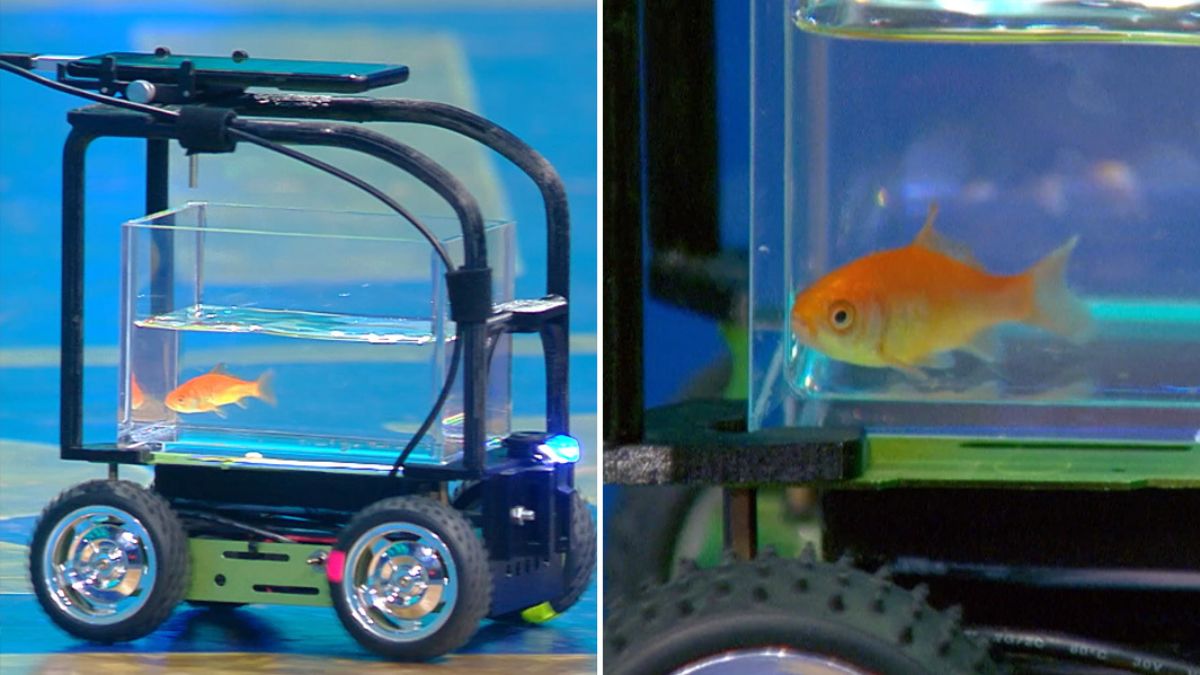
From the fishbowl to the fast lane: Blub, an Italian goldfish, has secured a Guinness World Record for driving a car. By navigating 40 feet in just one minute using a motion-sensing vehicle, Blub proved that even the smallest aquatic minds can master the mechanics of the road.
Computer engineer and pet owner Thomas de Wolf was the man behind the motorised invention.
How can a fish drive a car?
The fish-operated vehicle (FOV) developed by Wolf functions through a sophisticated translation of movement into mechanical action. The success of the invention has profound implications for the future of assistive technology.
The vehicle has a camera mounted above the water tank that monitors the fish's position and orientation. This motion-sensing camera detects movement when the fish moves to a particular direction, and in turn, the car moves in that direction.
An onboard computer processes the fish's "intent"—for example, if the fish swims toward a specific side of the tank, the computer interprets this as a directional command.
The wheels of the vehicle move in the direction the fish is facing. If Blub swims toward a target (usually a red board for a food reward), the car moves toward that target.
How can it be helpful for people with physical impairments?
In future, the technology could be useful for those suffering from physical impairments.
1. Non-invasive navigation for paralysis: For those suffering from quadriplegia or ALS (Amyotrophic Lateral Sclerosis), traditional joysticks are not an option. The FOV technology proves that computer vision can track any subtle movement—like eye tracking or slight head tilts—and translate it into smooth, multi-directional movement for a wheelchair.
2. Adaptive 'intent' algorithms: The software used for Blub filters out "noise" (random swimming) from "intent" (swimming toward a goal). In the future, smart prosthetics or wheelchairs could use similar AI to distinguish between a user’s accidental muscle twitch and an intentional command to move, reducing "driver fatigue" for those with motor control issues.
3. Spatial awareness aids for the visually impaired: Blub learned to navigate an unfamiliar terrestrial environment from within an aquatic one. This "cross-domain" navigation could lead to devices that translate environmental data (via LiDAR) into sensory feedback—such as haptic vibrations or audio cues—helping visually impaired individuals navigate complex 3D spaces.
