



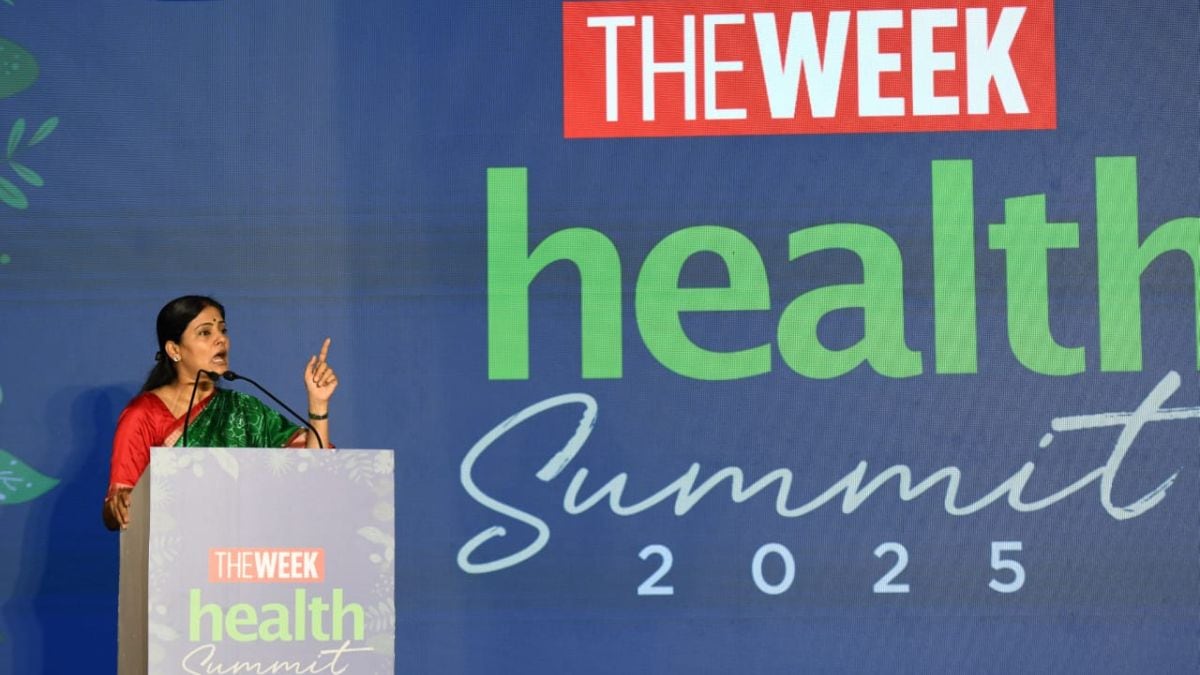
“Only a healthy India can be a developed India,” Union Minister of State for Health and Family Welfare and Chemicals and Fertilizers Anupriya Patel stated as she opened The Week Health Summit 2025. Her words set the summit’s tone, a call to action that urges policymakers, clinicians, innovators, and citizens to collectively drive India’s next chapter in healthcare transformation.
The minister’s keynote was a sweeping articulation of the government’s roadmap, shaped by the lessons of Covid-19 and the growing burden of non-communicable diseases. “Pandemics can hit us anytime,” she warned. “Universal health coverage is not a choice, it is a must.” A nation of 1.4 billion, she said, demands a health system that is not just reactive but resilient, decentralised and digitally empowered.
Before her address, Riyad Mathew, Chief Associate Editor and Director of THE WEEK, welcomed the minister and the assembled audience. He reaffirmed the magazine’s enduring commitment to health journalism and its role in bridging public understanding across urban, semi-urban and rural India. “We see ourselves as part of this movement with the Government of India,” he said, underscoring the summit’s theme: learning from global best practices while honouring India’s own strides.
Government’s strategic approach to strengthening healthcare infrastructure
Patel’s speech highlighted the government’s efforts to expand health budgets year after year, coupled with decisive structural reforms. A major focus, she said, has been strengthening primary and secondary healthcare so that tertiary centres do not crumble under pressure. The establishment of 23 AIIMS, the expansion of medical seats, and investments in district-level care reflect this push toward decentralised access.
At the heart of this strategy is prevention. “Healthcare is not only the responsibility of the minister but of every citizen,” she said. Initiatives like Ayushman Arogya Mandirs aim to fortify primary care at the grassroots, promoting early detection and preventive practices. Public-private partnerships, she added, are being encouraged through programmes like the Pradhan Mantri Ayushman Health Project, ensuring that India’s health infrastructure grows on both public and private pillars.
The minister outlined the government’s five foundational pillars for the sector—preventive, promotive, curative, rehabilitative and palliative care. She called GST 2.0 a game changer, pointing to exemptions on life-saving drugs as proof that fiscal reforms are complementing health reforms. On tuberculosis, Patel said India’s integrated strategy is showing outcomes: a 70.7% decline in TB cases, which she described as a result of “a sustained 360-degree approach.”
Digital health transformation: Building resilience for future pandemics
Digital health formed another core theme of her address. The Ayushman Bharat Digital Mission, unique health IDs for all citizens, teleconsultations through e-Sanjivini, and blood-bank digitisation through e-Raktkosh are not just technological add-ons, she argued; they are transforming India’s health ecosystem. “We have learnt from Covid, and we understand the importance of self-reliance,” she said, pointing to the government’s push to manufacture medical devices domestically.
Patel also revealed that the government is preparing a National Action Plan for future pandemics, an anticipatory framework to ensure that India never again finds itself unprepared for global health emergencies.
The summit carried not just policy, but culture. A serene Bharatanatyam prayer dance by Bhadra Sinha and Gayatri offered a meditative pause, capturing the harmony between wellness, tradition and resilience.
“Today, the minister has given us a comprehensive and candid view of India’s healthcare landscape, the challenges ahead, and how her team intends to work in the coming months," said R. Prasannan, Resident Editor at THE WEEK.
The Week Health Summit 2025 became a crucible of ideas, where India’s best minds reflected on challenges and solutions, and where the minister’s message resonated through every session, health is a shared national priority. To build a developed India, she reminded the audience, the nation must first build a healthy one.
