



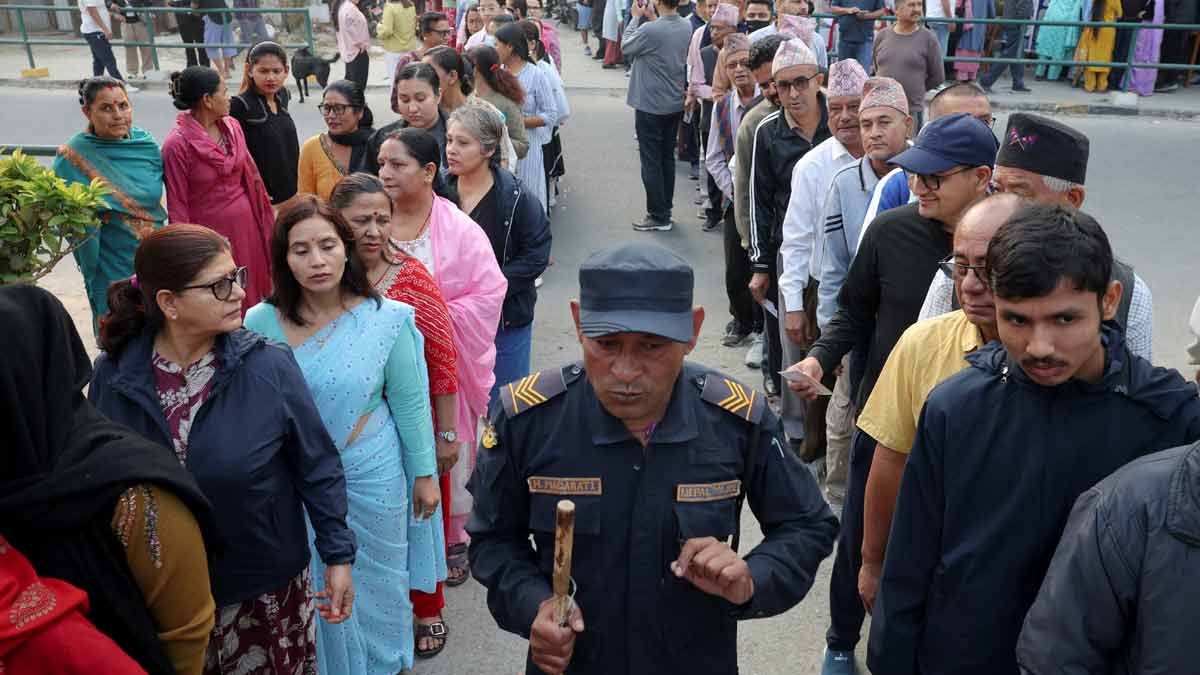
Polling is underway in Nepal for the general elections, the first since the Gen Z-led protests that toppled the government of K.P. Sharma Oli last year.
More than 18.9 million citizens are eligible to vote in the election to choose members of the 275-seat House of Representatives (HoR). A total of 3,406 candidates are contesting 165 seats under the direct voting system, while 3,135 candidates are competing for 110 seats through the proportional representation system.
Across the country, 10,967 polling booths and 23,112 polling centres have been set up. Voting began at 7 am and is scheduled to conclude at 5 pm.
According to media reports, Nepal’s political landscape is sharply divided between those supporting the demands raised during the Gen Z protests and traditional political forces that are less inclined toward sweeping reforms.
Oli's Communist Party of Nepal (Unified MarxistLeninist) and Pushpa Kamal Dahal ‘Prachanda’-led Nepali Communist Party are widely seen as representing the traditional political establishment. On the other hand, the Rastriya Swotantra Party (RSP) led by Ravi Lamichhane and the reformed Nepali Congress led by Gagan Thapa have positioned themselves as voices supporting the concerns raised by the Gen Z movement.
Newer political groups such as Kulman Ghising’s Ujyalo Nepal Party and Harka Sampang’s Shram Shakti Party have also entered the electoral arena, though their influence remains limited to certain regions.
The RSP has named former Kathmandu mayor Balen Shah as its prime ministerial candidate, while the Nepali Congress has projected Gagan Thapa as its PM face. Meanwhile, K.P. Sharma Oli remains the prime ministerial candidate of the CPN-UML.
India is closely watching the election, as its outcome could shape the future trajectory of relations between New Delhi and Kathmandu, including their strategic and economic cooperation.
India is Nepal’s largest trading partner, and a significant portion of Nepal’s trade with third countries passes through Indian ports and transit routes. A friendly government in Kathmandu could help ensure continuity in existing policies and bilateral agreements, particularly at a time when China’s influence in Nepal is growing.
Additionally, five Indian states share an open border with Nepal, allowing free movement of people between the two countries. Political stability in Nepal is therefore crucial for maintaining border security and law-and-order along the frontier.
India has also invested in several infrastructure and development projects in Nepal. A government less inclined toward cooperation with New Delhi could potentially affect the smooth progress of these initiatives.
