



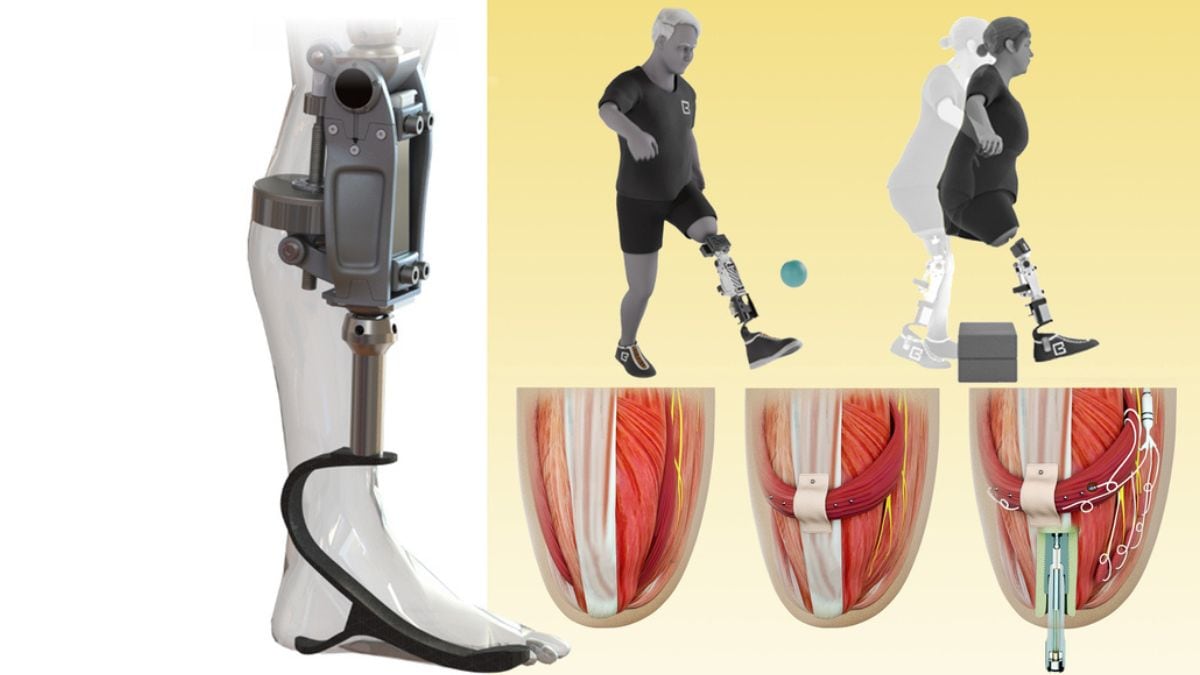
In a move to assure better quality of life, researchers from the Massachusetts Institute of Technology (MIT) have developed a new bionic knee that can restore natural movement.
This new development can help people with amputations above the knee to walk faster, climb stairs and avoid obstacles in their way with much ease, in comparison to using a traditional prosthesis.
What makes this bionic knee different?
In the traditional method, the residual limb sits within a socket, while the new system is directly integrated with the individual's muscle and bone tissue.
Why is this done?
By integrating it into the user's muscle and tissue, it gives the individual better stability and eventually more control over their movements.
“A prosthesis that's tissue-integrated — anchored to the bone and directly controlled by the nervous system — is not merely a lifeless, separate device, but rather a system that is carefully integrated into human physiology, offering a greater level of prosthetic embodiment. It’s not simply a tool that the human employs, but rather an integral part of self,” says Prof Hugh Herr, co-director of the K. Lisa Yang Center for Bionics at MIT.
As per MIT, people who participated in the study reported that the limb felt more like their own body.
How does it work?
This new surgical approach, also known as agonist-antagonist myoneuronal interface (AMI), reconnects the muscle pairs so that they still dynamically communicate with each other within the residual limb. This sensory feedback helps the user to decide how to move the limb, and also generates electrical signals that can be used to control the prosthetic limb, explained MIT.
A 2024 study explored how people with amputations done below the knee who received the AMI surgery were able to navigate better. The latest study extended the approach to develop the new bionic knee.
