



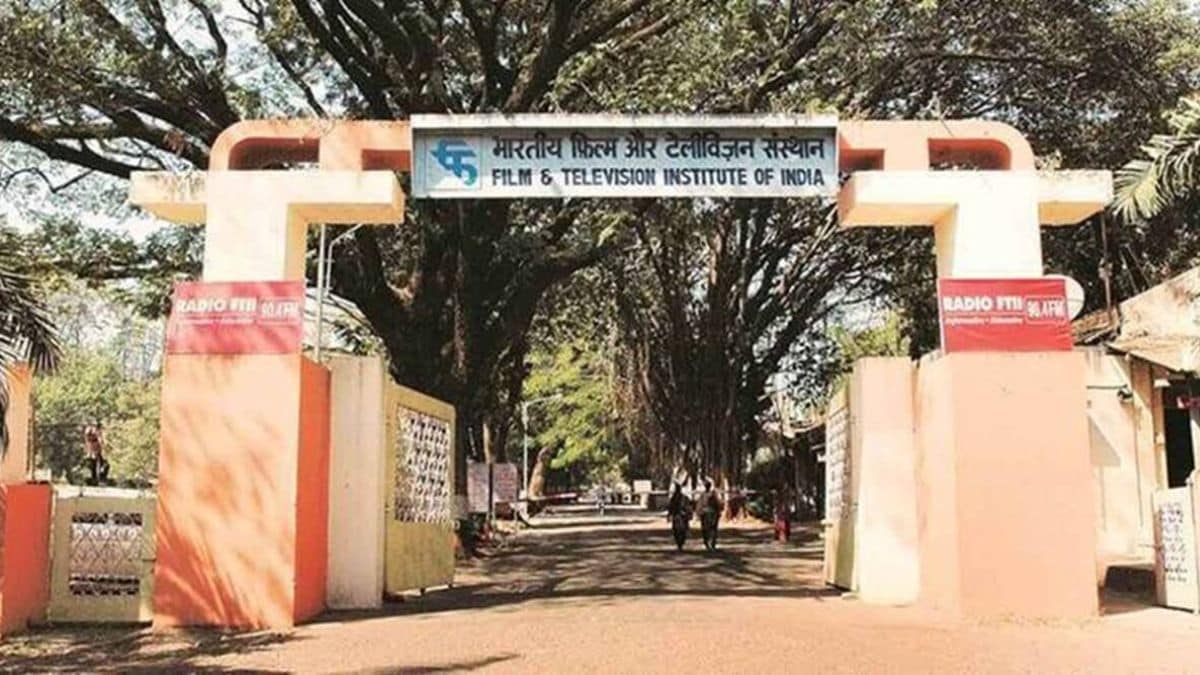
Earlier this year, I attended the New York Indian Film Festival and was immediately struck by the strong performance of films by FTII alums.
It spanned generations. Sholay: The Final Cut, which kicked off the festival — 4K restored for its 50th anniversary — played to a highly revved-up audience, clapping, whistling, shouting out famous dialogues before the actors on screen could.
The cast and crew featured three FTII alums: Jaya Bachchan, who played the beautifully restrained daughter-in-law; Asrani, the bungling British-era jailor; and Kuldip Sud, who did the sound recording for Sholay. All three alums were from the early days of the Film and Television Institute of India (FTII), graduating in 1970, 1965 and 1964 respectively.
The festival witnessed several competing films by FTII alums of more recent vintage. The festival’s top honour — the Best Film award — went to Baksho Bondi, co-directed by Tanushree Das and Saumyananda Sahi, FTII graduates from 2011 and 2016, respectively.
The Best Documentary award went to Waai, directed by Sainath Uskaikar, from FTII’s batch of 2020. Among the nominees were Aasmani, the directorial debut of actor Sayani Gupta (FTII 2011); Razaa by Pooja Tolani (FTII 2008); and Room at the Farm, co-directed by Jasmine Kaur Roy and Avinash Roy, both 2004 alums.
An impressive performance, no doubt, but the larger point this microcosm of the festival demonstrated is the inherent ability of FTII alums to perform across a variety of film genres. Sholay and Baksho Bondi are as different as different can be: one, the epitome of film as entertainment and commerce, the ultimate box-office blockbuster turned cult classic; the other, a modest-budget Bengali-language arthouse film, which has found much love on the festival circuit, winning recognition and awards along the way.
Indeed, film in all its myriad avatars — small and big; entertainment and art; national and regional; feature and short; fiction and documentary; television serials, OTT platforms and even ad commercials — has had an impact from FTII talent.
Before FTII opened its doors in 1961, film education was a strange concept in the country. Filmmaking was learned on the job. While this worked reasonably well in the pioneering days (thanks to the studio system) and produced many spectacular films and iconic filmmakers, by the time the Government appointed the S.K. Patil Enquiry Committee a few years after Independence, the broader film industry was in near-harakiri mode. Chaos reigned. Quality of films declined. Financial health had hit rock bottom. Among its many recommendations, the Committee also asked the Government to set up a film school so trained filmmakers could bring much-needed professionalism to the business and help India compete at an international level.
I have spent the last few years writing a book on my father, Jagat Murari, who built FTII from the ground up in the 1960s and 1970s. He took the Committee’s recommendations several notches higher. In his vision, FTII alums would transform the entire film industry — heighten its creative tenor and technical prowess, infuse social consciousness into its storytelling, and participate robustly in every aspect and genre of filmmaking. They would infiltrate every nook of the industry and, year by year, film by film, reshape its very DNA.
How do you change the DNA of an entire industry? By changing the DNA of the filmmakers — directors, actors, cinematographers, editors, sound designers, scriptwriters — who populate the industry. Jagat Murari did exactly that, putting in place a program that would help his student-filmmakers master their craft, while simultaneously nurturing an environment that would make them free-thinking artists.
Soon FTII was turning out top talent by the scores, the likes of Jaya Bachchan and Shabana Azmi, Adoor Gopalakrishnan and Subhash Ghai, Mani Kaul and K.K. Mahajan, and other cinema legends, as a matter of routine. They not only became some of the most significant names in Bollywood and beyond, but also spearheaded the Indian New Wave, kickstarted regional language cinema, and ushered television into the country.
How do you foster originality? Broaden perspectives? Expand the cinematic vocabulary of young filmmakers? FTII students saw not just Indian cinema, but also the very best of global cinema, absorbing Soviet montage, Italian Neorealism, the French New Wave, the Japanese masters, and more. They studied not only the works of Satyajit Ray and Ritwik Ghatak, but also internalised those of Sergei Eisenstein, Orson Welles, Vittorio De Sica, Akira Kurosawa, Ingmar Bergman, Jean-Luc Godard, Federico Fellini, to name just a few. A film was screened every day.
Alongside this gluttonous diet of films, a steady stream of the finest filmmakers of the time — Indian and international — came to FTII to serve as guest lecturers. Among the first was David Lean, fresh off the success of Lawrence of Arabia. The duo of Ismail Merchant and James Ivory, who had just released their first film, The Householder, came too. With visitors on campus ranging from Satyajit Ray to Raj Kapoor, Akira Kurosawa to Richard Attenborough, Balraj Sahni to Kamini Kaushal, students learnt from the best in a stimulating atmosphere where a diversity of viewpoints was heard and vigorously debated.
One of the first outcomes of training this new kind of filmmaker was the Indian New Wave of the 1970s and 1980s. Spurning Bollywood’s big-budget, glitzy-stars, song-and-dance formula, this movement thrived instead on small budgets, new actors, literary stories, realistic locations, and an examination of social issues. Film was repositioned as an art form. Mani Kaul’s Uski Roti, Saeed Akhtar’s Arvind Desai ki Ajeeb Dastaan, Ketan Mehta’s Mirch Masala, and Kundan Shah’s Jaane Bhi Do Yaaron all emerged from the same FTII-trained ecosystem. Shabana Azmi, Naseeruddin Shah, and Om Puri, trained in Method Acting at FTII, delivered realistic performances, which became another defining feature of the New Wave.
Regional language cinema burst forth across the country in tandem. From Malayalam, Adoor Gopalakrishnan’s Swayamvaram set the ball rolling; in its wake followed the work of Girish Kasaravalli in Kannada, John Abraham in Tamil, Jahnu Barua in Assamese, Manmohan Mahapatra in Odia, among others — all FTII alums.
FTII’s impact on Bollywood is arguably the most emphatic, and the least talked about. For this is where the majority of FTII alums gravitated, raising standards from within the industry. Subhash Ghai, known for blockbusters like Khalnayak and Ram Lakhan (and dubbed the “ultimate showman of Indian cinema”), told me he regards Ritwik Ghatak as his guru from his FTII days, regularly watches art cinema and applies his learnings to commercial cinema. Shabana Azmi straddles both art and commercial cinema, and brings the same acting prowess to both. Sanjay Leela Bhansali’s sumptuous films speak to a level of artistic and technical sophistication not seen earlier.
Influences travel, lines blur, and lessons ingrained by FTII students have found expression in whichever side of the aisle these filmmakers have chosen to work. Collectively, they have helped Indian cinema become the global powerhouse it is today.
Radha Chadha is a columnist and author, most recently, of The Maker of Filmmakers: How Jagat Murari and FTII Changed Indian Cinema Forever (Penguin Random House).
