



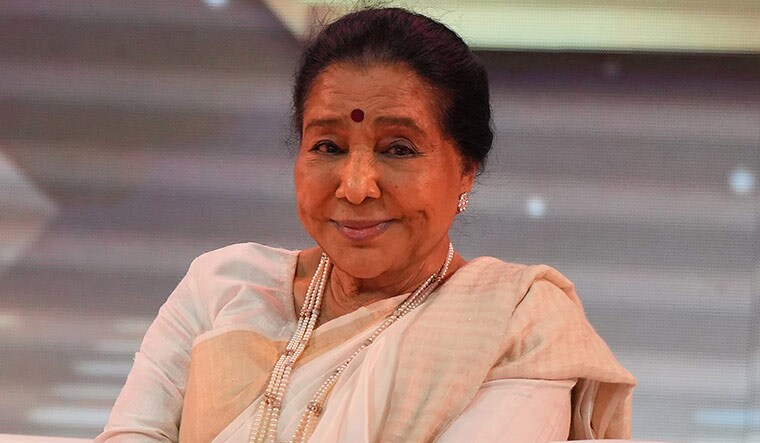
If Indian playback singing had rules, Asha Bhosle spent a lifetime quietly breaking them.
At a time when female voices in Hindi cinema were often expected to sound pure, restrained, and uniformly 'pleasant', Bhosle brought in something far more unpredictable by adding texture, attitude, and a willingness to experiment. She could sound flirtatious, melancholic, and playful with equal fervour. In doing so, she expanded not just her own repertoire, but the very idea of what a playback singer could be.
"Asha Bhosle’s public persona stood in sharp contrast to that of Lata Mangeshkar, while Mangeshkar cultivated an aura of devotion and respectability, Bhosle came to be seen as the voice of versatility, often associated with sensuous expression. But this idea of ‘versatility’ is, in many ways, insufficient. It fails to capture the varying thresholds, tonal ranges, and intensities that define her singing. Drawing on Roland Barthes’ notion of the ‘grain of the voice,’ one can better understand Bhosle’s unique vocal style marked by her remarkable ability to deploy pitch variations and non-verbal sonic textures,” says Shikha Jhingan of Jawaharlal Nehru University, in her paper Volatile Scales, Contingent Bodies: The Many Voices of Asha Bhosle.
Her career is often described through its staggering numbers, with thousands of songs. But what made Bhosle extraordinary was not just how much she sang, but how differently she sang each time.
"Listen closely, and her voice shifts shape depending on the composer, the character, and the emotional world of the song," says Jhingan.
"With O.P. Nayyar, there was a teasing sharpness, a rhythmic swagger; with R.D. Burman, the voice became experimental. In her ghazals, it softened into something more introspective, almost meditative. She could be three different singers in the same decade," those who have known her up close in the industry, tell THE WEEK.
Her ability to adapt was instinctive. "She had an uncanny understanding of performance, of how a voice could inhabit a character without overwhelming it, says well-known and deeply respected flautist Rakesh Chaurasia.
And yet, for all her range, some say she was often boxed in during her early years. She became the go-to voice for cabaret numbers and 'bold' songs, tracks that required a certain daring that mainstream heroines were not yet allowed to express. While this could have limited another singer, Bhosle turned it into a space of reinvention.
Instead of resisting the label, she expanded it. The so-called 'cabaret singer' delivered some of the most technically nuanced and emotionally layered performances in Hindi cinema. The voice that sang Piya Tu Ab To Aaja could also deliver the haunting depth of Dil Cheez Kya Hai. That contradiction became her signature.
Bhosle was already moving across genres from film songs, non-film albums, ghazals, pop experiments, and later, international collaborations.
In the 1990s and early 2000s, when many of her contemporaries had stepped back, Bhosle was still reinventing herself, working with younger composers, lending her voice to remixes, and reaching audiences who had not grown up with her music. “She never sounded dated,” says Chaurasia.
Perhaps what makes her legacy so enduring is that it resists simplification. She was not just the voice of glamour, or sorrow, or romance. She was all of it and often within the same song. Asha Bhosle thrived on change. She refused to be defined by a single style, a single image, or even a single era.
