



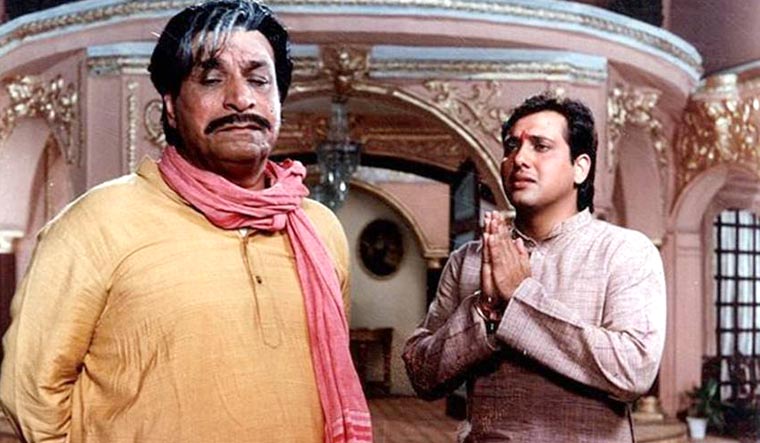
Kader Khan was always more than the sum of his 300-odd roles, the consummate multi-hyphenated Bollywood artiste who left his imprint on commercial cinema through not just his portrayal of characters, ranging from buffoon to bad man, but also his more than 250 writing credits.
Engineer-scriptwriter-actor-dialogue writer, Khan, who died in Toronto at 81 before he could see the dawn of a new year, was all these and more. For those who grew up in the 1980s and 1990s on a staple diet of commercial films that either featured him or were penned by him, Khan was that rare personality who was important on screen and off it, too, with his stamp in blockbusters such as Amar Akbar Anthony and Muqaddar Ka Sikandar.
Unusually, for someone who spent so much of his life in showbiz, there was little known about his private life.
Before he slipped into the skin of his characters on screen—providing easy laughs and sometimes empathy in a range of films good and bad—Khan took his first tentative steps in Bollywood as a back-end writer giving shape to storylines.
The Kabul-born Pathan started his career as a professor of civil engineering before being pulled into the world of showbiz as a writer. Khan was famously spotted by screen legend Dilip Kumar while he was performing in a play at his college's Annual Day function.
It was the era of grand commercial films and the romantic hero of the 1960s and the early 1970s was already ceding ground to the 'angry young man', embodied by Amitabh Bachchan.
In 1972, he made his debut as a writer with the Jaya Bhaduri-Randhir Kapoor teen romance Jawani Diwani, still remembered for its music and its portrayal of young love.
Khan went on to deliver some of Bollywood's best written screenplays and whistle-worthy dialogues in hits such as Agneepath and Shola Aur Shabnam.
He stepped in to help shape Bachchan's career after Salim-Javed, who wrote Zanjeer and Sholay, went their separate ways in 1982.
It was Khan who gave Bachchan some of his career's biggest hits with memorable dialogues and writing in a series of films—Sharaabi, Lawaaris, Muqaddar Ka Sikandar, Naseeb and Agneepath, for which the megastar won his first National Film Award for Best Actor in 1991.
Khan and Bachchan were the thread that tied rivals Manmohan Desai and Prakash Mehra.
The civil engineer-turned-hit writer also helped cement Govinda's career with his sharp dialogue and screenplays in Coolie No. 1, Raja Babu and Saajan Chale Sasural. The troika of filmmaker David Dhawan, actor Govinda and actor-writer Khan produced a number of hit comedies, including Hero No. 1 and Dulhe Raja.
"He played his innings very well. I have enjoyed working with him. He was so talented," Dhawan said.
All the while, Khan was also acting in a variety of films.
In 1973, a year after he wrote Jawani Diwani, Khan made his acting debut with Rajesh Khanna-Sharmila Tagore's Daag in the supporting role of a prosecuting attorney.
He established his presence as an actor with roles in Dil Diwana, Muqaddar Ka Sikandar and Mr. Natwarlal before evolving as a performer with impeccable comic timing.
There was scarcely any potboiler from the 1990s that did not feature the actor Khan—Kishen Kanhaiya, Bol Radha Bol, Aankhen, Coolie No. 1, Hero No. 1, Dulhe Raja, the films were many.
As an actor, he will be remembered for striking a balance between comedies and dramas, sometimes exploring the grey side.
Some of his stand-out performances are as the old Sufi who guides a lost child in Muqaddar Ka Sikandar, the Yamraj who gets tricked by a human in Taqdeerwala, the greedy employee who kills his boss in Khoon Bhari Maang, the Type-A controlling father in Hero No. 1 and the epic Duggal sahab who, on some days, is blind, deaf or speechless in Mujhse Shaadi Karogi.
Khan was a two-time recipient of the Filmfare Award for Best Dialogue for Meri Awaaz Suno (1982) and Angaar (1993). He also won the Best Comedian Filmfare Award for Baap Numbri Beta Dus Numbri (1991).
As the years rolled by, the roles dwindled.
His last appearance on screen was in 2017 in the forgotten film Masti Nahi Sasti. Before that, he was seen in Tevar (2015).
He never officially retired but, in his own words, was somewhat lost in oblivion.
"Some people refused to keep me with them. I was a little unwell. And people refused to take me back into their films," Khan said at the trailer launch of his comedy Hogaya Dimaagh Ka Dahi in 2015.
He had started keeping unwell by then.
He said he wanted to make a comeback as a writer and could tell that there was a "difference in the level of writing".
"As a writer, I feel that I should come back. I'll try my best to bring the earlier zubaan (language) back and people are definitely going to enjoy talking in that zubaan," he told reporters.
The starry lights of Mumbai were no longer appealing and some years ago, the actor moved to Toronto to be with his son.
And on the final day of 2018, he slipped into a coma in far away city in Canada, never to wake up again.
