



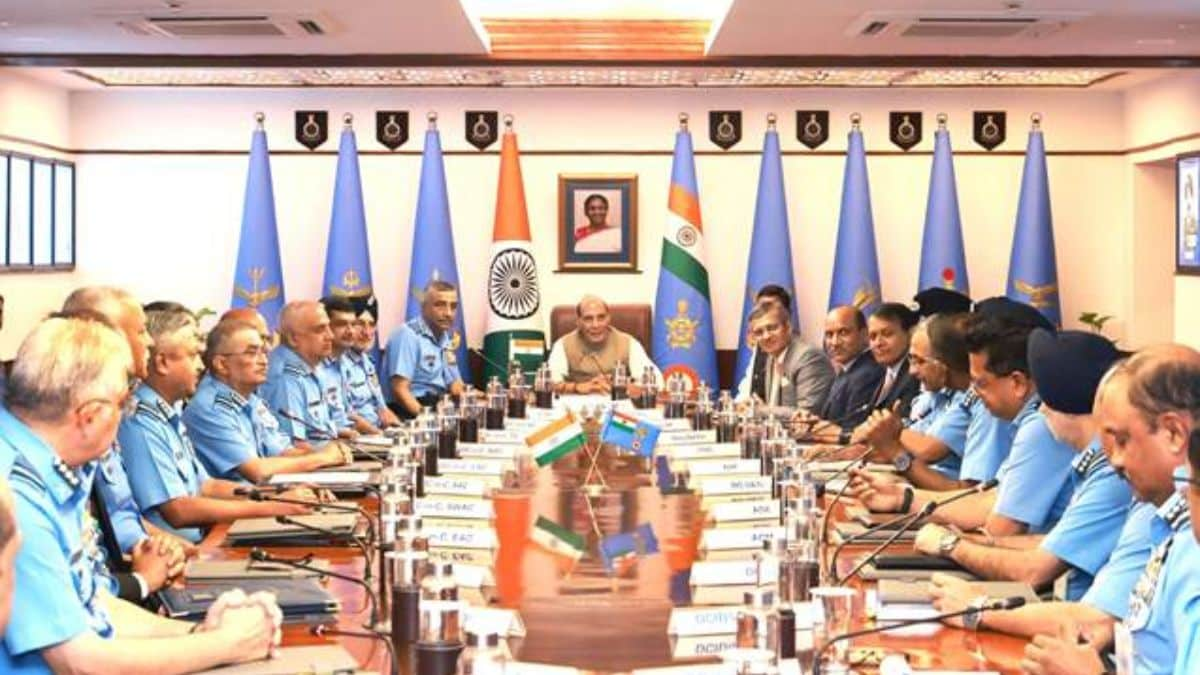
Defence Minister Rajnath Singh, on Thursday, urged the defence forces to develop capabilities and methods that leave the adversary with no time to react or recover, while also ensuring that India's defence forces are never caught off guard by an unexpected move from the enemy.
Speaking at the Air Force Commanders’ Conference in New Delhi, Singh called upon the commanders to focus on both the offensive and defensive dimensions of the ‘element of surprise’ to maintain operational readiness against conventional and emerging threats.
“Our defence forces must develop capabilities and methods that leave the adversary with no time to react or recover, while simultaneously ensuring that we are never caught off guard by an unexpected move from the enemy. Surprise can manifest in various forms, both conventional and electronic,” he said, according to a defence ministry release.
Singh emphasised that intelligence and surveillance mechanisms must be further strengthened and operational preparedness enhanced to ensure that personnel remain alert, agile and equipped to respond effectively to any emerging challenge.
Pointing out that contemporary conflicts are extending beyond traditional battlefields into non-contact domains, with missiles, drones and advanced weapon systems playing a major role, Singh urged commanders to adapt to the evolving nature of modern warfare.
Referring to the Russia-Ukraine and Israel-Hamas conflicts, he stated that drones and air defence systems have emerged as critical components of modern warfare. He exhorted the commanders to remain prepared for emerging challenges such as kamikaze drones, surveillance and counter-drone operations.
Singh also called upon the IAF to develop dedicated doctrines and architectures for emerging domains of warfare, including electronic, cyber and space. “Victory in future conflicts would depend not merely on the number of aircraft, but also on technological sophistication, speed of response and precision of preparations,” he said.
He urged commanders to make these emerging challenges a core priority, focusing on integrating them into institutional thinking, planning and operational processes.
Singh commended the IAF for effectively implementing its doctrines and operational methods during and after Operation Sindoor, appreciating the professionalism, restraint and judgement demonstrated by air warriors.
He stated that the lessons learnt during the operation were reflected in the IAF's evolving operational procedures, particularly through the increased emphasis on drones and air defence systems.
He also urged commanders to sustain efforts towards training air warriors in emerging technologies and leveraging the technological knowledge and expertise of young recruits.
