



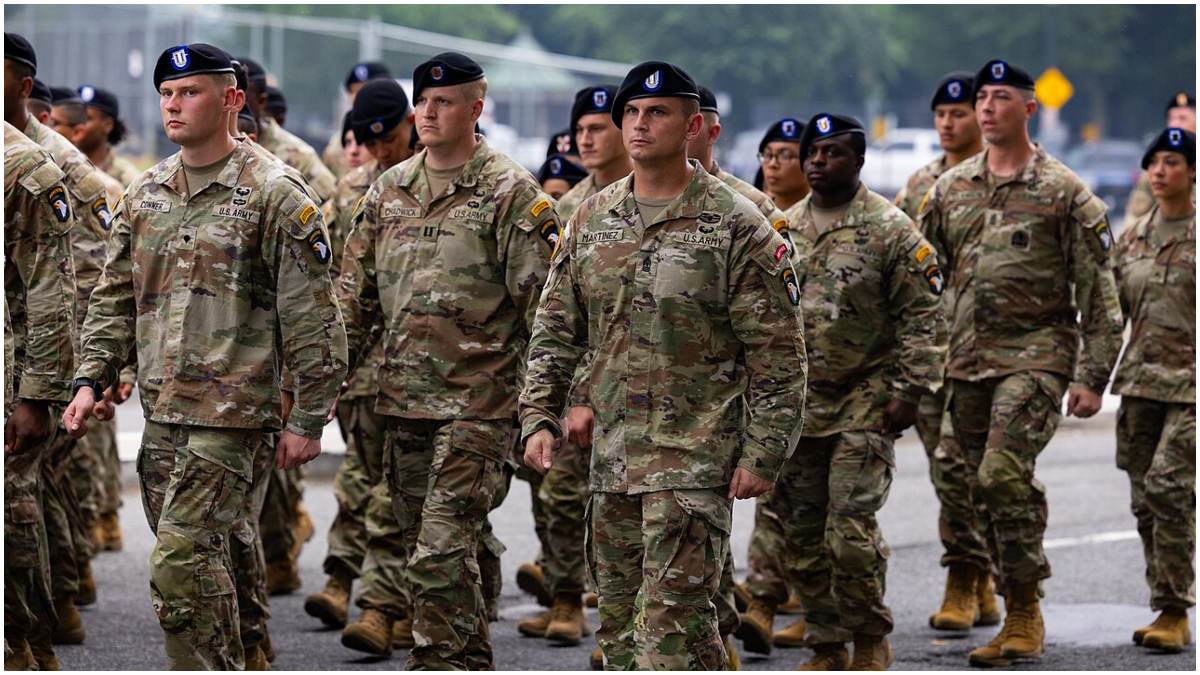
On October 7, 2026, the US Army released its new warfighting guidance, ‘How the Army Fights’ (HTAF), written with a possible high-intensity conflict with China in mind. The 46-page document was issued under Acting Chief of Staff Christopher LaNeve. As reported, its central demand is that forward-positioned forces be ready to act on day one of a conflict in the First Island Chain, the arc running from southern Japan through Taiwan to the Philippines. Taiwan sits within that arc, but it is not the only issue. A regional posture is different from a plan, and strategists should keep the two apart.
Start with what the Army is quietly admitting. For decades, it prepared to fight in the Middle East and, in the background, to fight a heavy war in Europe or Korea, with time to gather forces at home and move them across an ocean. LaNeve’s foreword dispels that comfort. He writes that the homeland is no longer a safe rear area and that a peer adversary can disrupt the Army’s ability to generate and project combat power before its formations ever close with the enemy. That is a blunt thing for a service chief to write. Anyone who has studied the PLA’s anti-access and area-denial network knows that the ports, airfields and sea lanes the old plan relied on would be among the first targets.
The document, as reported, has four parts: convergence, strike, close battle and endurance. Convergence comes first. Electronic warfare, cyber and space capabilities are intended to jam the other side’s communications and create gaps in its air defences. One scenario in the guidance places a Multi-Domain Task Force in the Luzon Strait. Behind the front, the Army is hardening the Second Island Chain, which includes Guam and Palau, with fuel, engineering, medical and air defence assets. It plans to use drones and unmanned surface vessels for resupply across vast distances.
There is real logic here. Deterrence works on the other side’s arithmetic. If American units are already forward, Beijing cannot plan for a window in which it fights only Taiwan’s forces while a relief force is still crossing the Pacific. That is the old tripwire argument, long made by analysts who wanted more Army weight in the region. The guidance turns the argument into doctrine, and doctrine drives budgets and force structure.
But the logic cuts both ways, and that is the point. Forward forces within reach of the PLA Rocket Force are also the first targets. A commander who knows his launchers are exposed feels pressure to fire early. A commander in Beijing who sees an American opening built on jamming, cyber and space effects feels the same pressure from the other side. Day-one readiness compresses time for everyone, and compressed time is where misjudgment turns into war. The coverage says a good deal about how to begin and sustain a fight. It says little about how to stop one. It would be wise to review the full text once available, on escalation control, before calling the concept mature.
Then there is endurance, the least glamorous element and the one that decides outcomes. Day one is the cheap part. Long-range missiles are costly and finite, and reloading launchers in contested waters is a very different job from firing them. Unmanned resupply is promising but unproven at this scale against an adversary who will jam and shoot. The war in Ukraine has already shown how hard it is to move ground forces under drone surveillance and precision fires. A doctrine can declare that stocks are forward and logistics hardened. Only a long war shows whether that is true.
The plan also assumes access, which is political. Forward fires in Japan or the Philippines require host governments willing to accept the risk of becoming targets, and Tokyo and Manila will weigh that against their own interests, not Washington’s.
Beijing can be expected to read all of this as encirclement. Its commentators will likely point to missiles near its coast as proof that containment, not defence, is the American aim, and they have a point about how it looks. Washington has an equal point that the PLA’s rapid deployment capabilities and growing reach forced the change. Both can be true at once, which is exactly why this kind of competition is so hard to cool down.
All of this assumes there is a day one to recognise. So ask the harder question: how do you respond to a war that was never declared? Picture the island absorbed by coercion, below the threshold of war. Cables are cut, the grid fails, and government communications go silent within about ninety minutes. By the time anyone asks whether this is an attack, no one left in the capital can answer. Beijing calls it a restoration of order, and later the region lives with the new map. The warnings were quiet: coast guard patrols a day early, survey ships working tighter grids, port rotations a few days shorter. Each was routine. Together, they may not have been. A doctrine built around a first shot says little about when a pattern warrants a response. And alliances are tested after such a crisis, not during it, when budgets normalise, domestic politics push back, and members disagree on what the alliance is for. Perhaps the real question is whether the world is watching the wrong horizon.
For India, this is not someone else’s debate. We are outside the theatre, but we are not spectators. Three lessons travel well. First, the sanctuary is gone for us too. Ladakh in 2020 and the drone exchanges in the recent past showed how quickly the rear area becomes the front. Second, depth has to be built before a crisis, not during one. Pre-positioned stocks, hardened fuel and ammunition points, and forward engineering and medical capacity are what let a force fight beyond the first week. Third, we should not outsource our judgement. An American plan is built around American interests. If a Taiwan crisis comes, our choices in the Indian Ocean and on the northern border will need to be ours.
What should we do with that? Study the US logistics model closely, especially how it layers forward and rear stocks. Put serious money into tactical electronic warfare and counter-drone capability, because the first fight will be for the electromagnetic spectrum and the air above the battalion. War-game the Line of Actual Control on the assumption that a Pacific crisis is unfolding at the same time, with capabilities, supplies and partners stretched thin. The fallout of a post-Taiwan scenario would be felt most by India next. The wise prepare for the future now, not let the crisis dictate their choices, especially when the next war will never be a repeat of the last one.
(The opinions expressed in this article are those of the author and do not purport to reflect the opinions or views of THE WEEK.)
