



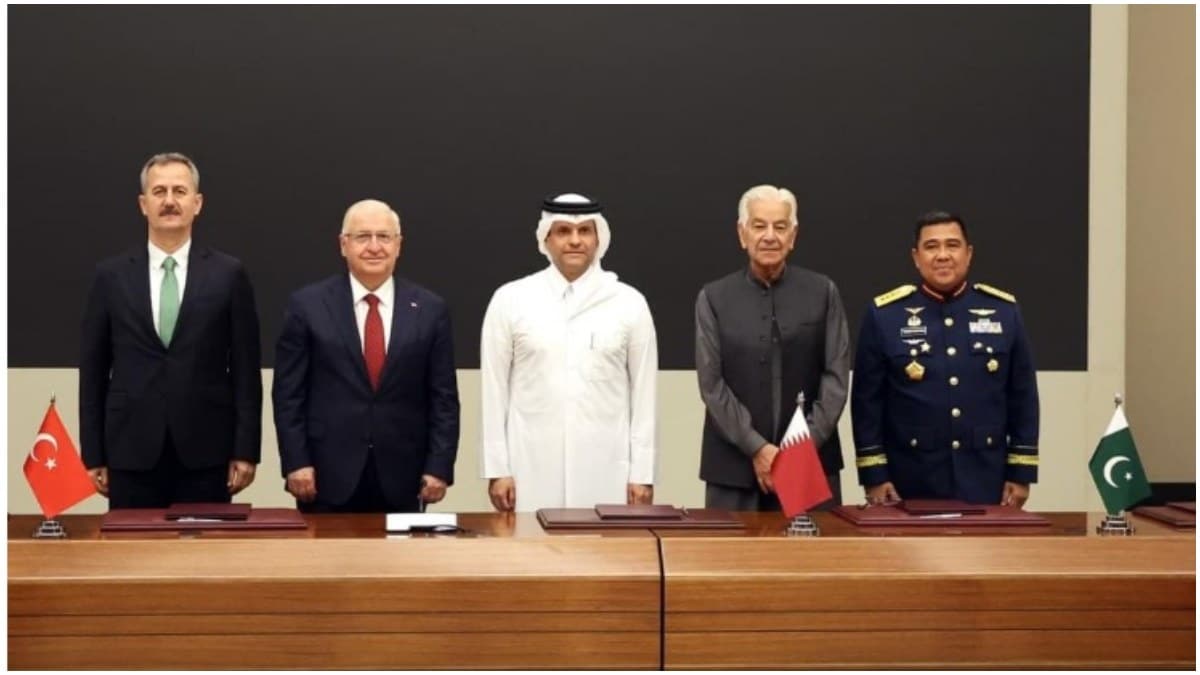
Pakistan, Turkiye, Qatar and Indonesia have signed a multilateral defence cooperation agreement that could help Islamabad strengthen its military capabilities and gain access to advanced defence technologies.
The agreement, called the 'Badr Memorandum of Understanding', was signed in Doha on Wednesday. It focuses on joint defence manufacturing, technology sharing, military training and research and development among the four countries.
The agreement comes months after Pakistan, Saudi Arabia and Turkiye signed the Makkah Joint Defence Agreement in August, under which an attack against one participating country would be treated as an attack against all three.
The Badr Memorandum of Understanding was signed by Pakistani Defence Minister Khawaja Asif, Turkish Defence Minister Yasar Guler, Qatar's Deputy Prime Minister and Minister of State for Defence Sheikh Saud bin Abdulrahman, and Indonesian Deputy Defence Minister Yusuf Jauhari.
According to Qatar's defence ministry, the agreement aims to strengthen cooperation in defence manufacturing, improve military capabilities and promote technical training and research among the participating countries.
The ministry said the pact would also allow the four countries to combine their defence manufacturing capabilities and develop military equipment to meet the requirements of allied and friendly nations.
Haluk Gorgun, chairman of Turkiye's Defence Industry Presidency, said the agreement would establish a foundation for strategic cooperation in joint production and technology development.
"Technology sharing, joint development and strengthening domestic production capabilities lie at the heart of sustainable defence industry," Gorgun said, according to news agency PTI.
He added that Turkiye valued partnerships that went beyond conventional arms purchases and helped countries develop their own technical expertise and industrial infrastructure. "We believe that the Badr Memorandum of Understanding will contribute to transforming the complementary capabilities of Qatar, Pakistan, Indonesia, and Turkey into concrete projects," he said.
Pakistan's foreign office has not yet commented on the agreement.
Why could the agreement concern India?
The Badr agreement could be significant for India mainly because of the opportunities it offers Pakistan to strengthen its military capabilities through international partnerships.
Pakistan currently depends heavily on China for defence equipment. Cooperation with Turkiye, Qatar and Indonesia could help Islamabad diversify its sources of weapons and military technology.
The agreement's emphasis on joint manufacturing, technology sharing and research could also improve Pakistan's access to advanced defence systems, including drones. Such cooperation could support Islamabad's efforts to modernise its armed forces and develop its domestic defence industry.
However, the memorandum does not establish a collective military alliance or require the participating countries to support Pakistan in a conflict involving India. Its significance lies primarily in the possibility of expanding Pakistan's access to weapons, training and defence technology.
Indonesia's involvement adds another dimension to the agreement, particularly because New Delhi has been exploring defence export opportunities in the Southeast Asian country. A few months ago, reports emerged about discussions concerning India's possible supply of BrahMos supersonic cruise missiles and Astra air-to-air missiles to Indonesia under a potential $630 million deal.
However, unlike the Makkah Joint Defence Agreement signed by Pakistan, Saudi Arabia and Turkiye in August, the Badr memorandum does not contain a stated mutual defence commitment. While the Makkah pact treats an attack on one participating country as an attack on all three, the Badr agreement focuses on defence industrial cooperation, technology development and training.
