



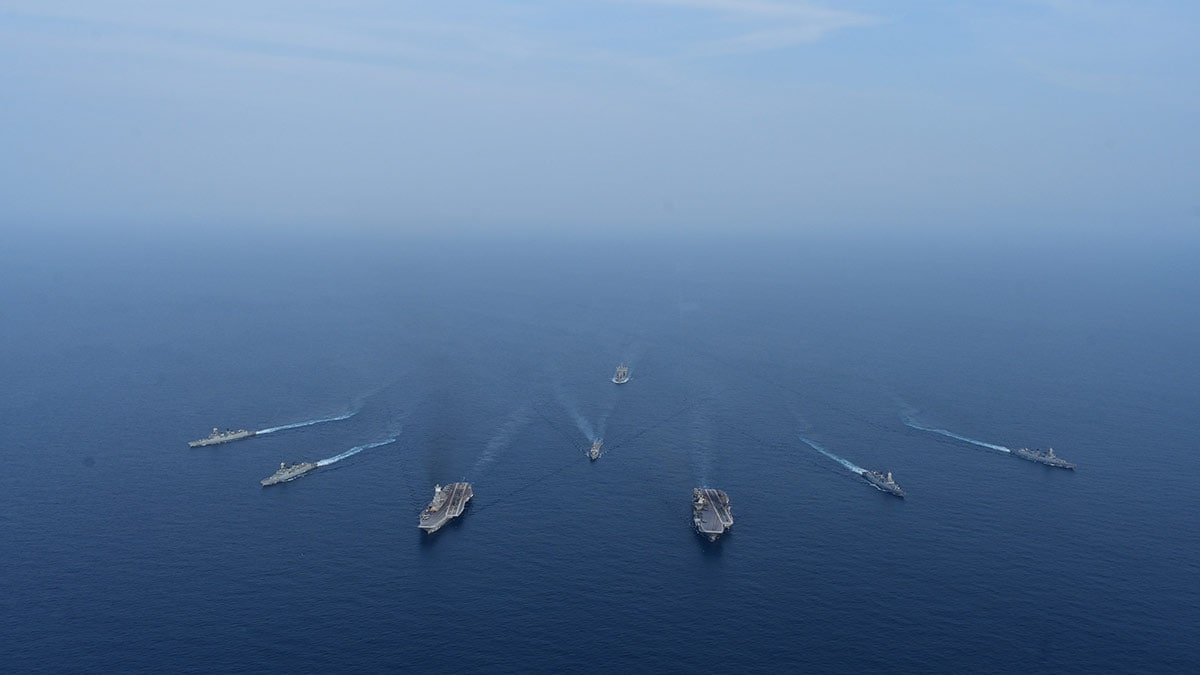
The disruption of shipping through the Strait of Hormuz amid the US–Iran conflict has exposed an uncomfortable truth: maritime chokepoints are no longer merely geographic features; they can become instruments of coercion. For India, whose national defence, energy security, trade and diaspora interests depend on secure seas, the crisis is a warning that development of maritime power needs added focus.
The US-Iran conflict is unfolding amid deepening US–China rivalry. Beijing’s economic, technological and defence ties—including reported assistance to Iran—complicate Washington’s calculations. The precise scale and operational effect of Chinese support require careful assessment. But the broader lesson is clear: partnerships, technology, logistics and control of strategic geography now shape modern wars.
China, in addition to reaching out globally through the maritime domain, is extending regional influence through the Belt and Road Initiative (BRI) projects, infrastructure investment and defence cooperation with Pakistan, Myanmar, Bangladesh, Iran, Sri Lanka and others. That is not to say that every Chinese-funded port is a military base, and that every trade partner is a military ally. Yet commercial infrastructure can acquire military value when paired with access agreements, logistics, intelligence cooperation and recurring naval deployments.
The United States has responded through the Quad—India, the US, Japan and Australia—and AUKUS, its security partnership with Australia and the United Kingdom. Their purposes and structures differ, but both reflect anxiety over China’s growing military reach and its consequences for the Indo-Pacific balance.
India must grasp these implications while still maintaining its strategic autonomy. Nonetheless, its task is neither to match China ship for ship nor to retreat into strategic caution. It must build the independent capabilities, partnerships and diplomatic influence needed to protect its own interests.
The Indian Ocean also as a centre of gravity
India’s maritime geography is a major asset. Its peninsula overlooks sea lanes linking the Persian Gulf, Africa, Europe and East Asia. The Andaman and Nicobar Islands sit near the approaches to the Malacca Strait, through which much of East Asia’s commerce and energy flows.
But geography is an opportunity, not a substitute for power. It must be converted into persistent surveillance, combat capability, logistical endurance and regional influence.
India’s economic exposure is substantial. A Hormuz disruption can raise oil and gas prices, affect fertilisers and petrochemicals, increase freight and insurance costs, and disrupt industrial production. The consequences reach households through inflation and reach Indian seafarers and expatriates in the Gulf through insecurity and evacuation risk.
The Indian Navy has built real credibility through anti-piracy operations, mission-based deployments, coastal surveillance and information-sharing. It has maintained a presence in the Gulf of Aden since 2008 and uses mission-based deployments across key Indian Ocean areas, including the Gulf of Oman, Red Sea, Malacca approaches and Bay of Bengal. The Information Fusion Centre–Indian Ocean Region, established in 2018, provides a common maritime picture and links India with partner nations and international organisations.
Yet peacetime awareness is not wartime protection. Monitoring shipping is fundamentally different from defending merchant vessels against missiles, drones, mines, electronic interference and hostile state forces.
The Hormuz crisis makes that distinction stark. The difficulties surrounding merchant shipping—as well as questions over the fate of an Iranian warship that had earlier visited India for naval engagement—underline the limits of diplomacy when conflict begins. India still needs clear policy, timely intelligence and realistic operational options for surveillance, diversion, escort, evacuation and diplomatic intervention. Nonetheless, it should not offer protection it cannot reliably deliver.
A two-front maritime problem during war
India’s border disputes with China are in the land domain. However, a future India–China confrontation may not remain confined to the Himalayas. China’s expanding fleet of carriers, destroyers, submarines and surveillance platforms will complicate Indian calculations across the Indian Ocean. China’s strategic partnership with Pakistan could add a second pressure point.
Pakistan’s Chinese-origin frigates, submarines and other naval systems could intensify threats in the Arabian Sea. Chinese naval deployments, together with possible access to strategically located ports, could stretch Indian surveillance and operational resources from the western seaboard to the eastern Indian Ocean.
The danger is cumulative. India could simultaneously need to conduct land operations and also defend its western coastline, track Chinese deployments, counter submarines and protect merchant shipping. Cyberattacks, electronic interference and threats to undersea cables could precede or accompany conventional hostilities.
India should not assume that every Chinese-backed commercial port will become a naval base. But it must plan for the possibility that infrastructure, logistics arrangements and host-country agreements could enable a more persistent Chinese military presence.
The strategic imperative is therefore deterrence: India must be able to raise the cost of maritime coercion and deny any adversary a quick, decisive advantage at sea. That requires preparation for competition below the threshold of war as well as for high-intensity conflict.
Six maritime priorities
1. Integrate surveillance and decision-making
India should fuse coastal radars, satellite imagery, maritime patrol aircraft, unmanned systems, underwater sensors and commercial shipping data into a single operational picture. The IFC-IOR is a strong foundation, but information must move rapidly from detection to decision.
The Navy, Coast Guard, intelligence agencies and civilian authorities need secure channels for sharing information and coordinating responses. Partnerships with trusted countries should extend coverage without compromising India’s independent assessment or operational control.
2. Build a fleet for sustained war
India needs more than headline platforms. Carriers and destroyers matter, but submarines, anti-submarine-warfare vessels, fleet tankers, minesweepers, maritime patrol aircraft and logistics ships determine whether a navy can fight and remain at sea.
Anti-submarine warfare deserves special attention as China extends its naval reach and Pakistan modernises its submarine force. So do precision-munition stocks, repair facilities, replenishment capacity and resilient supply chains. India’s ability to keep warships deployed depends as much on fleet tankers and at-sea logistics as on missiles.
Drones, autonomous underwater vehicles, artificial intelligence and electronic warfare must be integrated into conventional formations. Technology should multiply the fleet’s effectiveness, not replace trained crews, doctrine and sound command judgement.
3. Protect approaches and infrastructure
India should prioritise the Arabian Sea approaches to the Persian Gulf, the Bay of Bengal and the eastern approaches near Malacca. The Andaman and Nicobar Command requires the resources to strengthen surveillance and contribute to awareness across the eastern Indian Ocean.
India cannot control Hormuz or Malacca alone. It can improve early warning, coordinate with partners and protect shipping where feasible. Undersea cables, offshore energy installations, ports and maritime communications also need stronger protection.
New Delhi should prepare contingency plans for energy supplies, alternative routes and evacuation of Indian nationals. Maritime resilience must extend beyond the battlefield to the economy and civilian population.
4. Turn indigenisation into combat power
Domestic shipbuilding is necessary but insufficient. Real self-reliance requires indigenous propulsion, sensors, sonars, weapons, electronic-warfare systems and secure communications.
The government should deepen collaboration among the Navy, public-sector shipyards, private industry, research institutions and start-ups. Procurement must reward delivery schedules, reliability and combat performance—not domestic-content declarations alone.
India must also be able to scale production of drones, precision munitions and critical components during a crisis. A navy dependent on foreign supply chains for spares, maintenance or ammunition cannot claim full strategic autonomy.
5. Partner without surrendering autonomy
India should deepen cooperation with the United States, Japan, Australia, France, Indonesia, Singapore and others through exercises, logistics arrangements, information-sharing and coordinated patrols. The Quad can advance maritime domain awareness, disaster response and capacity-building; AUKUS will shape the regional balance through Australia’s future undersea capabilities.
But cooperation must not become automatic alignment. India’s interests in the Persian Gulf, its relationships with Iran and Gulf Arab states, and its dependence on secure energy supplies demand diplomatic flexibility. India must retain the ability to judge each crisis on its merits.
Engagement with smaller Indian Ocean states is equally important. India should offer credible alternatives in port development, coastal surveillance, training, connectivity and disaster relief. Its aim should be to become the region’s preferred security partner through reliable delivery and respect for sovereignty—not by forcing choices between Washington and Beijing.
6. Create a national maritime crisis doctrine
India needs a clearly articulated framework defining command responsibilities, deployment thresholds and civil-military-commercial coordination during maritime emergencies.
For shipping crises, it should cover threat assessment, communication with shipowners and masters, diversion, evacuation, medical assistance and decisions on naval escort. For major conflict, exercises must test simultaneous responses across the Arabian Sea, Bay of Bengal and eastern Indian Ocean.
The doctrine should connect maritime operations with energy reserves, resilient ports, cyber defence and national logistics. Its purpose is to close the gap between possessing naval capability and employing it promptly and coherently.
From presence to leadership
India’s maritime strategy must combine military credibility with diplomatic legitimacy. It should champion freedom of navigation, peaceful dispute settlement, international law and the security of commerce. The United Nations Convention on the Law of the Sea remains central to that framework.
Practical cooperation in search and rescue, humanitarian assistance, disaster relief, anti-piracy and infrastructure protection can build regional trust. India’s geography and its economic and human ties across the Indian Ocean give it advantages distant powers cannot easily replicate. But those advantages must be sustained through consistent engagement, credible capability and tangible public goods.
India should also resist militarising every regional disagreement. Deterrence works best when backed by diplomacy; partnerships endure when built on shared interests rather than fear alone.
The way forward
The Hormuz crisis shows how the threat to a chokepoint can generate leverage far beyond the battlefield. It also reveals the limits of military power when a determined adversary can impose severe costs on global commerce.
India’s response must be balanced: a navy capable of sustained operations, an industrial base able to replenish combat power, an integrated surveillance network, resilient economic arrangements and partnerships that strengthen regional security without constraining national choice.
The choice is not between strategic autonomy and partnerships. It is between autonomy backed by credible capability and autonomy reduced to declaration without means.
India need not dominate every ocean or counter every Chinese initiative. It must ensure that no adversary can threaten its vital maritime interests at an acceptable cost. In the Indo-Pacific, strategic autonomy will increasingly be measured not by what India declares, but by what it can deter, defend and deliver at sea.
(Lt Gen Philip Campose (Retired) is a former Vice Chief of the Indian Army. He has authored a book titled ‘A National Security Strategy for India: The Way Forward’.)
(The opinions expressed in this article are those of the author and do not purport to reflect the opinions or views of THE WEEK.)
