



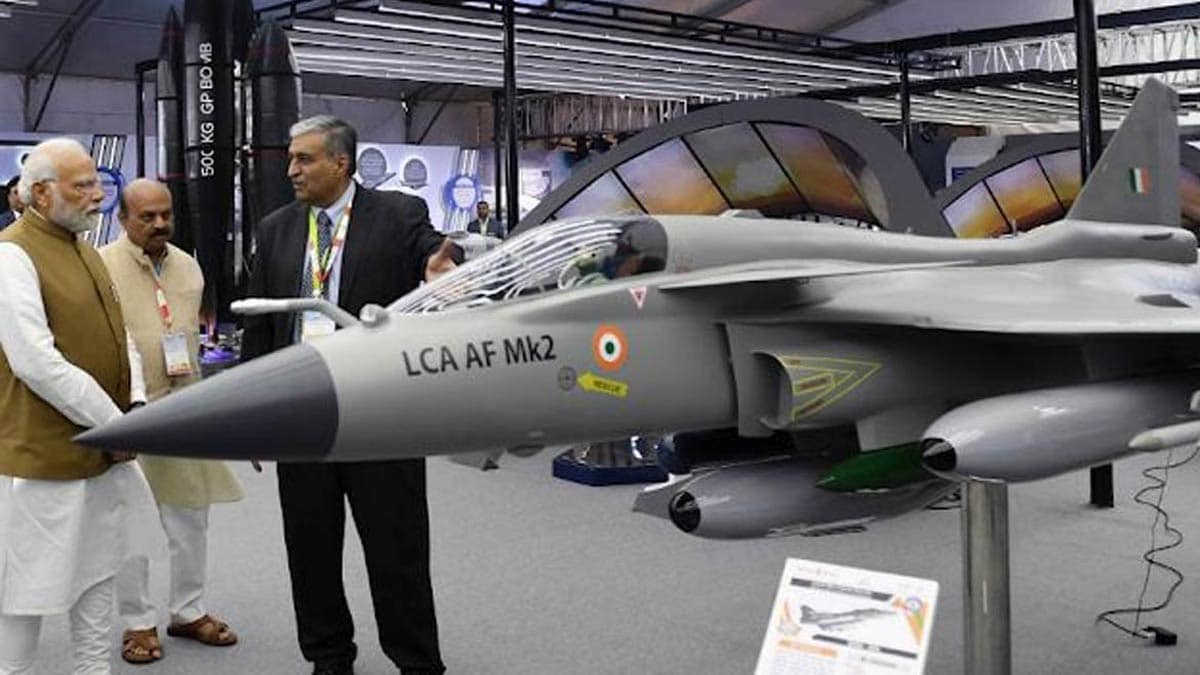
India’s indigenous LCA Tejas Mk2 programme is heading towards a key milestone, as the fighter's first flight is scheduled for the middle of next year, Defence Secretary Rajesh Kumar Singh said on Thursday.
Singh said the programme remains on track for the planned flight, after which the prototypes will have to undergo evaluation by the Indian Air Force (IAF).
“As of now, the LCA (Light Combat Aircraft) Tejas Mk2 is still on, with the first flight scheduled for the middle of next year. Let the prototypes come and let the Air Force evaluate them, and thereafter, we will see,” he said, according to news agency ANI.
The IAF had initially projected a requirement for 120 LCA Mk2 aircraft. However, Singh indicated that further decisions would follow only after the prototypes are delivered and evaluated.
“I think initially, the requirement that they had projected was for 120 Mk2 aircraft. But let them deliver the prototypes, let them be evaluated, and we'll see thereafter,” he said.
Singh also outlined the approach planned for the development of the LCA Mk2, saying the fighter should undergo a process of “spiral development” involving continued upgrades.
The programme is expected to remain within the existing public-sector ecosystem led by Hindustan Aeronautics Limited (HAL).
However, the private sector will have a significant role in the programme. Singh pointed out that HAL is increasingly relying on private companies for sub-assemblies and larger components, including fuselages.
Private-sector production lines have also been introduced for some of these components.
The LCA Mk2 programme will, in all probability, remain public-sector-led, but substantial participation from Indian private industry and the MSME sector is already built into it, Singh said.
Singh also offered an update on plans to integrate Indian weapons and systems on Rafale fighters.
He said Indian weapons had already been agreed to for integration on the contracted Rafale Marine aircraft.
The latest programme, however, would go a step further as a “buy-and-make” programme.
Under the proposal, the bulk of the aircraft would be assembled in India, alongside significant levels of indigenisation and integration of Indian systems and weapons.
The procurement is currently at the RFP submission stage. Bids have been received and are being evaluated.
Singh said the procurement cycle could reach a conclusion before the end of this year.
