



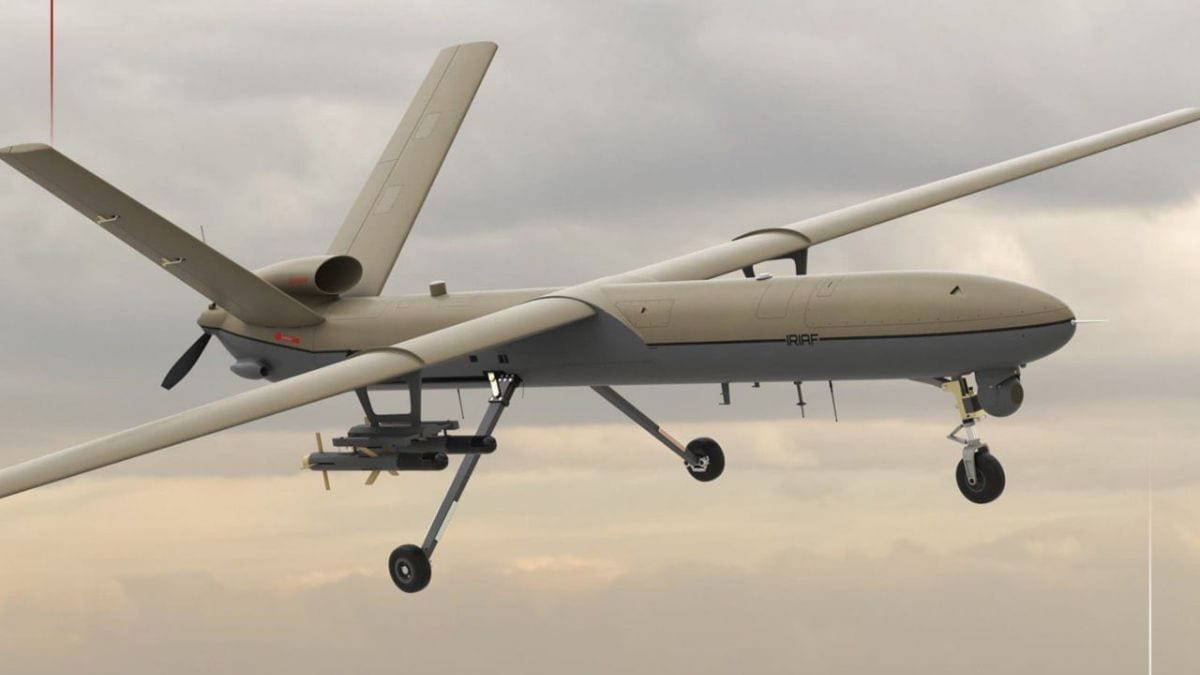
Since direct hostilities between the United States and Iran erupted on February 28, Tehran has fired more than 850 missiles and 2,650 drones at targets across the Arabian Peninsula. The barrage has exposed a vulnerability few in the Gulf were prepared to confront: the region's most expensive, most sophisticated air defence architecture is struggling to keep pace with a threat that costs almost nothing to build and even less to lose. That arithmetic, more than any diplomatic overture, explains why Gulf capitals have spent the past several months quietly building the kind of security relationship with Kyiv that would have seemed implausible even two years ago.
The war in Ukraine and the widening conflict in the Middle East, once treated as separate theatres by policymakers and analysts alike, have converged into a single interlocking problem. Gulf states and Ukraine now face a common adversary in the cheap, mass-produced loitering munition, and it is Kyiv, not Washington, that has spent four years building the software and machine-learning tools capable of beating it. At the centre of that convergence sits an uncomfortable truth: the West's most advanced air defence systems were never built to stop the world's cheapest weapon, and they were certainly never built to out-think it.
For decades, Gulf defence doctrine was built around premier American hardware. Riyadh, Abu Dhabi and their neighbours poured hundreds of billions of dollars into Patriot PAC-3 batteries and Terminal High Altitude Area Defence (THAAD) systems, platforms engineered to bring down ballistic missiles and supersonic aircraft, not to parse a radar picture cluttered with dozens of slow, low-flying decoys. Tehran studied Russia's playbook in Ukraine closely, then married those lessons to its own industrial base to mass-produce the Shahed-136, known in its Russian-operated guise as the Geran-2, a loitering munition that slips beneath radar coverage and saturates sensor networks by sheer volume. Oil facilities, desalination plants and shipping lanes through the Strait of Hormuz now sit permanently exposed to it.
The economics of the mismatch are almost absurd. A Shahed costs somewhere between $30,000 and $35,000 to build. A single Patriot interceptor runs roughly $4 million; a THAAD interceptor exceeds $12 million. During one recent bout of escalation, Gulf forces expended more than 800 Patriot missiles in three days fending off incoming barrages, an expenditure that gutted stockpiles just as Western manufacturers, hobbled by long production cycles and chronic shortages of rocket motors and critical minerals, proved unable to restock them. Firing million-dollar interceptors at cheap drones is not a sustainable defence; it is a war of attrition the Gulf was destined to lose on cost alone.
Ukraine faced this exact arithmetic years earlier and answered it not with better missiles but with better software. Rather than wait on procurement bureaucracies that move at the speed of peacetime, Ukrainian engineers and front-line units built high-speed FPV interceptor drones fitted with optical sensors and automated tracking algorithms that identify, close on and destroy a Shahed without a human finger on the trigger for the final seconds of the intercept. Each costs somewhere between $800 and $3,000, a rounding error next to the threat it neutralises. The hardware is almost incidental; the advantage sits in the software layer Kyiv built around it, a fusion engine that stitches acoustic sensors, commercial cameras, mobile radar and jamming equipment into a single, unified low-altitude picture, something legacy Western systems, designed for a handful of fast, high-value threats rather than swarms of cheap ones, were never devised to produce.
That expertise has now migrated south, and it is no longer theoretical. The US military has deployed Sky Map, Kyiv's AI-driven command-and-control detection platform, at Prince Sultan Air Base in Saudi Arabia, with Ukrainian advisers on-site training American and Saudi operators to read its real-time data fusion. Ukrainian forces have flown domestically produced interceptors in combat over more than one Gulf country. The UAE has requested roughly 5,000 interceptors from the Ukrainian manufacturer TAF Industries; Qatar has asked for 2,000; Kuwait and Saudi Arabia have signalled interest in direct acquisition and localised co-production, though neither has confirmed final numbers. One system in particular, the Sting interceptor, pairs thermal-imaging cameras with AI-assisted targeting, autonomously classifying and closing on its target at speeds up to 343 kmph; it had already destroyed more than 3,900 Geran-type drones over Ukraine by early March. Riyadh has moved beyond training towards co-production, signing a deal for Ukrainian interceptor missiles as part of a broader weapons agreement still under negotiation, with an eye to eventually building the algorithms, not just the airframes, under licence.
Ukraine dispatched more than 200 military advisers and electronic-warfare specialists to Saudi Arabia, the UAE, Qatar, Kuwait and Jordan, embedding its interceptor algorithms into existing radar networks and running live counter-drone training exercises. President Volodymyr Zelensky has toured Gulf capitals repeatedly, signing defence agreements in Riyadh, Abu Dhabi, Doha and Kuwait, pitching not hardware sales but a transfer of the underlying artificial intelligence itself.
The arrangement suits both sides' longer-term ambitions. Ukraine offers battle-tested intellectual property and the kind of agile, wartime software engineering that peacetime defence industries rarely produce. The Gulf offers capital, manufacturing scale and industrial infrastructure that maps cleanly onto existing modernisation programmes, Saudi Arabia's Vision 2030 chief among them. In exchange for tactics and technology, Ukraine secures refined fuel and crude oil to prop up its damaged energy grid, along with munitions and pledges of postwar reconstruction financing. Each Gulf state has carved out its own niche: the UAE is using EDGE Group to localise the underlying intellectual property, Saudi Arabia is leaning on its procurement budget to build domestic manufacturing capacity, and Qatar is concentrating on secure communications and cyber systems.
None of this is without friction. Western governments are watching closely for dual-use technology, particularly the AI targeting stacks, leaking through Gulf commercial intermediaries into Russian or Chinese hands, a concern that has already produced tighter export controls. Iran has warned that it regards this cooperation as a legitimate target, raising the prospect of retaliation at sea or by missile. And Ukraine's own factories, under continuous bombardment, cannot yet produce counter-drone hardware at the scale the Gulf eventually wants, leaving the relationship dependent on joint production lines that are still being built, quite literally, under fire.
Everything described so far is defensive: knocking Iranian drones out of the sky before they reach their targets. But the same Ukrainian systems carry an offensive shadow that Gulf capitals have not yet openly embraced. Kyiv's AI-assisted maritime strike drones, the Sea Baby and MAGURA series, now carry extended range and autonomous targeting engineered to keep functioning under heavy jamming, capabilities Zelensky himself has linked publicly to choke-point scenarios like the Strait of Hormuz, rather than to air defence alone. Paired with Ukraine's own long-range precision strike systems, such as the Palianytsia missile-drone, and the new AI Centre of Excellence Kyiv has agreed to stand up with the UK to institutionalise this expertise across allied militaries, the underlying technology could just as easily help a Gulf state hold Iranian naval assets or launch sites at risk as it currently helps intercept Shaheds. Neither Kyiv nor its Gulf partners have said so publicly, and for good reason: the leap from counter-drone defence to enabled retaliation would read as a significant escalation in Tehran and Moscow alike. But the distinction between the two, as with so much of this technology, is a matter of political choice, not of technical capability.
What this cooperation does not represent is a Gulf break from Moscow, and reports of a strategic divorce are premature. Ukrainian expertise is simply the newest addition to a defence portfolio that already includes Turkish drones, Chinese dual-use technology, American missile shields and quiet, ongoing coordination with Russia itself. OPEC+ remains too valuable to both Riyadh and Moscow to abandon, and Dubai continues to function as a financial conduit that Western sanctions have failed to close. Kyiv, in this sense, gives the Gulf a way to hedge against Washington's suspicions of Russian favouritism, without spending a single riyal of its relationship with Moscow. What began as an emergency wartime improvisation on the steppes of Ukraine has become, almost by accident, the algorithm now writing Gulf air defence doctrine.
(Utkarsha Mahajan is doctoral scholar, SIU-JRF, Symbiosis School of International Studies, Symbiosis International Studies, Symbiosis International (Deemed) University, Pune.)
