



At 20,000 feet on the Siachen Glacier—often dubbed the world’s highest and coldest battlefield—temperatures drop to -55°C to -60°C, oxygen levels plunge to a fraction of sea-level density, and howling blizzards can isolate posts for days. In this unforgiving environment, nature is frequently a more deadly adversary than enemy fire. Hypothermia, high-altitude pulmonary edema (HAPE), frostbite, and sudden avalanche burials account for a significant portion of casualties sustained in super-high-altitude deployments.
To safeguard the soldiers guarding these critical frontiers, the Indian Armed Forces are turning to the Internet of Military Things (IoMT). By integrating smart wearables, biometric sensors, and low-power mesh networks directly into a soldier’s operational gear, the military is converting every individual jawan into a connected, data-generating node on the battlefield network.
The digital uniform: Architecture of a smart wearable
The modern IoMT suite for high-altitude infantry goes far beyond commercial smartwatches. It comprises a non-intrusive, multi-layered Body Sensor Network (BSN) woven directly into specialised Extreme Cold Weather Clothing Systems (ECWCS):
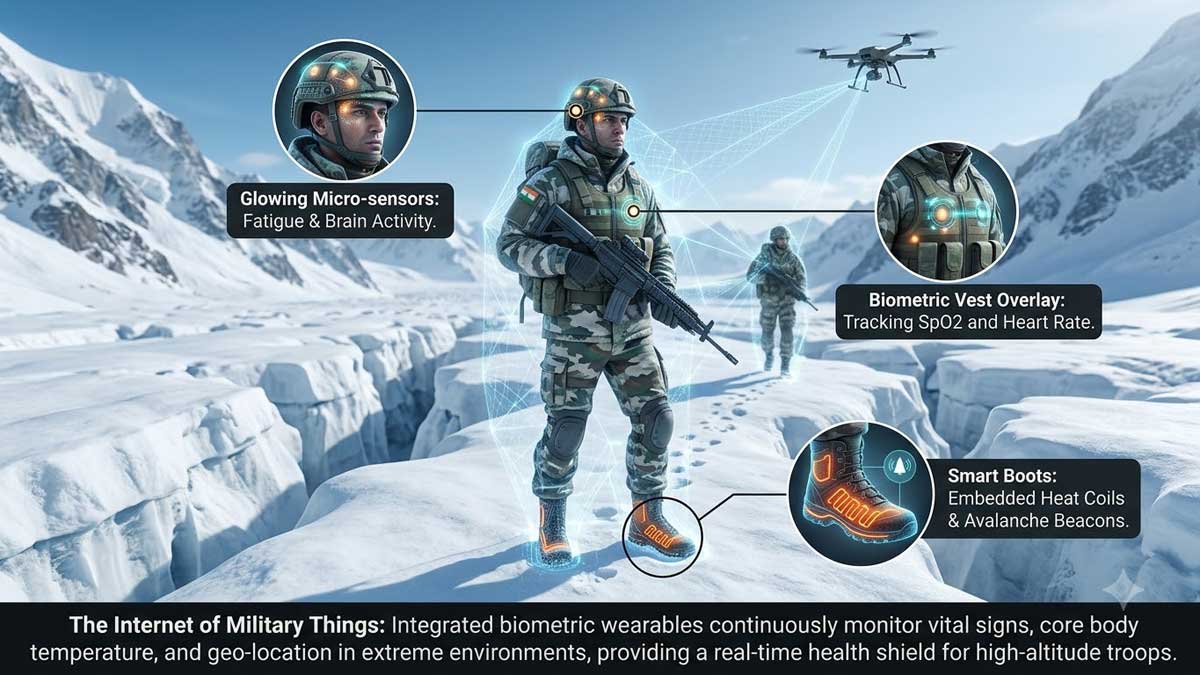
- Biometric smart vests: Embedded with micro-sensors that continuously monitor core body temperature, heart rate, blood oxygen saturation, and respiration rates. Sudden drops in blood oxygen saturation—a precursor to altitude sickness—trigger immediate automated alerts to unit medics.
- Smart insoles & thermal boots: Fitted with micro-heating elements and motion sensors, these maintain blood circulation in extreme sub-zero conditions to prevent frostbite while tracking step metrics and detecting sudden falls or impact trauma.
- Avalanche detection & geo-location nodes: Compact, ultra-wideband (UWB) and LoRa-enabled transceivers worn on helmets or vests transmit real-time GPS/NavIC coordinates. If a soldier is buried under snow, these nodes function as localised beacons that penetrate meters of ice, guiding search-and-rescue teams straight to the victim's location.

Edge processing and low-power mesh networks
Broadcasting continuous medical data in remote sectors like Siachen or Eastern Ladakh presents two major engineering hurdles: battery drain in extreme cold and severe communication blackouts caused by terrain obstruction.
IoMT addresses these obstacles through Edge AI and Ad-Hoc Mesh Networking. Microcontroller chips (such as TinyML-enabled processors) embedded in the wearable hub analyse vital signs on the body. Instead of constantly transmitting baseline data, the device operates in a low-power "silent mode." It fires off data packets only when an anomaly occurs—such as a sharp spike in heart rate combined with zero movement (indicating a fall or trauma).
To overcome mountain topography that blocks traditional radio signals, soldiers' wearables form a Mobile Ad-Hoc Network (MANET). Information hops short distances from soldier to soldier, unit to vehicle, and eventually to base camp without requiring line-of-sight satellite links for every individual operator.
From individual health to force readiness
The aggregate data from an entire platoon gives field commanders a real-time "Health & Readiness Dashboard." Prior to launching an alpine patrol, commanders can evaluate the physiological strain and acclimatisation metrics of each soldier, ensuring only fully fit personnel are assigned to high-stress missions.
In combat or rescue scenarios, this biometric grid transforms medical response times. Instead of relying on manual distress calls, base camp medical teams receive automated, prioritised casualty reports detailing exact location coordinates, injury severity, and physiological status—enabling targeted, rapid evacuation.
Sovereign production and Atmanirbhar protection
Historically dependent on imported cold-weather gear, India is now developing indigenous IoMT wearables through defence startups, DRDO labs, and academic research institutions. By ensuring that sensors, communication chips, and encryption protocols are produced domestically, the armed forces prevent supply chain vulnerabilities while safeguarding sensitive biological and operational data from foreign interception.
Through the Internet of Military Things, technology becomes an invaluable shield. The jawan still holds the line at extreme altitudes, but they do so backed by an intelligent, untiring digital life-support network.
(The author is the chairman of Flugelsoft Group.)
